REVIEW · NAPLES
Naples Walking Tour: Old Town and Spaccanapoli
Book on Viator →Operated by Napoli Official Tour · Bookable on Viator
Old Naples rewards the curious. This 2-hour walk ties Greek roots to today’s street life as you trace the Decumani (main Roman streets) through Spaccanapoli. I like how the route is built around real landmarks you can’t fake on a map, from Piazza Dante to the end at Piazza del Gesù Nuovo. I also like the small touches that make the walk easier, like headsets when the group is bigger and a food stop with a sweet or salty tasting.
The biggest plus is the way the guide turns each corner into a timeline. You’ll hear how Port’Alba links to the historic center and the Decumanus Major, then you’ll walk the street of nativity scenes on Via San Gregorio Armeno and the spine of the city on Spaccanapoli. One possible drawback: the experience is only as smooth as the guide’s style, and at least one person reported feeling shut out or getting uncomfortable remarks—so if you like lots of Q&A and a very neutral tone, keep that in mind.
In This Review
- Key highlights at a glance
- Why 4:00 pm works well for Naples Old Town
- Piazza Dante to Port’Alba: the old city starts fast
- Piazza Bellini: tufa stone and 4th-century BC clues
- Via dei Tribunali (Decumano Maggiore): the main spine meets everyday Naples
- Via San Gregorio Armeno: the nativity-scenes street
- Spaccanapoli (Decumano Inferiore): where the city feels lived-in
- Piazza del Gesù Nuovo: an ending square with real options
- What you get for the $30.25: guide, headsets, and tasting
- Guide quality: some names shine, and style can vary
- Logistics you’ll actually care about in Naples
- Who this Naples Walking Tour suits best
- Should you book this Naples Old Town and Spaccanapoli walk?
- FAQ
- How long is the Naples Walking Tour: Old Town and Spaccanapoli?
- Where does the tour start and end?
- What time does the tour begin?
- How much does the tour cost?
- Is the tour in English?
- What is included in the ticket price?
- Do I need to pay for admissions at the stops?
- What happens if weather is poor?
- Is there a limit on group size?
- Should you book this Naples Walking Tour?
Key highlights at a glance
- Piazza Dante start: a clean entry point into Neapolis, with quick context for what you’re about to see
- Port’Alba and ancient walls at Piazza Bellini: gate history plus stone from the 4th century BC nearby
- Via dei Tribunali (Decumano Maggiore): pizzeria-lined streets and branching alleyways toward San Gregorio Armeno
- Via San Gregorio Armeno: the nativity-scene street you’ll want to slow down for
- Spaccanapoli (Decumano Inferiore): a straight shot through neighborhoods where locals actually live
- Finish at Piazza del Gesù Nuovo: a strong ending hub with Santa Chiara close by and places to eat
Why 4:00 pm works well for Naples Old Town
This tour starts at 4:00 pm, which is a smart time to see Naples without cooking under the midday sun. Late afternoon also tends to feel more human: streets are active, church squares are livelier, and you have enough daylight left to enjoy stonework and street textures.
It’s also the right length. At about 2 hours, you get the big story of the old center without ending up with blisters and a headache. For $30.25 per person, you’re paying for a guided path through the most important “axes” of the city plus a small tasting. For Naples, where wandering solo is easy but interpretation is hard, that price-to-time ratio is usually fair.
You can also read our reviews of more walking tours in Naples



Piazza Dante to Port’Alba: the old city starts fast
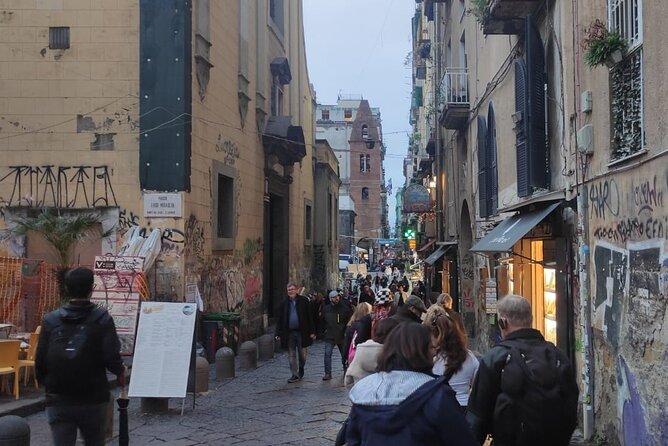
You begin at Piazza Dante, which is a practical meetup point and also a good mental starting line. From here, the tour pushes you back into Greek and Roman Naples. I like this approach because it helps you stop looking at buildings as random scenery. Instead, you start seeing the street grid as a clue: where you walk now has echoes of what was laid out centuries ago.
From Piazza Dante, you head toward Port’Alba, one of the older gates of the city. This isn’t a “stand here and take a photo” kind of stop. The point is to show you how the historic center is shaped, including the idea of the Decumanus Major—one of the big east-west Roman axes. When you understand that, the rest of the walk becomes easier to follow.
Practical tip: this section moves at a comfortable walking pace, but the streets are narrow. Keep an eye on footing and don’t try to “speed walk” just because you’re excited.
Piazza Bellini: tufa stone and 4th-century BC clues
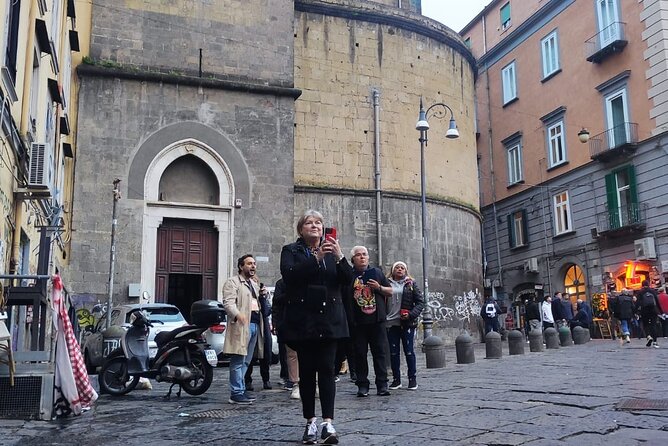
Next comes Piazza Bellini, and this stop pays off if you notice details. You’ll see remains of Greek Neapolis walls—made with compact tufa blocks—and the dating places the fortification to roughly the second half of the 4th century BC.
What I like about this part is that it gives you a reality check. Naples isn’t just “pretty old streets.” It has physical layers. Seeing that stonework (and hearing what it was for) helps you understand why the city’s historic core feels tightly packed. It wasn’t designed for wide open space; it was designed for survival and control.
If you’re short on time, don’t rush this stop. This is one of the few moments where the past is literally in the same footprint as the present.
Via dei Tribunali (Decumano Maggiore): the main spine meets everyday Naples
Now you hit the heart of the historic center: Via dei Tribunali, also known as Decumano Maggiore. This is the main artery, and it’s exactly the kind of street where a guide earns their fee. Without context, it’s easy to get swept up in shops, church fronts, and food smell trails—and miss the city logic.
Here, you’ll notice historic businesses along the route, including some famous Neapolitan pizzerias. That’s part of the charm: this isn’t a dead museum street. It’s a working neighborhood street where old and new run side by side.
You’ll also learn that other historic alleys branch off from this main line, including Via San Gregorio Armeno. So the walk isn’t just one straight hallway. It’s a set of connections, and you’re being taught how to read them.
Tip for the best photos: pick your moment. A quick stop in mid-street is fine, but if you can step slightly aside near a doorway or corner, you’ll get cleaner compositions with less crowd clutter.
Via San Gregorio Armeno: the nativity-scenes street
If Naples has a street that practically dares you to slow down, it’s Via San Gregorio Armeno. This is the famous street of nativity scenes, and it’s a great match for the tour because it’s both cultural and visible. You can see the tradition in storefronts, displays, and the kind of crafts people come looking for.
This stop is shorter, but it’s memorable. I like that the tour doesn’t treat the nativity scenes as a single fact. It frames them as part of how people celebrate and remember. Even if you’re not shopping, you’ll probably end up watching people browse and thinking about why this street matters.
Practical note: this street can be tight. If you’re traveling with a stroller, have mobility limits, or just don’t love crowds, keep your pace steady and avoid sudden stops that block foot traffic.




Spaccanapoli (Decumano Inferiore): where the city feels lived-in
Then you reach Spaccanapoli—the street that runs from the Quartieri Spagnoli area toward Forcella, bisecting Naples and functioning as the Decumano Inferiore. This is the part of the tour that feels most like walking inside the actual city.
The route here is about more than architecture. It’s about texture: churches you can’t miss, apartments where locals live, and old buildings that look like they’ve survived everything. You’ll also pass small bars along the way, which helps explain why Spaccanapoli feels so human. It’s not just sight-seeing; it’s everyday rhythms layered on top of ancient planning.
This is also where your guide’s voice matters most. Good guiding keeps the street from becoming background noise. You’ll want to listen for how the city’s structure affects what you see street-level.
Comfort tip: this section is still walking-on-stone-city style. Wear shoes you can trust for uneven pavement.
Piazza del Gesù Nuovo: an ending square with real options
Your tour ends at Piazza del Gesù Nuovo, one of the key squares in the historic center. The church with the same name is right there, and Basilica of Santa Chiara is nearby, so you finish in an area that feels important without being hard to navigate.
I like endings like this because you can keep the momentum. After the tour, you’re not stuck at some generic drop-off. You’re in a real hub with characteristic restaurants around you, which makes it easy to transition from walking to eating.
If you still have energy, this finish point is also a good launchpad for a relaxed follow-up wander. You’ll already understand the logic of where streets connect.
What you get for the $30.25: guide, headsets, and tasting
This tour is priced at $30.25 per person, and for Naples, the value comes from how much you’re buying beyond landmarks: a local guide plus a structured route through the old city’s main axes.
You also get:
- a local guide
- headsets when there are six participants or more, so you can hear clearly even in crowded corners
- a food tasting (sweet or salty)
The free-entry nature of the stops matters too. You’re not paying additional admission fees while you learn. That keeps the experience predictable—especially helpful when you’re trying to fit Naples into a tight schedule.
One more planning detail: the tour is offered in English, and you’ll receive confirmation at booking. A mobile ticket makes it easy to check in on the day, and the start location is near public transportation, which is helpful in Naples where getting around can be a chore.
Guide quality: some names shine, and style can vary
The tour’s rating is very high, and the names that show up in standout experiences include Rosa, Ines, Georgia, Giorgia, and Giovanni. The praise patterns are consistent: clear explanations, passion for Naples, and good communication.
Still, one caution is worth respecting. A negative comment in the mix mentioned a guide repeating themselves and being rude at times, including religious-related remarks that made at least one participant uncomfortable. That doesn’t mean the tour is guaranteed to be like that, but it does mean your outcome can depend on the guide assigned that day.
My practical advice: go in with flexibility, but also treat your guide like a professional resource. If you want to ask questions, do it early. If the tone isn’t your style, you can still follow the route and enjoy the streets; the physical itinerary is strong on its own.
Logistics you’ll actually care about in Naples
A few details help you plan smoothly:
- Group size is capped at 20 travelers, which usually keeps the walk lively but not chaotic.
- The tour runs for about 2 hours.
- It requires good weather. If it’s canceled due to poor weather, you’ll be offered another date or a full refund.
- Service animals are allowed.
- Most people can participate, but like any city-walking tour, you should expect uneven sidewalks and tight spaces.
Also, this one tends to book ahead. The average booking window is around 33 days, so if you’re traveling in peak season or around popular events, don’t wait until the last week.
Who this Naples Walking Tour suits best
This tour is ideal if:
- you want a guided route through Old Town Naples without building your own itinerary
- you care about the story behind the streets, not just photos
- you like the idea of walking the city’s main axes: Decumano Maggiore and Decumano Inferiore
- you enjoy practical culture stops, like Via San Gregorio Armeno
You might consider a different option if you:
- strongly prefer silent or self-paced wandering
- don’t like guided discussions that can touch on religion or local beliefs (since one negative account raised that issue)
- have limited mobility and struggle with narrow, uneven streets
Should you book this Naples Old Town and Spaccanapoli walk?
I’d book it if your goal is to understand Naples quickly and walk away with street-level context. The route is efficient—Piazza Dante to Port’Alba to the Decumani—and it ends in a spot where you can immediately turn the day into dinner plans at Piazza del Gesù Nuovo.
If you’re the type who asks lots of questions, book with confidence but come prepared to adapt to the day’s guide style. With the headsets and the tight 2-hour format, you’ll still get value even if you don’t love every explanation.
FAQ
How long is the Naples Walking Tour: Old Town and Spaccanapoli?
It’s about 2 hours.
Where does the tour start and end?
It starts at Piazza Dante (P.za Dante, 80135 Napoli) and ends in Piazza del Gesù Nuovo (80134 Napoli).
What time does the tour begin?
The start time is 4:00 pm.
How much does the tour cost?
The price is $30.25 per person.
Is the tour in English?
Yes, it’s offered in English.
What is included in the ticket price?
Included are a local guide, headsets to hear the guide clearly when there are 6+ participants, and a food tasting (sweet or salty).
Do I need to pay for admissions at the stops?
The stops listed are marked as free admission.
What happens if weather is poor?
The tour requires good weather. If it’s canceled due to poor weather, you’ll be offered a different date or a full refund.
Is there a limit on group size?
Yes. The tour has a maximum of 20 travelers.
Should you book this Naples Walking Tour?
Book it if you want a well-paced introduction to Naples that connects Greek and Roman street structure to what you see today—especially on Spaccanapoli and Via San Gregorio Armeno. Skip it only if guided history with potential cultural/religious commentary would make you uncomfortable.