REVIEW · NAPLES
Herculaneum Small Group Tour and Ticket With an Archaeologist
Book on Viator →Operated by Askos Tours · Bookable on Viator
Buried city, explained one house at a time. This 2-hour Herculaneum tour pairs skip-the-line admission with an archaeologist guide so you can read the ruins like a real neighborhood, not a random pile of stones. You’ll move through the site at a steady pace, with headsets to keep the story clear even in the open air.
I especially like the way the route focuses on the highlights you actually want to see: standout mansions, the thermae, and the details that show how people ate, worked, worshiped, and lived. I also like the small group size, capped at 20, which makes it easier to ask questions and stay together.
One drawback to plan for: you should expect plenty of standing and walking, with limited chances to sit, so if you need frequent breaks, build extra time into your day.
In This Review
- Quick hits
- Herculaneum’s special feel: smaller than Pompeii, sharper in detail
- Price and value: why $53.81 is more than just a ticket
- Getting there smoothly: Corso Resina, the ticket office, and easy transit
- The 2-hour pacing: what the small group and headsets really change
- House of the Deer to Balbus’s terrace: stags, benefactors, and funerary inscriptions
- Augustales and Telefo: religion and legend in everyday spaces
- Tramezzo di Legno, Skeleton House, and the Central Thermae: daily life you can picture
- Black Salon to the Grand Portal: luxury rooms, frescoed walls, and charred details
- Why an archaeologist guide changes the whole visit
- Rain, walking, and hearing support: practical things to know before you go
- Who this tour suits best (and who might want a different plan)
- Should you book this Herculaneum archaeologist tour?
- FAQ
- How long is the Herculaneum small group tour?
- How big is the group?
- Is the tour offered in English?
- Where does the tour start?
- Does the ticket include admission to Herculaneum ruins?
- Are headsets included?
- Are dogs allowed on the tour?
- Can I cancel for a full refund?
Quick hits
- Skip-the-line entry saves time at the start
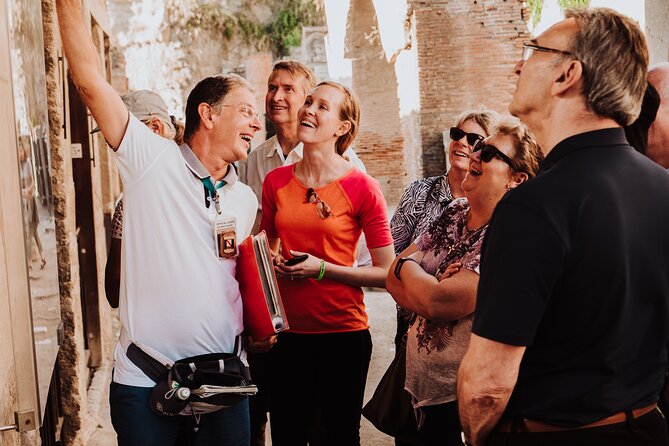
- Archaeologist-led commentary turns buildings into daily-life stories
- Headsets help you hear well in a busy, outdoor site
- A tight route hits major rooms and houses in about 2 hours
- Ends inside Herculaneum Ruins, so you can continue on your own
Herculaneum’s special feel: smaller than Pompeii, sharper in detail
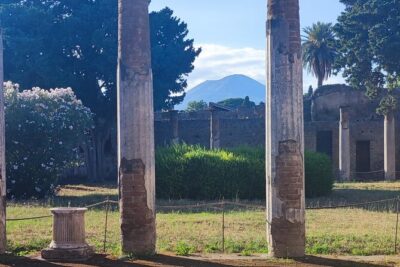
Herculaneum is the “same disaster” story as Pompeii, but it plays very differently. Because the town is more compact, you can get closer to the living spaces and notice features that would be hard to connect with in a bigger, faster-moving crowd. The result is that the site feels like a walk through rooms and streets, not just a checklist.
This tour leans into that advantage. Instead of skimming the obvious big stuff, you’re guided through specific houses and public spaces that let you understand how social status, work, religion, and leisure fit together in one town.
You can also read our reviews of more tours and experiences in Naples


Price and value: why $53.81 is more than just a ticket
At about $53.81 per person, this is not a bargain tour in the strictest sense. But it stacks value in three practical ways:
- Your entrance fee is included, so you are not juggling separate purchases.
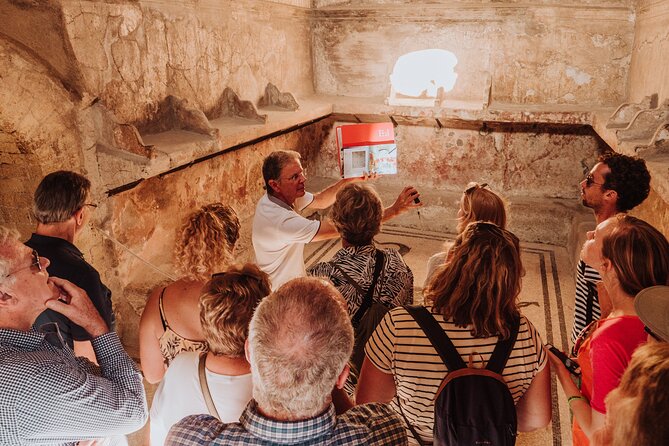
- You get a licensed guide with an archaeological background, which is the difference between seeing remains and understanding them.
- You receive headsets, which is a big deal in a ruin where the guide’s voice can get swallowed by noise and distance.
Also, every stop on the route is covered by the included park ticket—there are no extra “per-house” ticket hurdles while you’re walking. For many people, that makes the cost feel fair because you’re paying for interpretation plus smooth access, not just entry.
Getting there smoothly: Corso Resina, the ticket office, and easy transit
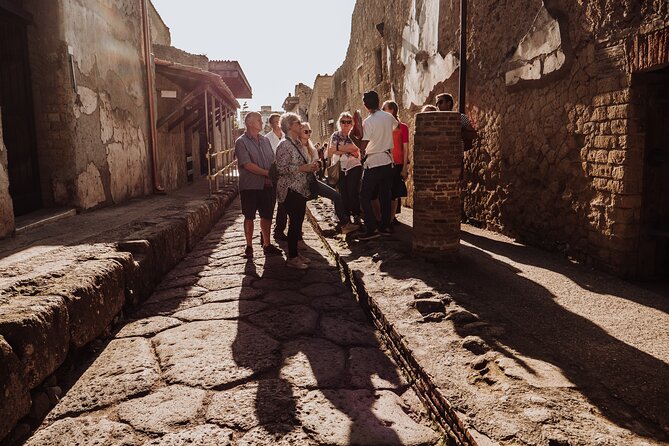
The meeting point is the Ticket Office of the Herculaneum ruins. In practical terms, you’ll want to plan to arrive before your start time so you can get checked in and start the walk without stress.
Here are the two easiest ways to reach it:
- By train: the Circumvesuviana station is about 10 minutes’ walk away, with the tour meeting area near Corso Resina.
- By car: there’s unguarded parking close to the meeting area on via Pignalver.
One small planning tip: many tours get booked about 42 days in advance on average, so if you’re traveling in a busy season, treat this as something to reserve early rather than last-minute.
The 2-hour pacing: what the small group and headsets really change
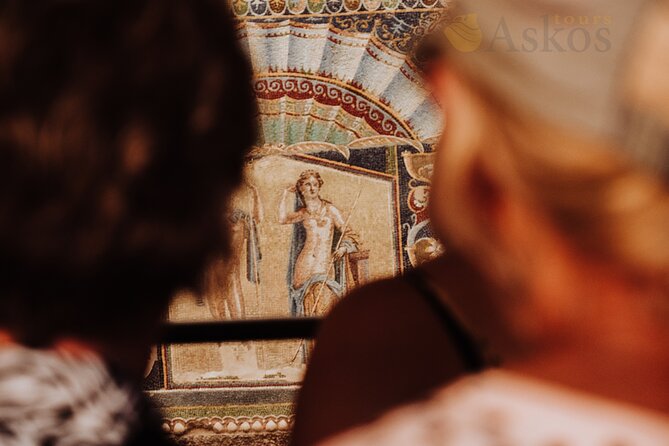
The tour runs about 2 hours and is designed as a tight walking route. The stops are short—around 10 minutes each—so you’ll cover a lot of ground without feeling like you’re sprinting between highlights.
The group stays small, up to 20 people per guide, which helps in two ways. First, your guide can keep an eye on the group and adjust the pace. Second, you’re not stuck listening from far away.
That’s where the headsets matter. Even in rain, wind, or louder parts of the site, the audio support keeps you connected to the explanation. And yes, the site involves standing and some walking, so comfortable shoes are the smart move.
House of the Deer to Balbus’s terrace: stags, benefactors, and funerary inscriptions
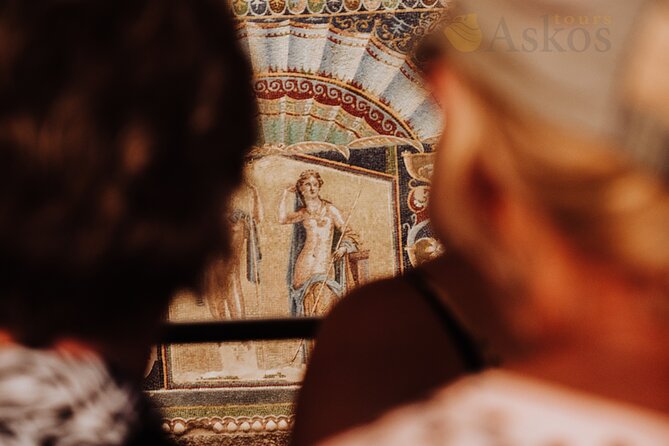
Your route kicks off with a house named for what you can still see in the layout—the House of the Deer. The name comes from marble statues of stags/deer discovered in the peristyle. As you look at the space, the guide’s role is to help you connect decoration to status: what the residents displayed, and what kind of public impression they wanted to make.
Next is La Terrazza di M. Nonio Balbo, tied to M. Nonius Balbus, the city’s major benefactor. This is where you start to grasp the local power structure: buildings and restorations didn’t happen by accident. Balbus was honored after his death, and the long inscription on his funeral altar is part of the story. It’s the kind of detail that turns a terrace from “pretty stone” into “a monument to someone’s political and social reach.”
These two stops are a strong start because they teach you how to read Herculaneum’s evidence: naming, materials, and inscriptions point to real people, not just archaeological categories.


Augustales and Telefo: religion and legend in everyday spaces
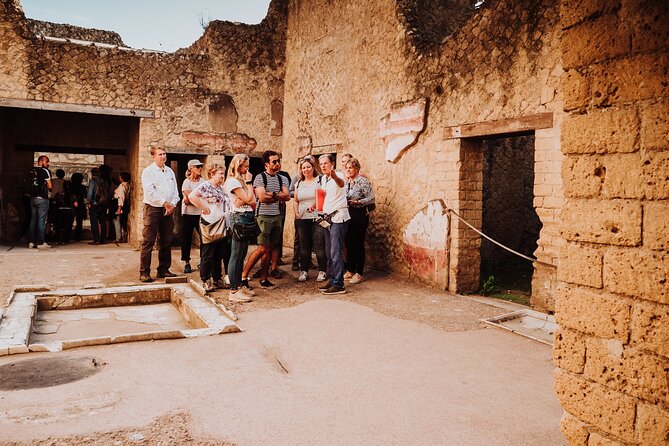
From benefactors and display, you move into the College of the Augustales. The building is thought to have been connected to the cult of Emperor Augustus and may have served as headquarters for the Collegium Augustalium (and possibly even the local curia). This is a good moment to understand how politics and religion braided together in daily life.
Then you’ll visit Casa del Rilievo di Telefo. This house is associated with a prominent family—possibly Marcus Nonius Balbus—and stands out for one unusual feature: it has its own private access to the adjoining Suburban Thermae to the south. It’s a reminder that in Roman towns, even leisure spaces could be designed around status and convenience.
If you like the human story side of archaeology—how ideas, cults, and family power influenced architecture—this section is a highlight of the walk.
Tramezzo di Legno, Skeleton House, and the Central Thermae: daily life you can picture
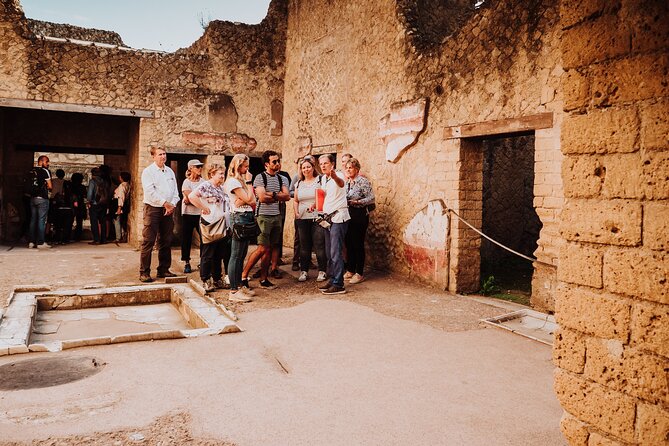
A big favorite on this route for many people is the portion of a house identified as Partem Domus lignea – Casa del Tramezzo di Legno. The focus here is the surviving wooden partition—an important detail because wood usually doesn’t last. The guide helps you picture how that partition would have shaped movement, privacy, and the flow between spaces.
From there, you’ll move to the House of the Skeleton, named after human remains found in a second-floor room during excavations in 1831. This stop is emotionally heavy, but it also teaches you how archaeology works: names and interpretations often come from specific finds tied to very particular locations.
Then the tour shifts back into something practical and visual: the Central Thermae. These were built around the beginning of the 1st century AD and are organized in the classic Roman way—men’s and women’s baths with separate entrances. Even if you’ve heard the general idea of Roman baths before, seeing the layout in person helps you understand how routine and gendered space were built into the town.
Black Salon to the Grand Portal: luxury rooms, frescoed walls, and charred details
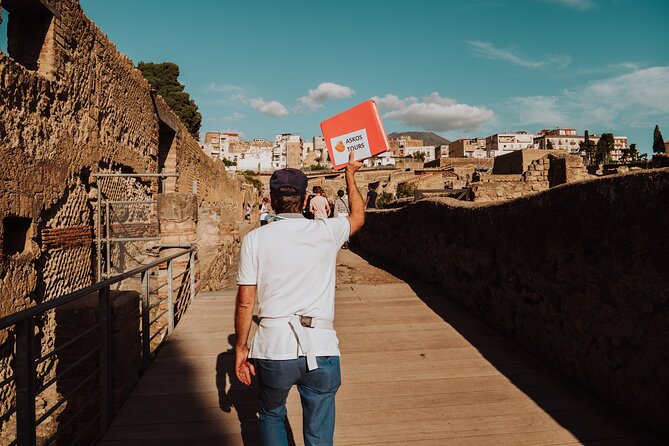
Now the tour turns toward luxury and architectural character.
House of the Black Salon is one of Herculaneum’s more opulent mansions. The entrance still shows carbonised remains of doorposts and lintel—evidence you can point to and interpret. The guide can connect those charred elements to what the house looked like before the eruption and why entrances mattered socially.
Next is Casa Sannitica, which reflects a typical Samnite arrangement. The atrium is skirted by a gallery with Ionic columns, and the rooms had frescoes. This stop helps you notice how regional influences show up even in a single town.
Then you’ll reach Casa del Bel Cortile, one of the most original houses on the route. Instead of a traditional atrium, it uses a courtyard with a stairway and a stone balcony. It’s a great example of how you can’t assume a Roman house always follows one template.
The walk ends at House of the Grand Portal in the central archaeological area. Here, you’ll see domus spaces with collonnati and frescoes, plus charred remains of wooden parts. It’s a fitting finale because it pulls together the tour’s themes: architecture + decoration + the physical traces of what was lost.
Why an archaeologist guide changes the whole visit
You’ll often hear that you can do ruins on your own. Sure—but you miss the “why,” and that’s where Herculaneum becomes memorable.
This tour is led by an archaeological guide, and the style varies by person. Some guides have a knack for weaving engineering and cultural context into the story. For example, guides like Michele have a way of connecting technical building choices with how families would have used the spaces. Paulo and Gennaro are praised for clear, paced explanations that help you understand how a lively town functioned. Others, like Luciano Leone, have used reconstructions and visual materials to show what structures may have looked like around 2,000 years ago.
You don’t need to be a classics scholar. What you need is someone to point out the right feature at the right moment—and explain how it connects to daily life. That’s exactly what this format is built for.
Rain, walking, and hearing support: practical things to know before you go
This tour operates in all weather, so pack for rain or drizzle if the forecast looks messy. The site is outdoor, and you’ll be moving between rooms and openings, so expect wet stone underfoot if it’s raining.
Comfort matters here. There’s a lot of standing and some walking, and the route is short-stop and short-break. If you need a slower pace, it’s smart to mention it before the tour starts or choose good footwear with grip.
On audio quality: the guide provides headsets, and at least one experience on record notes that the audio worked well even for someone using hearing aids, with the guide regularly checking that they could hear clearly. That’s reassuring if your hearing needs more support than a standard outdoor conversation.
One more timing consideration: since the tour is designed to hit many points in about 2 hours, a slower group start or extended explanations can cut into time for extra independent exploring afterward. If your schedule is tight, keep a little buffer.
Who this tour suits best (and who might want a different plan)
This tour is a strong fit if you like:
- Hands-on archaeology explanations that connect spaces to real routines
- A focused route where you see multiple houses without committing to an all-day museum plan
- Choosing Herculaneum as your main ancient-site experience instead of splitting attention across too much
It also works well for families when teens are interested in history and can handle the walking. One family experience praised the calm, engaging approach and the ability to cover the planned highlights.
The main “not ideal” scenario is mobility limitations or anyone who needs frequent long sit-down breaks. The tour can be done in good weather, but in any case you’re on your feet most of the time.
Should you book this Herculaneum archaeologist tour?
If you want a guided walk that makes the site make sense, I’d book it. The combination of skip-the-line entry, an archaeological guide, and headsets turns Herculaneum from static ruins into a walkable story of how people lived. And because the tour ends inside the site, you can keep exploring after the route if time allows.
Skip it only if you’re the type who prefers silent touring with a map and don’t care about interpretation, or if walking for about 2 hours is a tough match for your body.
FAQ
How long is the Herculaneum small group tour?
The tour lasts about 2 hours.
How big is the group?
The group is capped at a maximum of 20 travelers per guide.
Is the tour offered in English?
Yes, it is offered in English.
Where does the tour start?
The meeting point is at the Ticket Office of the Herculaneum ruins. The listed start location is Corso Resina, 187, 80056 Ercolano NA, Italy.
Does the ticket include admission to Herculaneum ruins?
Yes. Entrance fee tickets for Herculaneum entry are included in the tour price.
Are headsets included?
Yes. Headsets are provided so you can hear the guide more clearly.
Are dogs allowed on the tour?
Dogs are allowed at the Herculaneum Archaeological Park with leash/muzzle rules and you must carry bags for droppings. Within certain indoor premises, including the Antiquarium and areas with mosaic floors, access is permitted only for dogs that are carried or in an appropriate carrier.
Can I cancel for a full refund?
Free cancellation is available up to 24 hours in advance for a full refund. Canceling less than 24 hours before the start time does not get a refund.