REVIEW · NAPLES
Pompeii private tour from Naples. The best choice for cruisers
Book on Viator →Operated by Nino Pezzullo · Bookable on Viator
Pompeii goes fast on cruise time. This private Pompeii day trip from Naples is built for limited hours, with an English-speaking guide and admission included as you move between the big sights. You’ll cover a lot of ground in about 5 hours, without the usual scramble.
I especially like the private group setup—just your people, so questions don’t get lost in the shuffle. I also like how entry feels handled ahead of time, so you spend more moments looking and less time waiting, thanks to the guide’s advance coordination and ticket handling.
One possible drawback is the pace: most stops are brief (often around 10–20 minutes). You’ll see key highlights, but if you want slow, museum-style reading, you might feel the time pressure.
In This Review
- Key highlights you’ll care about
- Pompeii from Naples: the cruise-day route that actually works
- Meeting at Stazione Marittima and getting to Pompeii on time
- The morning start at Porta Marina: Pompeii’s main entrance energy
- Forum of Pompeii and Santuario di Apollo: public life and belief
- Macellum and the Suburban Baths: food, trade, and adult reality
- Casa del Fauno and Casa dei Vettii: power shown in stone
- Panificio di Popidio Prisco and bread-making talk
- Teatro Grande and Anfiteatro Romano: two kinds of spectacle
- Via dell’Abbondanza and the Basilica: commerce, justice, and the city center
- Price and value: what $216.27 buys you on a private cruise day
- What the private guide experience really changes
- Who should book this Pompeii private tour
- Should you book? My take for first-timers
- FAQ
- What is the duration of the Pompeii private tour from Naples?
- How much does the tour cost per person?
- Is this tour private or shared with other groups?
- Where do we meet for the tour?
- What languages are offered?
- Are admission tickets included?
- What vehicle is used for transport?
- What happens if the weather is poor?
- Is free cancellation available?
Key highlights you’ll care about
- Private tour from Naples’s cruise area: you meet at Stazione Marittima and your day ends back there.
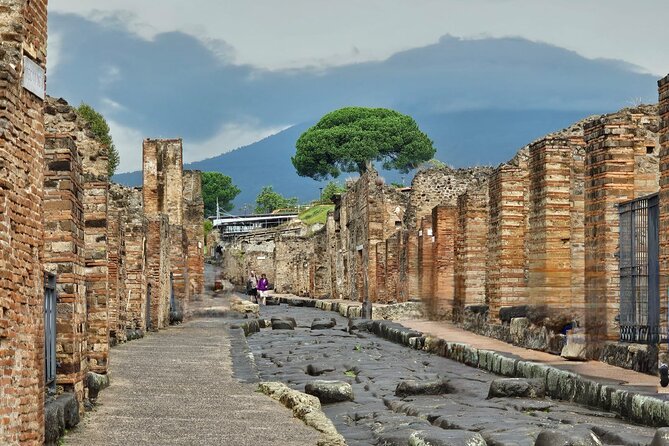
- 12 stops that map Pompeii’s “everyday world”: gates, forum life, worship, markets, baths, homes, and entertainment.
- Admission tickets included at each listed site: less hassle for you, more time for looking.
- English guide and real-world context: you’re not just walking ruins; you’re getting the story of Campania and Naples.
- Comfortable transportation: a 2014 Peugeot 3008 handles the drive, with bigger vehicles available on request.
- Crew-friendly communication: the guide is set up to contact you clearly before you move.
Pompeii from Naples: the cruise-day route that actually works
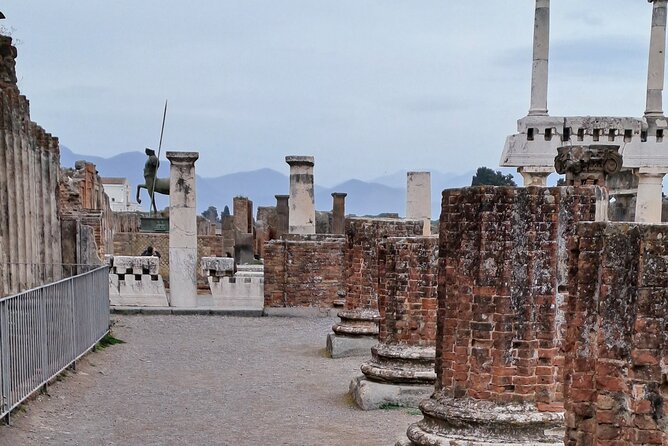
Pompeii is one of those places where “I’ll just wander” can turn into a half-day of stress. This tour avoids that trap by running a focused loop that hits the places most people came for, while still making sense as a walking journey through ancient city life.
The structure matters. You start at a major gate, then work through the public heart of the city, then shift into worship, commerce, bathing culture, elite houses, and finally entertainment and street life. Even if you only have one shot at Pompeii, this routing helps you leave with a real sense of how the town functioned.
Because it’s private, you also get a better chance to steer the day. If you’re most curious about daily life—shops, bread, baths—or if you want the big-money homes and theaters, your guide can shape the attention you get within the set time.
You can also read our reviews of more private tours in Naples


Meeting at Stazione Marittima and getting to Pompeii on time
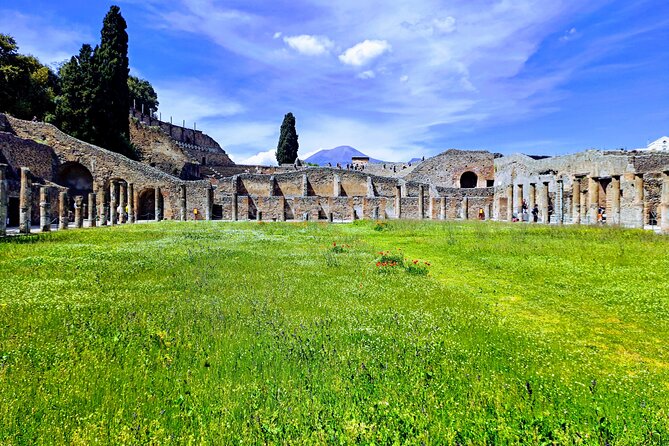
Your day starts at Stazione Marittima in Naples (80133 Napoli). The tour ends right back at the meeting point, which is a big deal for cruise days when you don’t want to gamble on transit or timing.
Transport is simple and practical: you’ll ride in a 2014 Peugeot 3008. If your group needs a larger car or a mini van, that’s available by request, with a supplement—useful if you’re traveling with more luggage or prefer extra comfort.
Guides on this kind of route tend to be used to cruise logistics. In prior experiences, pickup has happened just outside the cruise terminal area, with a short walk to the car. That’s the type of detail you’ll appreciate when you’re trying to avoid last-minute running around.
The morning start at Porta Marina: Pompeii’s main entrance energy
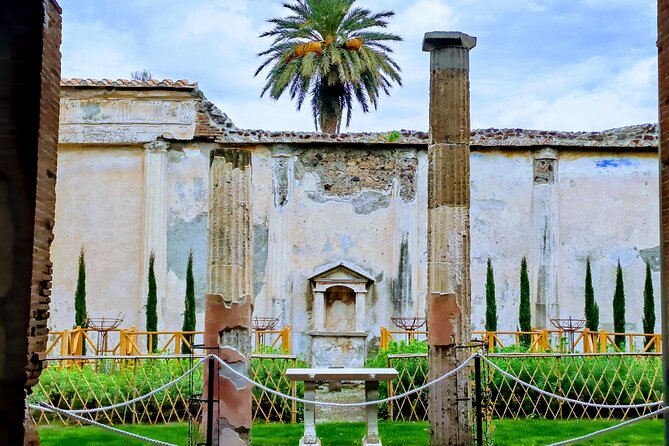
You begin at Porta Marina, one of the seven gates of Pompeii. The point of starting here is not just location—it sets the tone. It’s a strong first stop because it anchors you in the idea of Pompeii as a living city with controlled entrances, not a random scatter of ruins.
Expect a short, focused visit—about 10 minutes. In that time, I’d treat this like orientation. Look at how the gate frames the street connection and imagine the flow of people arriving and departing.
A quick stop is also practical for cruise travelers. You keep the morning moving while your energy is still high and the crowds (if any) are lighter.
Forum of Pompeii and Santuario di Apollo: public life and belief
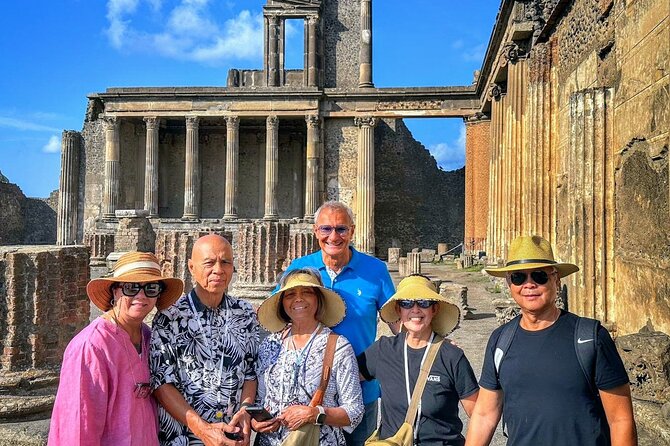
Next comes the Forum of Pompeii, the civil forum that functioned as a center of daily life. It’s where the city’s main public energy converged, with major buildings facing the forum space.
You’ll have about 20 minutes here. That’s enough time to walk the area, connect it to what Roman civic life meant, and understand why this space was the city’s social and administrative center—not just a pretty square.
Then you shift from civic life to religious life with the Santuario di Apollo. This sanctuary is tied to one of the older places of worship in Pompeii and sits in a strategic point. The choice of Apollo connects to the Greek and Etruscan presence in Campania, which helps you see Pompeii as part of a wider regional story.
This stop is shorter—around 10 minutes—so ask your guide a question right at the start. It’s the easiest place to get a quick but meaningful framework for what you’ll see next.
Macellum and the Suburban Baths: food, trade, and adult reality
The Macellum is Pompeii’s market. This is one of those stops where you’ll feel like you’re stepping into a working economy. The courtyard center originally held a circular structure used for selling and cleaning fish, which gives you a specific image of daily trade.
Plan on about 20 minutes. In that window, you can notice how market spaces support movement and how daily needs were built into the city’s layout.
Then the tour heads to the Suburban Baths, which are different from many other thermal sites in Pompeii because they were private. This is also where the tour becomes very real about what ancient Romans did for entertainment and services: the changing room had pictures with erotic subjects advertising the activities upstairs.
This stop is about 15 minutes. If you’re visiting with younger travelers, it’s worth flagging this part in advance so nobody gets surprised. If you’re an adult history buff, it’s exactly the kind of detail that makes Pompeii feel human rather than staged.



Casa del Fauno and Casa dei Vettii: power shown in stone
After markets and baths, you pivot into wealth. Casa del Fauno is one of Pompeii’s largest houses, and its scale—and the quality suggested from the street—lets you read the owner’s social level fast. The idea here is to understand how status displayed itself through architecture and space.
You’ll get about 15 minutes. That’s a sweet spot: long enough to see it’s not just one room, but a whole lifestyle setup, even if you won’t have time for deep, room-by-room study.
Next is the Casa dei Vettii, another top-tier house. It’s described as among the richest and most famous in Pompeii, with rooms richly decorated. You’ll also hear about its link to Priapus, the god associated with prosperity, who appears as a protector in the house’s context.
This also takes about 15 minutes. I like this pairing because it gives you two angles on elite life: “grand and large” at Casa del Fauno, and “decorated and specifically themed” at Casa dei Vettii.
Panificio di Popidio Prisco and bread-making talk
Not all Pompeii highlights are buildings for the rich. The Panificio di Popidio Prisco is a bakery, and you’ll get an explanation of how bread was produced there.
This stop runs about 15 minutes. You’ll get more value if you treat it like a story stop: bread wasn’t a background detail—it was part of the whole city’s rhythm, tied to labor, supply, and everyday routines.
It’s also a nice change of pace. After theaters, baths, and elite residences, a bakery feels grounded and practical. It helps you remember that Pompeii wasn’t only about grand public events.
Teatro Grande and Anfiteatro Romano: two kinds of spectacle
Pompeii understood entertainment, and this tour hits that side in a big way.
First, you’ll see the Teatro Grande, built around the middle of the 2nd century BC. This theater hosted Greco-Roman comedies and tragedies, so it’s a great stop for thinking about shared cultural entertainment.
You’ll have about 10 minutes here. That’s short, but it’s enough to get the theater shape into your mind and connect it to the kinds of stories people watched.
Then comes the star for many history fans: the Anfiteatro Romano (Roman amphitheater). It’s described as the oldest in the Roman world, built in 70 BC, and it could hold up to 20,000 spectators.
Expect about 15 minutes. If you’re trying to understand Roman engineering and crowds, this is your stop. Even in a brief visit, the scale can hit you immediately—especially when you remember it was designed for mass viewing.
Via dell’Abbondanza and the Basilica: commerce, justice, and the city center
Your route continues with Via dell’Abbondanza, one of Pompeii’s most important streets. It functioned as the city’s shopping lane, where you’d find well-known shops.
You’ll get about 20 minutes. This is a good time to switch from “major monuments” mode to “street life” mode. The street view helps you picture how people moved between daily needs, not just where big events happened.
The finish point in the forum area is the Basilica, described as the most sumptuous building in the Forum. This was where management of business and justice took place—so it’s the civic end of the story, tying together your earlier forum stops.
You’ll spend about 15 minutes here. I like that it lands near the end because you’ll have already built context. You can walk in with a clearer sense of what the forum meant.
Price and value: what $216.27 buys you on a private cruise day
At $216.27 per person, this isn’t a budget shuffle tour. It’s priced like a proper day trip with transport and guide time—plus admission included across the major stops.
The value equation is strongest for cruisers. You get a fixed meeting point at Stazione Marittima, door-to-door routing, a plan that fits about 5 hours, and less time burned on independent navigation. If you’ve ever tried to coordinate transit, tickets, and entry timing in a limited cruise window, you know why this matters.
It also tends to work well for small groups. Reviews for this kind of private format often highlight smooth ticket handling and skipping slow entry lines, especially when guides pre-arrange what you need. When your party is small, your guide can also move you at a pace that fits your attention.
What the private guide experience really changes
The best part of a private Pompeii tour is that you’re not stuck with a loud herd. You can ask the question that’s actually on your mind: Why this god? What was daily work like? How did baths function socially? What did the wealthy house communicate?
In past experiences, the tour hosts have included Nino Pezzullo, and some groups have also been guided by Carmen, who lives in Pompeii and studied archaeology in Naples, even working on digs in Pompeii. That kind of background matters because it shows up in the small explanations that help ruins make sense.
Communication has also been a strong point. In prior visits, the guide has contacted people via WhatsApp and shared a video location ahead of pickup. That’s small until you’re on a cruise schedule, then it’s the difference between smooth and stressful.
One more practical factor: time at each stop is limited, so a strong guide helps you pick what to notice. That’s how a short visit turns into real understanding rather than a checklist.
Who should book this Pompeii private tour
This tour fits best if you fall into one of these groups:
- You’re on a cruise and need a plan that returns to the port area on time.
- You want private pacing for a small group, with time to ask questions.
- You prefer a route that covers Pompeii’s biggest categories: civic center, worship, commerce, homes, food, and entertainment.
- You’d rather pay for convenience than spend time coordinating entry and transport on your own.
If you’re the type who wants to linger for an hour at each wall painting, then you may find the stop lengths feel short. But if you want an organized, high-impact overview that feels grounded in daily life, this route makes a lot of sense.
Should you book? My take for first-timers
I’d book this private Pompeii tour if you want the safest path to a memorable day without wasting time. The meeting point at Stazione Marittima, the short stop schedule, and the fact that admission tickets are included add up to real value for cruise travelers.
I’d think twice if your top goal is slow, detailed study of a single house or museum. This is a highlights-and-context route. You’ll leave with a strong overview, but you won’t get the kind of deep dive that takes multiple days.
FAQ
What is the duration of the Pompeii private tour from Naples?
It runs for about 5 hours.
How much does the tour cost per person?
The price is $216.27 per person.
Is this tour private or shared with other groups?
It is a private tour. Only your group participates.
Where do we meet for the tour?
The meeting point is Stazione Marittima, 80133 Napoli NA, Italy, and the tour ends back at the same place.
What languages are offered?
The tour is offered in English.
Are admission tickets included?
Admission tickets are included for the listed stops.
What vehicle is used for transport?
Transport is carried out with a 2014 Peugeot 3008. Larger cars or mini vans are available on request for a supplement.
What happens if the weather is poor?
This experience requires good weather. If it’s canceled due to poor weather, you’ll be offered a different date or a full refund.
Is free cancellation available?
Yes. You can cancel up to 24 hours in advance for a full refund.