REVIEW · NAPLES
Tour of Naples and his Idol Diego Armando Maradona
Book on Viator →Operated by Gray Line I Love Rome by Carrani Tours · Bookable on Viator
Maradona lives in every corner of Naples, and this short walk connects his legend to the streets where fans still feel it. You start in the heart of the old town, move through the grand 19th-century Galleria Umberto I, and finish at the big outdoor art stops tied to Diego Armando Maradona.
I love how this tour sticks to places you can actually picture: the Quartieri Spagnoli lanes feel like the real setting for Neapolitan football devotion. I also love the street-art angle—Murales Maradona 1990 is the kind of stop that makes you understand why Maradona wasn’t just a player to this city.
One thing to plan for: it’s a mostly-on-foot route through busy, narrow streets. You’ll want comfy shoes and a bit of patience if the neighborhood is full of scooters, conversations, and last-minute market traffic.
In This Review
- Key highlights to look for
- Naples and Maradona in 60 Minutes: The Point of This Walk
- Teatro di San Carlo: Opening the Story in the Right Place
- Galleria Umberto I: The 19th-Century Passage That Changes the Mood
- Quartieri Spagnoli: Narrow Lanes, Real Energy, Real Meaning
- Murales Maradona 1990 and the Fan Pilgrimage Stops
- Price and Logistics: What $57.78 Gets You
- The Right Mindset: What You Should Expect on the Ground
- Who This Maradona Walk Suits Best
- Should You Book This Naples and Maradona Tour?
- FAQ
- How long is the Naples and Maradona tour?
- What does the tour cost?
- Where does the tour start and end?
- How many people are in the group?
- What are the main places you visit?
- Do I need an admission ticket for the stops?
- What kind of ticket will I receive?
- How far in advance should I book?
- Can I cancel for a full refund?
Key highlights to look for
- Small group vibe (up to 15) for a more personal pace through the old center.
- Teatro di San Carlo as the opening scene, where the city once gathered for a champion.
- Galleria Umberto I for an easy change of mood: from ornate interiors to the street life just outside.
- Quartieri Spagnoli to understand why Maradona devotion became part of local identity.
- Maradona murals at Via Emanuele de Deo, including fan pilgrimage points tied to Napoli’s championships.
- Free access points with all included stop admissions marked as free.
Naples and Maradona in 60 Minutes: The Point of This Walk
This isn’t a long, sit-down tour. It’s a fast, focused stroll built for recognition. You’ll move through Naples in a way that helps the Maradona story land in your brain as a city story, not just a sports story.
The value here is in the pacing. In about an hour, you get the “why Naples loved him” feeling, then you see it made visible through street art. When a tour can connect neighborhood texture with Maradona imagery, you stop thinking of murals as decoration and start treating them like local landmarks.
The route also gives you a neat contrast. It starts with a major public centerpiece (Teatro di San Carlo), slides into a beautiful covered passage (Galleria Umberto I), then lands in the older, tighter streets where everyday Neapolitan life makes the devotion feel believable. That shift is the whole point.
If you’re the type who likes your travel with a clear theme—football, art, and neighborhoods all tied together—this one-hour experience is a smart use of time. You won’t feel like you’re “filling time.” You’ll feel like you’re getting your bearings on Naples’ Maradona footprint.
You can also read our reviews of more tours and experiences in Naples.

Teatro di San Carlo: Opening the Story in the Right Place
You begin at Teatro di San Carlo, in the old town area near Via San Carlo. Even if opera isn’t your thing, this stop works because it’s about gathering. This is one of those city landmarks where people traditionally show up together—locals, visitors, and anyone who wants to be part of a shared moment.
For Maradona fans, that matters. The tour frames Maradona as more than talent. It shows him as a champion the city truly rallied around. Starting at Teatro di San Carlo is a clever way to set the emotional tone before you step into the street-level Naples that made him part of daily life.
You’ll likely spend only a few minutes here, and that’s fine. This is a “launch point” stop. The goal isn’t a deep dive into performing arts. It’s to make your Maradona perspective broader than a highlight reel.
Practical tip: arrive with a small buffer. Even a quick start matters when the tour then moves into tighter lanes.
Galleria Umberto I: The 19th-Century Passage That Changes the Mood
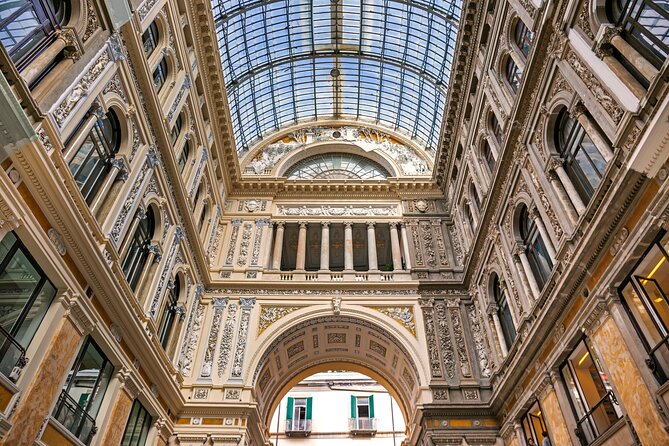
Next you pass through Galleria Umberto I, one of Naples’ big visual surprises. It’s end-of-the-1800s architecture, built as a passage for commerce and strolling, with that classic covered-gallery feel: shops, people, and a sense that the city is continuing right above street level.
I like this stop because it resets your senses. You go from a major civic landmark into something more atmospheric—bright interior spaces, layered movement, and daily rhythm. Then, when you step out of the gallery into the old streets, the change feels intentional rather than random.
This gallery also helps you understand Naples as a place where everyday life and big emotions sit side by side. Maradona mania didn’t happen in a vacuum. It grew in the same neighborhoods where people buy, chat, drink coffee, and argue about everything under the sun.
Time note: this stop is short. About ten minutes. You’re not wandering forever. You’re collecting one strong image—Naples’ elegance—before you head into the rougher, more local-feeling streets where the story gets real.
Quartieri Spagnoli: Narrow Lanes, Real Energy, Real Meaning
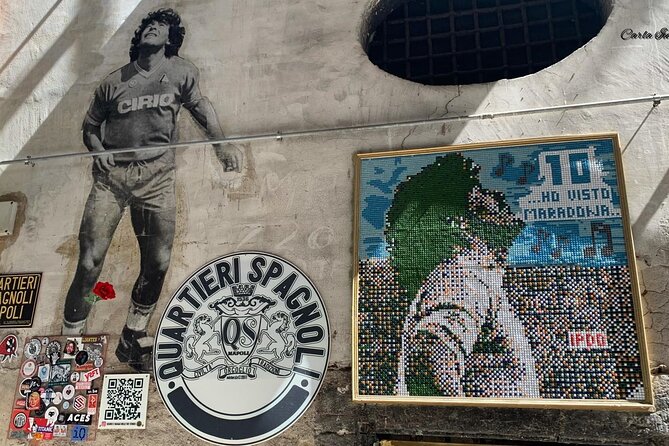
Then comes the neighborhood that makes this tour click: the Quartieri Spagnoli. This area is known as a cluster of three historic neighborhoods—San Ferdinando, Avvocata, and Montecalvario—so you’re not just looking at one street. You’re stepping into a district with its own identity.
The description says it all: narrow alleys, clothes hanging from balcony to balcony, and the constant motion of scooters, markets, and conversations. This is the Naples you see in photos, yes—but more importantly, it’s the Naples that makes Maradona’s connection feel grounded.
Here’s why I think this stop is essential: the tour isn’t asking you to admire Maradona from a distance. It’s showing you where the city’s collective love makes sense. A star becomes a symbol when a whole community adopts him. In the Quartieri Spagnoli, you can feel how symbol and street life overlap.
You spend a longer chunk of time here (around 25 minutes), so this isn’t a rushed “point and go.” You get a chance to slow down just enough to notice the details: the tight geometry of the lanes, the way people interact at close range, and the feeling that you’re walking inside someone’s daily neighborhood story.
Possible drawback: because this is an active residential area, it can be crowded or noisy. If you’re sensitive to tight spaces or you hate stopping for people, wear patience like a second pair of shoes.
Murales Maradona 1990 and the Fan Pilgrimage Stops
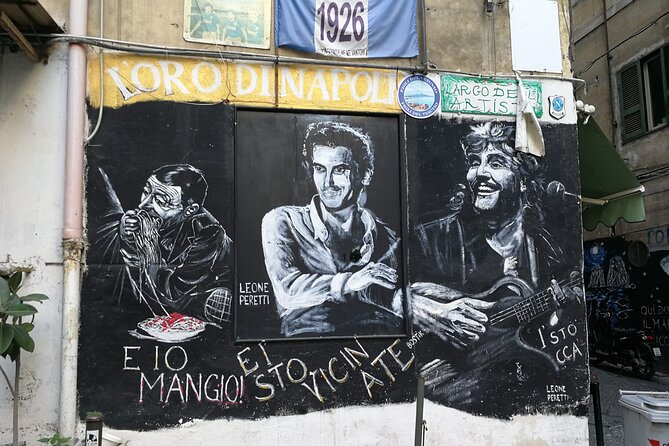
The finale is where the tour becomes visual. Naples uses street art as a public memory system, and this Maradona walk treats murals like destinations, not background decoration.
At the Maradona mural area connected to Murales Maradona 1990 along Via Emanuele de Deo (including the Piazzetta Diego Armando Maradona area), you’ll see multiple works tied directly to Napoli’s championship eras. This is also where the tour mentions a virtual-tour component that helps you connect two specific fan points: Vico Lungo Gelso and Piazza Maradona.
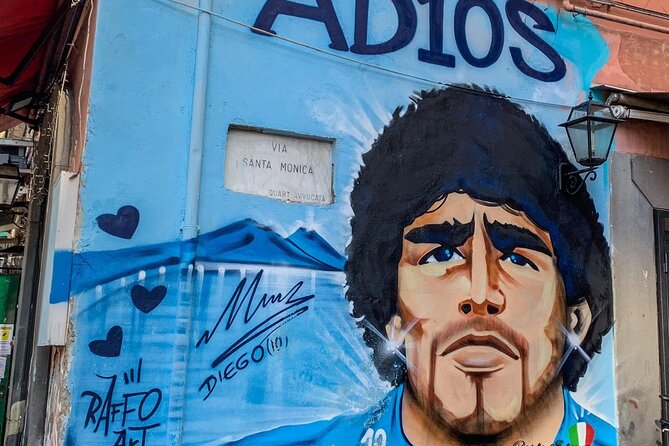
What’s on the wall matters. You’ll find a ceramic mosaic that was donated by two Italian-French artists. And you’ll see work by the Argentine street artist San Spiga, created to mark the 30th anniversary of the first Napoli championship (as described by the tour framing). Nearby, there’s also a full-length mural showing Maradona while he “dribbles,” giving you that action pose fans instantly recognize.
Then you continue to the famous mural that many fans treat like a pilgrimage point for the second Napoli championship in 1990. This is the moment where the tour stops being a walk and becomes a kind of recognition ritual. If you care about Maradona, your brain will connect the paintings to the city’s identity faster than you expect.
How to enjoy this section: bring your phone, but don’t let it steal the whole experience. Look first, then take photos. With street art, the best details are often the ones you notice after you stop framing the shot.


Price and Logistics: What $57.78 Gets You
At $57.78 per person for about one hour, this tour is priced like an experience that prioritizes a small-group route and theme-based guidance. Is it worth it?
I think it’s fair if:
- you want a clear Maradona route without planning it yourself,
- you like walking and street-level Naples,
- and you’re okay with a short timeline rather than a multi-hour neighborhood deep dive.
The most important practical detail is the limit: up to 15 travelers. That smaller group size helps the guide keep everyone together in tight alleys. It also makes it easier to ask questions, especially when the whole point is meaning—why Maradona mattered, how Napoli absorbed him, and how it shows up now.
Another value point: the listed stops have free admission tickets for each stop (Teatro di San Carlo and the gallery/mural areas are noted as free in the tour description). That helps you avoid surprise costs.
Scheduling note: the experience is commonly booked about 25 days in advance. That doesn’t mean you must book that early, but it’s a good sign of demand. If you’re traveling in peak season or on a tight schedule, don’t assume you’ll get a last-minute spot.
Transportation is also a plus. It’s described as near public transportation, so you’re not locked into one complicated route just to start the walk.
The Right Mindset: What You Should Expect on the Ground
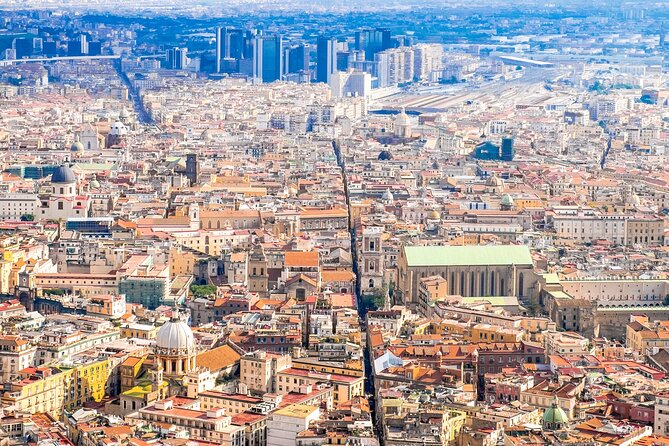
This tour is built around three Naples modes: landmark, passage, and neighborhood. Don’t expect museum pacing. Expect “see it, feel it, connect it.”
Here’s what I’d plan around:
- Shoes matter: you’ll be walking in old-center streets and through crowded areas.
- Time is limited: you get short stops with meaning, not long exploration.
- Street art is the payoff: the murals are not just pretty; they’re the proof of the theme.
If you care about football, you’ll likely feel the emotional logic quickly. Maradona is treated as a city-level figure: a hero who brought joy and pride, and whose name became part of daily life. The tour’s structure reinforces that message by repeatedly moving you back to places that represent community—first a public gathering (Teatro), then a commercial passage (Galleria), then a working neighborhood (Quartieri Spagnoli), then public art as collective memory (the murals).
Guide factor: the tour feedback mentions guides like Mira and Sascha as particularly strong on details and local insider storytelling. That matters because Maradona in Naples isn’t just trivia; it’s context.
Also: service animals are allowed, and the tour states that most participants can join—so if you can handle short walking segments, you’re likely a good fit.
Who This Maradona Walk Suits Best

This experience is best for:
- Maradona fans who want a Naples-focused route tied to real places,
- people who enjoy street art as a storytelling medium,
- visitors who want a short, efficient Naples activity that still feels meaningful,
- and first-timers who need an easy way to understand the city beyond the usual highlights.
If you’re looking for a deep historical lecture, this probably won’t scratch that itch. It’s not designed as a multi-hour academic history class. It’s a compact “get the connection” walk.
If you love architecture, you’ll enjoy the Galleria stop. If you love neighborhoods, you’ll enjoy the Quartieri Spagnoli portion. If you love fandom made visible, the murals are the reason to choose this tour.
Should You Book This Naples and Maradona Tour?
Book it if you want a tight, themed walk that turns Maradona into a Naples street story. The route is short but purposeful: Teatro di San Carlo sets the emotional scale, Galleria Umberto I gives you a beautiful city intermission, Quartieri Spagnoli shows you the neighborhood soul, and the Murales Maradona 1990 stops are where the theme becomes real in your eyes.
Skip it or rethink it if you need lots of museum time, hate crowded narrow streets, or prefer longer, slower neighborhood exploration. Also, if you’re in Naples only for a brief layover and walking feels like a burden, look for a less street-heavy option.
My take: for the money and the time, this is a smart pick. You get a coherent Maradona narrative in about an hour, plus street art you’ll remember long after you leave the area.
FAQ
How long is the Naples and Maradona tour?
It runs for about 1 hour.
What does the tour cost?
The price is $57.78 per person.
Where does the tour start and end?
It starts at San Carlo Theatre, Via San Carlo, 98, 80132 Napoli, Italy, and ends at Via Emanuele de Deo, Napoli (at Piazzetta Diego Armando Maradona).
How many people are in the group?
The tour has a maximum of 15 travelers.
What are the main places you visit?
You’ll go to Teatro di San Carlo, Galleria Umberto I, Quartieri Spagnoli, and the Maradona mural area on Via Emanuele de Deo, including fan-related mural stops tied to 1990.
Do I need an admission ticket for the stops?
Admission tickets are listed as free for the stops included in the experience.
What kind of ticket will I receive?
You receive a mobile ticket.
How far in advance should I book?
On average, this tour is booked 25 days in advance.
Can I cancel for a full refund?
Yes. You can cancel up to 24 hours in advance of the experience for a full refund. If you cancel less than 24 hours before the start time, the amount paid is not refunded.