REVIEW · NAPLES
Herculaneum, Vesuvius and Pompeii Full Day Tour from Naples
Book on Viator →Operated by Around Vesuvio · Bookable on Viator
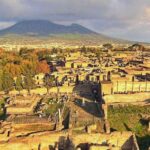
Herculaneum, Vesuvius, and Pompeii in one day is a lot to fit. The payoff is huge: you’ll go from a perfectly preserved Roman town to a smoking volcano viewpoint, then into the ruins of Pompeii with an audio guide and map. I like that this tour handles the transport so you don’t have to figure out buses, and I also like that the stops are timed so you get a real taste of each site. One thing to watch: it’s a long, walking-heavy day, and Pompeii can feel rushed if you want slower, deeper exploring.
The biggest strength for me is the way the day is structured around time at three major sites. You get about 2 hours at Herculaneum, an allocated chunk on Vesuvius for the crater views, and then 2 hours at Pompeii with an audio guide and detailed map. Add air-conditioning on the vehicle, and it becomes a practical way to “do the classics” from Naples without needing a car.
The main drawback is that not every part is equally guided, and technology can be picky. Herculaneum is set up as self-guided, and Pompeii is audio-guided—so if your audio device or earphones aren’t working well, you’ll feel it. Also, while the tour lists a small max group size, you may still experience a busier feel depending on the day.
In This Review
- Key points to know before you go
- Naples pickup that sets the tone
- Herculaneum ruins: self-guided, compact, and easier to read
- Vesuvius National Park: crater views, steep terrain, and timing pressure
- Pompeii with audio guide and map: what you can realistically cover in 2 hours
- Group size, bus logistics, and how to keep your day smooth
- Price and value: what $153.80 buys you
- Who this tour fits best (and who should choose differently)
- Should you book the Herculaneum, Vesuvius, and Pompeii full-day tour?
- FAQ
- How long is the full-day Herculaneum, Vesuvius and Pompeii tour from Naples?
- Where is the meeting point in Naples?
- Is there an audio guide for Herculaneum and Pompeii?
- How long do you spend at each stop?
- What’s included in the ticket price?
- Can I cancel for a full refund?
Key points to know before you go
- Three major sites, one day: Herculaneum (2 hours), Vesuvius (about 3 hours total), and Pompeii (2 hours) in one loop from Naples
- Air-conditioned transport: helpful on a hot day when you’ll be sitting between stops
- Pompeii has audio + a detailed map: a built-in way to keep the chaos of ruins from swallowing your time
- Herculaneum is self-guided: you’ll rely on your own navigation and the site’s signage
- Expect a steep volcano walk: the crater area involves uphill terrain and limited-feeling facilities
- Group size can feel larger than promised: plan for a busier atmosphere than the max size suggests
Naples pickup that sets the tone
This is a full-day tour based out of Naples, with pickup and drop-off back at the same meeting point near Via Galileo Ferraris 40 (80146 Napoli). If you like precision, use the coordinates 40.8505189N, 14.2747942E on Google Maps to find the right area.
The first stop is basically the “start line”: about 20 minutes in Naples, which is enough time to board and get organized before you head out. Practically, this matters because the day’s schedule is built on momentum—if you show up late, you’ll feel it later when you’re trying to catch time at the sites.
One more detail that helps: the meeting point is near public transportation, so if you’re coming from somewhere else in Naples, it’s easier to get yourself there on time. The tour is also designed for a moderate physical fitness level, which is important later at Vesuvius.
You can also read our reviews of more tours and experiences in Naples



Herculaneum ruins: self-guided, compact, and easier to read
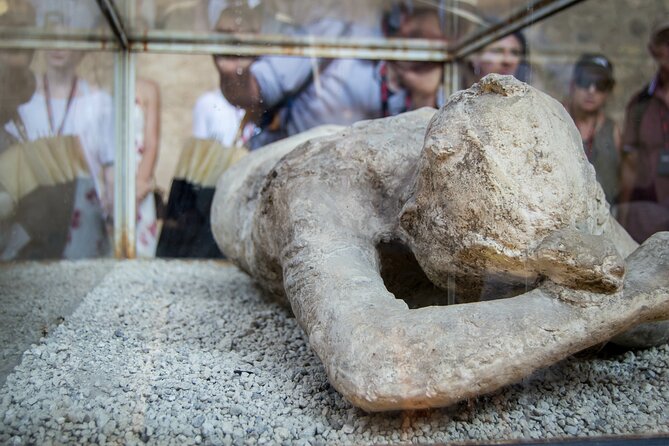
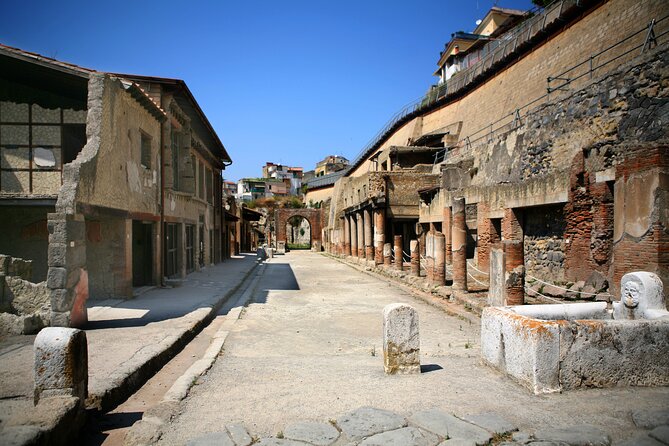
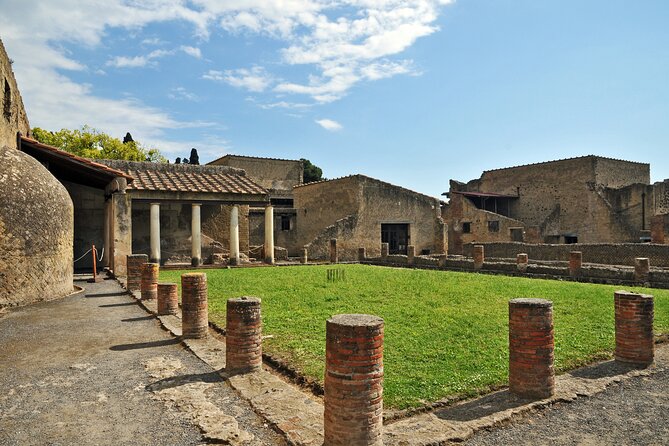
Herculaneum is often described as smaller than Pompeii, but don’t let that fool you. You’re still looking at a whole Roman world preserved under volcanic ash since 79 A.D. The tour gives you around 2 hours at the Archeological Park of Herculaneum and does it in a self-guided style—no audioguide included here.
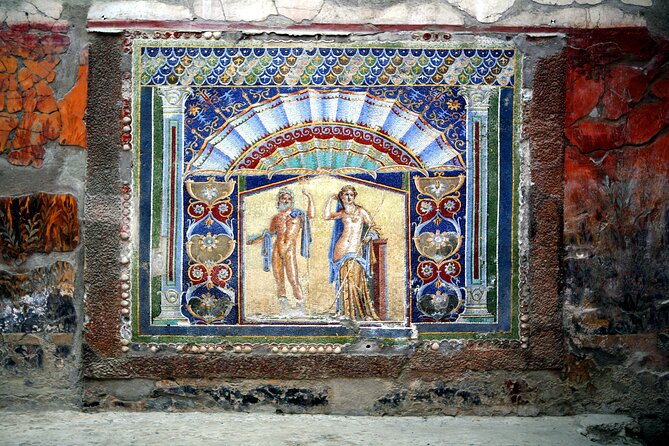
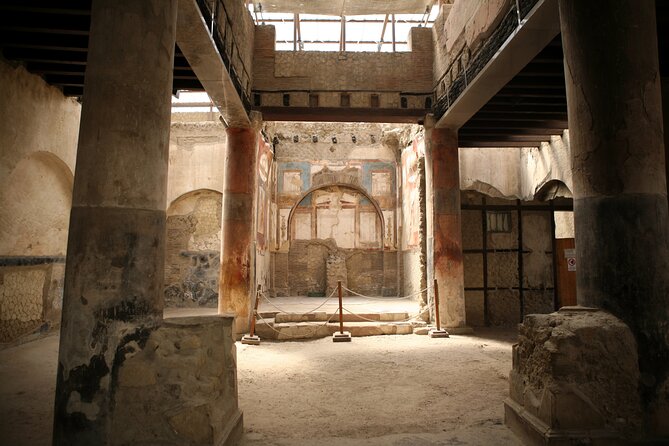
That’s actually a good fit for many visitors. The ruins are arranged in a way that’s fairly straightforward to wander through: you’ll see houses and villas with notable frescoes, plus the street grid and temple areas. If you’ve ever felt overwhelmed at a huge archaeological park, Herculaneum can feel more manageable because you can cover more ground without needing to “fight” a million choices.
Here’s the trade-off. Since it’s self-guided, you won’t have a spoken narration steering you from highlight to highlight. That’s fine if you’re comfortable reading signage and noticing details, but it can feel slower if you prefer a guided storyline. If you like to move quickly and see key buildings fast, give yourself permission to prioritize what you want—frescoes, streets, or temples—because 2 hours goes by.
Facilities are available at the site, so this is also a good place to reset before Vesuvius if you’re planning around walking and timing. After Herculaneum, you’ll transfer toward the volcano with the schedule already in motion.
Vesuvius National Park: crater views, steep terrain, and timing pressure
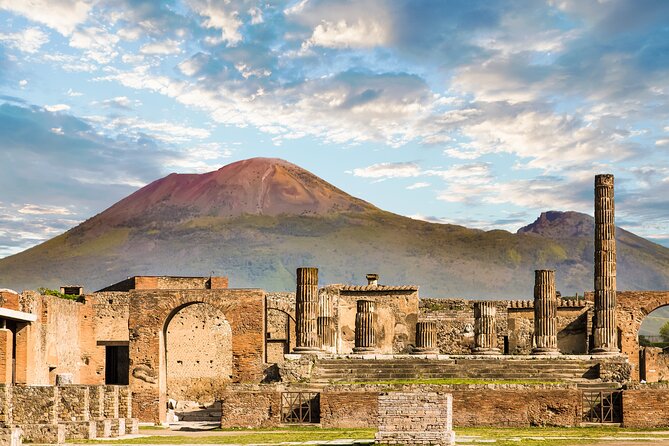
This is the dramatic middle of the day. Vesuvius is scheduled as about 3 hours total, with around 1.5 hours of free time to reach the crater area and visit the top. The bus takes you up by about 1,000 metres of elevation, so you’re not starting from sea level—but you’ll still deal with the uphill parts on foot.
The payoff is exactly what you hope for: fumaroles, the crater viewpoint, and panoramic views across the Naples region—often including sights like Capri, Ischia, Procida, Naples, and Pompeii from above. That kind of “from-the-skyline” perspective is hard to replicate elsewhere, and it’s one of the best reasons to do Vesuvius as part of a single-day combo rather than as a separate, stand-alone trip.
Now for the practical part: expect a steep walk near the top. One reviewer noted a roughly 20-minute walk to the highest point, and it being steep enough to make you work for the views. You’ll also want to manage restroom timing. Facilities exist, but they can feel limited once you’re higher up the volcano.
Also, note that the day’s pacing means Vesuvius is both a highlight and a time-management test. If you get slowed down by steep terrain, you can feel pressure when you still need to make it to Pompeii with enough time left.
If you’re going to prioritize one site to “go all in,” Vesuvius is the one where that effort pays off fastest.
Pompeii with audio guide and map: what you can realistically cover in 2 hours
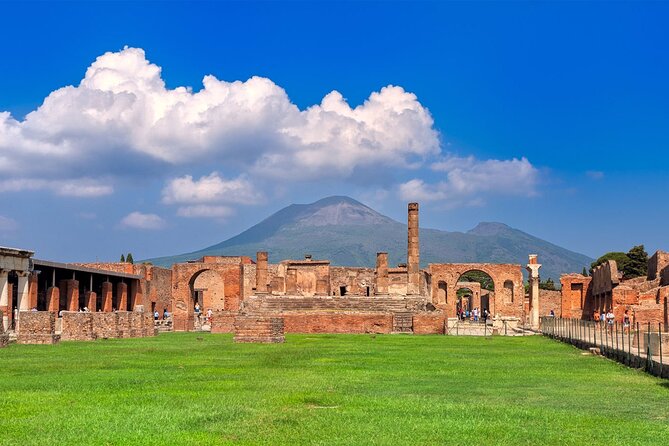
Pompeii is scheduled for about 2 hours at the Archaeological Park of Pompeii, and this portion is the most structured. You’ll get entry plus an audio guide with a detailed map, in English, to help you navigate the ruins.
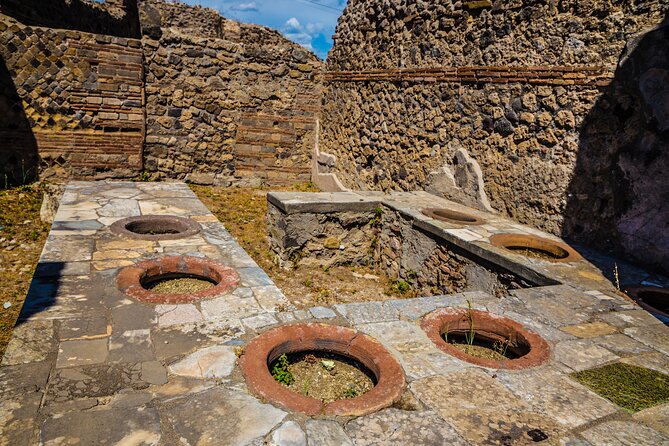
Within that time window, you can focus on major anchors: the Amphitheatre, the Thermopolis (a street-side food and drink stop), several temples, and standout Roman houses like the Casa del Fauno. In other words, you get a “greatest hits” route rather than a slow, museum-style visit.
This is where the audio guide matters. Pompeii is big, and the park isn’t designed to be instinctively obvious in every corner. An audio track plus a map gives you a fighting chance to see the highlights without losing time. That said, if your audio device or earphones aren’t reliable, the experience can stall because you’ll lose your navigation help.
Two more practical realities to plan around:
- 2 hours is short. If you want a deeper dive into murals, household details, or side streets, you’ll feel time slipping away.
- Ruins are easy to misread. Even with a map, it helps to decide what you care about most—big public spaces like the amphitheatre, or residential areas like Casa del Fauno—because you can’t cover everything in one sprint.
If you’re the type who likes to stop often and read everything, consider this tour as a strong introduction. If you want transportation plus a guided route through the main highlights, this is exactly the right format.
Group size, bus logistics, and how to keep your day smooth
The tour is capped at a maximum of 17 travelers, and it’s built as a small-group day trip. In practice, group size may still feel larger depending on how the operator loads vehicles that day—so expect the day to be social and organized, but also potentially a bit crowded.
One thing that helps: the transport is handled with an air-conditioned vehicle, which matters when you’re spending time sitting between stops. Another helpful detail from the experience pattern is that pickups can be handled by multiple vans, which can reduce long waits if you’re joining the group from the Naples meeting point.
The real scheduling challenge is the combination of walking + transfers + time windows at each stop. The day is roughly 8 hours 30 minutes, and you’ll likely rack up a solid amount of walking—especially at Vesuvius, where the terrain is steep and your time is best used carefully.
If you’re trying to fit this into a tight itinerary in Naples (like a cruise day), build in extra buffer. Getting back on schedule can be close when the day runs late. The tour’s structure is designed to keep moving, but volcano days have a way of adding variables—weather, crowds, and how quickly people move through uphill sections.
My best advice: treat Pompeii time as “highlight time,” not “everything time,” and treat Vesuvius time as “earn the view” time. When you approach it that way, the whole day feels like a win.



Price and value: what $153.80 buys you
At $153.80 per person, this tour is priced like a day trip that bundles serious logistics. The value comes from three places:
- Transport from Naples with an air-conditioned vehicle
- Included entry tickets for Herculaneum, Pompeii, and Vesuvius
- Audio guide + map for Pompeii, which helps you make the most of limited time
If you were to piece these pieces together yourself—tickets, reliable transit, and navigation—the cost can add up fast. This tour also saves you from the mental burden of coordinating between three separate sites on a single schedule.
Where the value balance shifts is guidance depth. Herculaneum is self-guided and Pompeii is audio-guided for a short window. So you’re buying access and route structure, not a full, slow, deep narrative at every stop. If what you want most is guided history and plenty of time to linger, you might prefer a longer Pompeii-focused tour or a private guide.
But if you want to see the big three from Naples in one day, this price can feel fair—especially because the volcano viewpoint is so often the hardest logistics piece to manage independently.
Who this tour fits best (and who should choose differently)
This tour is a strong match if you want a one-day overview of Herculaneum, Vesuvius, and Pompeii with built-in transportation and tickets. You’ll likely enjoy it most if you’re comfortable with self-guided wandering at one site and audio-guided navigation at another.
It’s also a good pick if you don’t want to deal with driving or multi-leg public transit. The Naples pickup/drop-off helps a lot, and the English offering makes it straightforward to follow.
I’d be cautious if any of these apply:
- You hate tech dependence. Audio devices can be finicky, and the Pompeii audio route is part of how you get value in the limited time.
- You want a lot of free time at Pompeii. Two hours is enough for highlights, not a full “read the whole city” visit.
- You’re sensitive to steep walking. Vesuvius involves real uphill effort near the top.
If you’re a moderate walker and you’re okay moving at an efficient pace, this can be an excellent way to check the major sites off your Naples trip without spending your whole day figuring things out.
Should you book the Herculaneum, Vesuvius, and Pompeii full-day tour?
I’d book this tour if your goal is simple: see Herculaneum and Pompeii plus get Vesuvius crater views, all without transportation headaches. The included tickets and Pompeii audio map do real work, and the combination is hard to replicate as efficiently on your own.
I wouldn’t book it if you’re looking for slow, fully guided time at each site. The format is compressed by design: 2 hours at Herculaneum, 3 hours with a crater walk at Vesuvius, and 2 hours at Pompeii. If you want depth over speed, you’ll likely feel the time limits.
If you do book, come prepared for a long walking day, and plan your Pompeii “must-see” list ahead of time. You’ll enjoy the day much more when you treat it like a smart highlight route—not a museum tour with no schedule.
FAQ
How long is the full-day Herculaneum, Vesuvius and Pompeii tour from Naples?
The tour runs about 8 hours 30 minutes (approx.), with time allocated at each site.
Where is the meeting point in Naples?
It starts at Via Galileo Ferraris, 40, 80146 Napoli NA, Italy, near the Via Galileo Ferraris area. The tour also provides coordinate guidance: 40.8505189N, 14.2747942E.
Is there an audio guide for Herculaneum and Pompeii?
Herculaneum is visited without an audioguide as part of this tour format. Pompeii includes an audio guide with a map to help you visit the ruins.
How long do you spend at each stop?
You get about 2 hours at Herculaneum, about 3 hours total at Vesuvius (including about 1.5 hours of free time to reach the crater), and about 2 hours at Pompeii.
What’s included in the ticket price?
The price includes an air-conditioned vehicle, entry tickets for Herculaneum, Pompeii, and Vesuvius National Park (including a VESUVIO entrance ticket), plus the Pompeii audioguide with map.
Can I cancel for a full refund?
Yes. You can cancel up to 24 hours in advance for a full refund. If you cancel less than 24 hours before the start time, the amount paid is not refunded.