REVIEW · NAPLES
Skip the Line Ancient Herculaneum Walking Tour with Top Rated Guide
Book on Viator →Operated by Herculaneum Tours · Bookable on Viator
Herculaneum feels closer than you expect. This skip-the-line walking tour is built for quick, smooth entry and then a guided route through the parts of the site that help you picture daily Roman life. I especially liked how you get an expert to explain what you’re looking at, and I liked the small-group feel that keeps questions from getting lost.
One thing to consider: at $215.05 per person for about 2 hours, it’s a higher-than-average ticket, so it’s best if you value strong interpretation (not just photo stops). You’ll also want solid shoes, since you’re walking on ancient-site terrain even though the pace is guided and manageable for many people.
In This Review
- Key highlights worth planning for
- Why Herculaneum’s layout makes a short guided walk work
- Price and time: what $215.05 really buys you
- Skip-the-line entry at Ercolano Scavi: the calm start you want
- Parco Acheologico di Ercolano: your first guided hour(s)
- Roman houses, shop doors, and the thermal baths in 20 minutes
- Casa di Nettuno e Anfitrite: myth, space, and quick context
- College of the Augustales: learning to spot civic meaning
- La Terrazza di M. Nonio Balbo: why viewpoints matter
- Casa del Rilievo di Telefo: the reliefs that anchor the story
- Who this tour suits best (and who should reconsider)
- Should you book Skip-the-Line Ancient Herculaneum Walking Tour?
- FAQ
- How long is the Ancient Herculaneum walking tour?
- What language is the tour offered in?
- Is admission included?
- Does the tour include skip-the-line tickets?
- Where does the tour start and end?
- Is hotel pickup included?
- Is the tour private or small-group?
- What kind of fitness level do I need?
- What should I know about weather?
- What is the cancellation window?
Key highlights worth planning for
- Skip-the-line tickets to cut the worst waiting at the entrance
- Small-group attention with time for questions and context
- A professional art historian guide plus a local guide for different layers of meaning
- Stop-by-stop focus on major houses and standout ruins, not a rushed blur
- Specific household sites like Casa di Nettuno e Anfitrite and Casa del Rilievo di Telefo
- Admission tickets included as you move between the key areas
Why Herculaneum’s layout makes a short guided walk work
If you’ve only seen ruins from far away, Herculaneum can surprise you. Pompeii grabs attention with scale, but Herculaneum often feels more human because the remains include more of the built-in spaces people actually used.
This tour fits that strength. In about 2 hours, you don’t try to conquer the whole archaeological area. Instead, you follow a guided path that hits major highlights—then you get help reading them. That matters because the site is full of details that are easy to miss when you’re on your own.
A good guide also changes the experience from look-and-move to look-and-understand. You’ll get context that turns stone, thresholds, and room layouts into something closer to a real home.
You can also read our reviews of more walking tours in Naples



Price and time: what $215.05 really buys you
At $215.05 per person, this isn’t the cheapest way into Herculaneum. But it’s priced like an interpretation-focused tour: guides, skip-the-line entry, and admission included along the route.
Here’s the practical way to judge value. If you’re the type who enjoys history only when it’s explained clearly—family life, public routines, how spaces were used—this price can feel fair. You’re not just paying for access. You’re paying for someone to point out the why behind what you see.
Also, you’ll spend less time stuck in entrance chaos because the tour is built around guaranteed line-skipping. That saves energy, not just minutes. For a short, high-impact visit, that’s worth real money.
One more cost-related point: the tour does not include hotel pickup and drop-off. So you’ll want to factor in how you’re getting to the meeting point in Ercolano.
Skip-the-line entry at Ercolano Scavi: the calm start you want
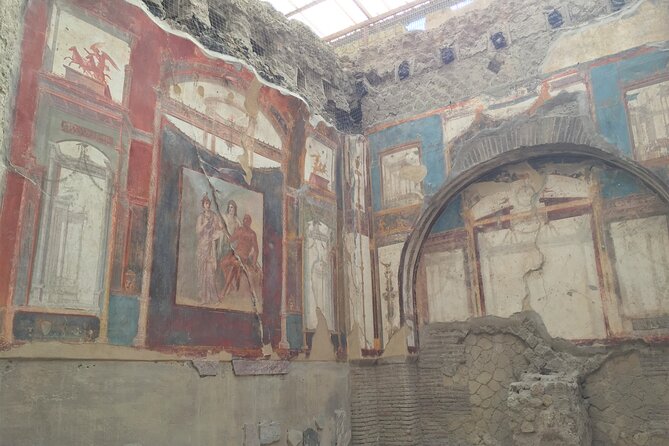
The tour starts at Ercolano Scavi 80056 Ercolano, Metropolitan City of Naples, Italy, and ends back at the meeting point. That back-to-the-same-place setup is useful. You’re not wandering around searching for where you parked or trying to catch a train after a long site visit.
The biggest win is the skip-the-line promise. On crowded ruins, entrance delays can steal your best hours. With the line-skipping approach, you start seeing things sooner and you’re less likely to feel like the day is being rationed.
On timing: the tour runs about 2 hours, so you should plan your day around it. Arrive with some buffer if you can, especially if you’re traveling from Naples. And bring the kind of patience you use at museums—because the guide will want you to slow down and look closely.
Weather-wise, the tour notes say it operates in all weather conditions and you should dress appropriately. If it’s canceled for poor weather, you’ll be offered another date or a full refund—so you’re not stuck if conditions go sideways.
Parco Acheologico di Ercolano: your first guided hour(s)
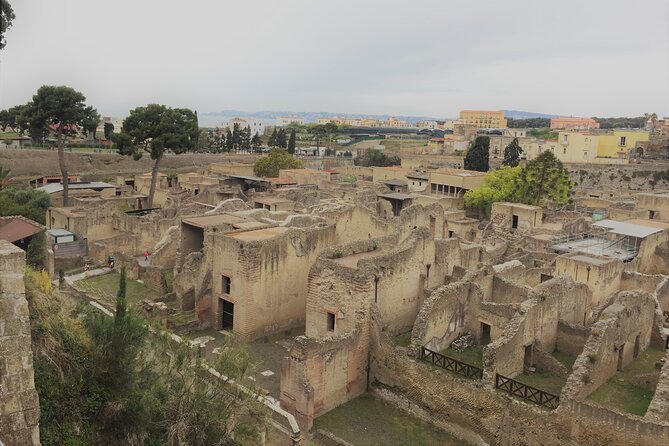
The first stop is Parco Acheologico di Ercolano, with a 2-hour private guided tour and admission included. This part matters because the guide sets the mental map. If you understand how the city is organized and what you’re looking at, every later stop lands harder.
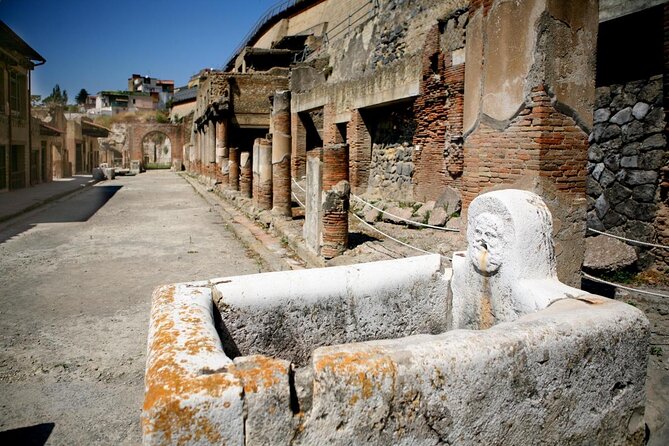
This is where you also learn to notice what’s actually preserved. Herculaneum’s appeal is that you can stand in a space and get clues about use—entryways, room flow, and the kinds of activities that were normal there.
The tour is described as giving “private lives” a sense of reality. That’s a good sign. It suggests you’ll get more than dates and names. You’ll get explanations tied to everyday routines: where people would gather, how homes were structured, and what the arrangement says about status and comfort.
Possible drawback: because you’re working with a short overall schedule, the first segment can feel like it’s setting you up for the rest rather than letting you linger. If you’re the type who wants to spend extra time photographing every wall detail, you may wish you had more hours on your own after the tour ends.
Roman houses, shop doors, and the thermal baths in 20 minutes
Next comes the Herculaneum Tours segment, which runs about 20 minutes with admission included. This is a fast but high-yield stretch. The idea is to help you imagine daily Roman life in the spaces you’ll recognize as homes and civic-commercial areas.
Three details in the description are especially useful because they signal the guide will point out specific things you can’t count on noticing alone:
- Roman houses where you can picture ordinary family rhythms
- Original doors and shop furniture, which are the kind of artifacts that make the past feel tactile
- Thermal baths, which are often the social center of Roman city life
Even in a short window, this approach gives you a “taste” of the city’s texture: threshold life, household life, and public bathing culture. If you care about how people spent time day-to-day, this is one of the sections that can make the whole visit feel coherent.
The trade-off is obvious: twenty minutes is not time to read every label and roam. You’ll likely feel the pace is guided and intentional—good for most people, but not for those who want a slow wander.
You can also read our reviews of more guided tours in Naples



Casa di Nettuno e Anfitrite: myth, space, and quick context
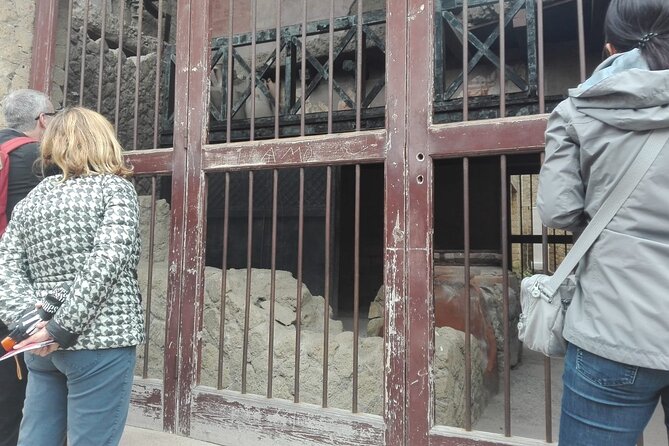
Casa di Nettuno e Anfitrite is a highlight stop lasting about 10 minutes, with admission included. The name alone tells you this is where myth meets architecture. The value here isn’t just a quick peek; it’s the guide’s explanation of what you’re seeing and why the space is linked to that theme.
In practical terms, a short stop like this works best when you know what to look for. With a guide leading the way, you can connect decorative and thematic elements to the household setting—who lived there, what they valued, and how imagery communicated taste and identity.
Drawback to keep in mind: ten minutes can feel tight if you’re a slow reader or if you stop often for photos. But if you want the highlights without turning Herculaneum into a half-day project, this time-boxing is exactly what makes a 2-hour tour work.
College of the Augustales: learning to spot civic meaning
The College of the Augustales stop also runs about 10 minutes with admission included. This site adds a public/civic layer to the day, so it’s not only about private homes.
The key here is context. A guide can help you understand how institutions and social roles show up in the physical layout. Even without a long visit, the interpretation can clarify why certain spaces felt important—who used them, what kind of status or ceremony they supported, and how the city’s culture was organized around roles and community life.
Because the stop is short, the guide’s ability to explain matters. In the reviews you’ll find strong praise for guides who keep things clear and answer questions. That’s what you want here: quick, accurate context that makes the ruins feel like part of a living system rather than isolated walls.
La Terrazza di M. Nonio Balbo: why viewpoints matter
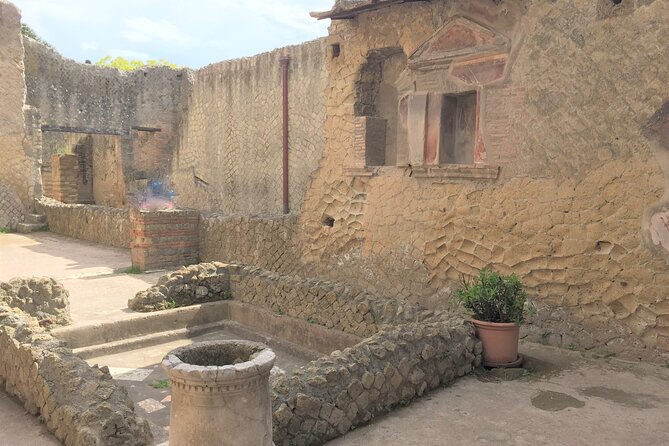
La Terrazza di M. Nonio Balbo is another about 10 minutes stop, with admission included. Terraces are valuable in ruins because they often show relationships between spaces: sightlines, airflow, and how the household interacted with the city around it.
A terrace also changes your perspective. After walking through rooms and doorways, you get a chance to see how height and openness could shape daily life. If the guide shows you how the space was meant to be used, it can turn a brief visit into something memorable.
Possible drawback: if you’re sensitive to crowds or weather, terrace time can feel exposed. The good news is that the stop is brief, so any discomfort is limited.
Casa del Rilievo di Telefo: the reliefs that anchor the story
The final highlighted stop is Casa del Rilievo di Telefo, also about 10 minutes with admission included. This is the stop that’s explicitly framed around the main feature: the relief work, tied to the story of Telephus.
A relief-focused site is perfect for a short guided tour because you can’t fully appreciate carving details without context. With the guide’s main-information framing, you’re not just seeing images—you understand what they depict and why that matters in a household setting.
If you love that moment when a place clicks—when you suddenly see what the artwork is doing and how it connects to the homeowner’s world—this is likely to be a highlight. The time limit still applies, though. If you want to stand and stare for a long stretch, this tour won’t give you that kind of freedom.
Who this tour suits best (and who should reconsider)
This tour makes sense if you want a focused visit with expert interpretation, including help putting private life, public roles, and key highlights into one narrative. The route is short, the group stays tight, and the guide-driven pacing keeps you from getting lost in the site.
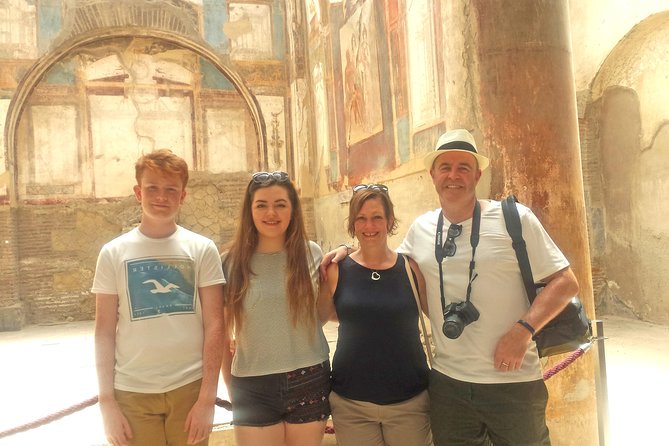
It’s also a good fit if you’re traveling with family or a mixed group. In feedback, the guide’s explanations are described as vivid and engaging for the whole family, and the tour is noted as not rushed.
Consider another option if:
- you prefer long independent wandering with lots of time at each stop, or
- you want to cover a bigger portion of Herculaneum than a tight highlight route, or
- you’re trying to stretch a very limited budget
Should you book Skip-the-Line Ancient Herculaneum Walking Tour?
I’d book it if your top priority is getting into Herculaneum quickly and having an art historian level guide translate the site into human terms. The combination of skip-the-line entry, admission included, and a schedule built around meaningful stops is a strong value package for a short stay.
I’d think twice if you’re price-sensitive and you’ll only skim the explanations. This is the kind of tour that rewards attention. If you show up ready to listen—ask questions, watch for the details your guide points out—you’ll leave with a clearer picture of how the city functioned.
One practical final tip: this tour is often booked about 47 days in advance on average. If you have a narrow travel window, don’t wait until the last week.
FAQ
How long is the Ancient Herculaneum walking tour?
It runs about 2 hours.
What language is the tour offered in?
The tour is offered in English.
Is admission included?
Yes. Admission tickets are included for the stops on the route.
Does the tour include skip-the-line tickets?
Yes. The tour includes guaranteed skip-the-line entry.
Where does the tour start and end?
It starts at Ercolano Scavi 80056 Ercolano and ends back at the meeting point.
Is hotel pickup included?
No. Hotel pickup and drop-off are not included.
Is the tour private or small-group?
It’s listed as private, and only your group participates.
What kind of fitness level do I need?
It’s recommended for people with moderate physical fitness.
What should I know about weather?
It operates in all weather conditions, so dress appropriately. If it’s canceled due to poor weather, you’ll be offered a different date or a full refund.
What is the cancellation window?
You can cancel for a full refund up to 24 hours before the experience start time. Free cancellation is available.