REVIEW · NAPLES
Naples Walking tour of the Historical Center
Book on Viator →Operated by Insolitaguida - Naples city tours · Bookable on Viator
A street walk in Naples can feel random. This one gets you reading the city like a map, with a smart guide and time in places most visitors skip. You’ll move through the old street grid and learn how Naples names, crafts, and legends fit together.
Two things I really like here are the off-the-beaten-path stop at Fontanelle Cemetery in a hillside cave, and the way the walk connects architecture with local folklore. The group stays small, so you get actual conversation instead of a human traffic jam.
One thing to consider: it’s about 2 hours on foot in the historic center, so if you don’t love walking or you’re sensitive to uneven streets, bring comfy shoes and keep your expectations realistic.
In This Review
- Key highlights you’ll feel on this walk
- Getting oriented fast: the walk starts at Piazza San Domenico Maggiore
- Spaccanapoli: the ancient street you’ll stop seeing as just a road
- Via San Gregorio Armeno: nativity crafts made year-round
- Basilica di San Lorenzo Maggiore: church, museum, and excavations in one stop
- Via dei Tribunali: the Greek road axis under today’s names
- Campanile della Pietrasanta: a bell tower that feels like a remnant
- Fontanelle Cemetery in a hillside cave: where folklore becomes architecture
- Coffee and sfogliatella: the included break that makes the timing work
- Price and value: what $120.68 buys you in Naples center
- Who should book this walk (and who might want a different plan)
- Should you book this Naples Historical Center walking tour?
- FAQ
- How long is the Naples Walking tour of the Historical Center?
- Where does the tour start, and does it end nearby?
- Is the tour offered in English?
- What is the maximum group size?
- What’s included during the walk?
- Does the experience include Fontanelle Cemetery?
- Can children or service animals join?
Key highlights you’ll feel on this walk
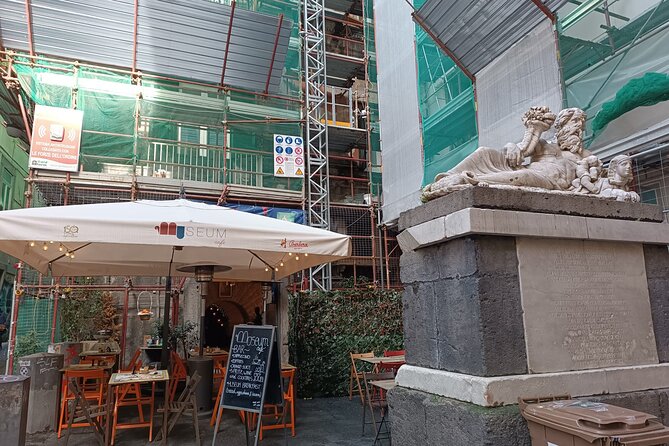
- Small-group attention (max 20) keeps the pace human and the answers specific
- Spaccanapoli: an ancient spine of Naples, known by a common name that locals actually use
- San Gregorio Armeno nativity workshops: year-round craft shops making both traditional and topical figurines
- San Lorenzo Maggiore: one of the city’s older churches linked to archaeological access
- Pietrasanta bell tower: a standout remnant that sits isolated with views toward two streets
- Fontanelle Cemetery: a hillside cave setting that makes the folklore feel physical
Getting oriented fast: the walk starts at Piazza San Domenico Maggiore
You’ll begin at Piazza San Domenico Maggiore, a good staging point because it’s central and easy to find once you’ve got the neighborhood vibe. I like that the tour ends back at the meeting point, so you’re not trying to reverse-engineer where you are after your feet are tired.
This is a city-center walk built for short stops and quick context. You’re not racing. You’re learning why these streets and buildings matter, which is what turns Naples from noise into sense.
The tour is offered in English, which matters here because local details can get lost if you’re just reading plaques. If you’ve got questions, a local guide can usually steer you toward what’s worth noticing next.
You can also read our reviews of more walking tours in Naples



Spaccanapoli: the ancient street you’ll stop seeing as just a road
Spaccanapoli is one of those Naples names that sounds like folklore, but it’s also geography. It runs through the ancient center along what’s often described as the lower decumanus, and in the central area you’ll also hear the official street names via Benedetto Croce and via Forcella. Locals keep calling it Spaccanapoli because it’s easier than any official map label.
What I like is how the tour treats Spaccanapoli like a timeline. You’re not only looking at buildings; you’re tracing how the street’s role in the city still shows up today—commercial life, foot traffic, and the overall rhythm of the historic core.
A drawback to expect: this street can be lively. Even if the tour keeps its group tight, you’ll still feel the everyday energy of the area. That’s not a problem, but it does mean you won’t be standing alone for perfect photos.
Via San Gregorio Armeno: nativity crafts made year-round
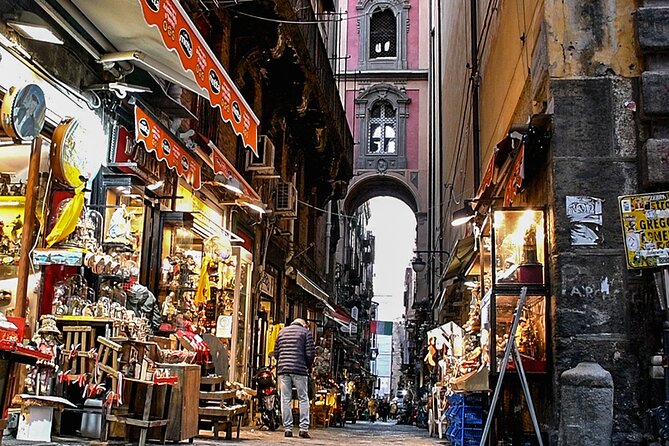
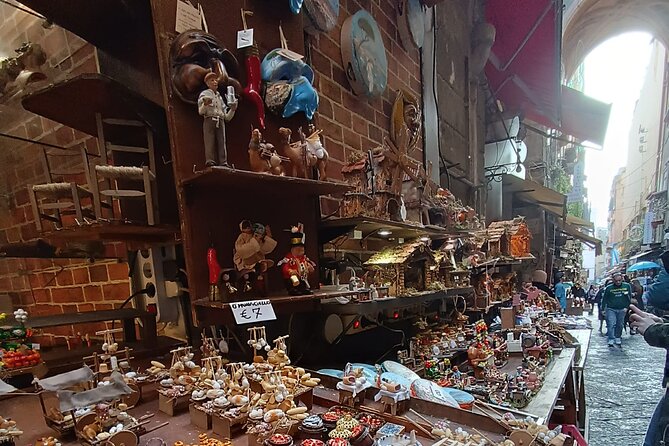
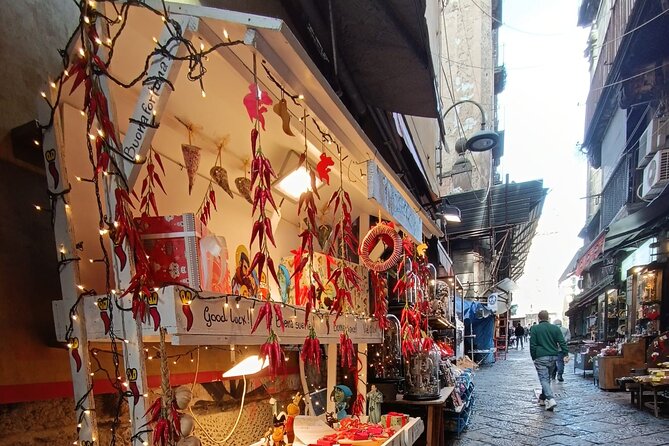
Next you’ll head to Via San Gregorio Armeno, famous for artisan shops that sell nativity-scene figurines. The interesting part isn’t just that it’s tourist-friendly. It’s that the street functions as a year-round exhibition space for craft workshops.
Today those makers produce both canonical characters and original ones. What really makes this stop click is the idea of figurines that respond to the year—eccentric artisans creating characters with topical features, sometimes landing as playful satire and sometimes more biting. A normal souvenir store sells one “look.” Here, you get a sense of how Naples processes current events through craft.
If you like design and handwork, this is the moment to slow down. Even a quick browse can teach you what kinds of styles and poses are popular right now—so when you see figurines later in another shop, you’ll know what you’re looking at.
Basilica di San Lorenzo Maggiore: church, museum, and excavations in one stop
At Basilica di San Lorenzo Maggiore, you’re in a monumental church complex that sits in the historic center near Piazza San Gaetano. It’s described as one of Naples’ older basilicas, which helps explain why it feels “built-in” to the neighborhood rather than like a standalone attraction.
What makes this stop more valuable than a quick exterior photo is the connection to the Museo dell’Opera di San Lorenzo Maggiore. That museum link also ties to access for the homonymous archaeological excavations, giving you a chance to see how the site layers time on top of time.
The trade-off is time. With only about 2 hours total, you won’t get a museum marathon. You’ll get just enough to understand the significance, then you move on before the walk gets too heavy.
Via dei Tribunali: the Greek road axis under today’s names
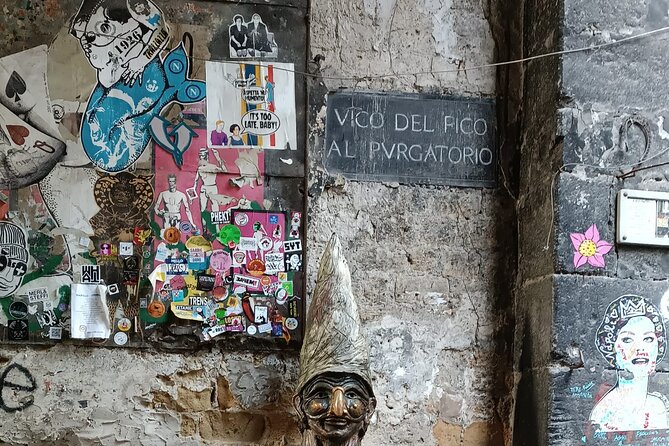
Via dei Tribunali is where the city’s ancient logic gets more interesting. This street is described as the decumanus major in the historic framework, and it lines up with today’s via dei Tribunali while still reflecting the ancient Greek road axis. The tour also flags something helpful for your brain: it’s more accurate to think in Greek terms with plateia rather than the Roman decumanus label, which came later by convention.
It’s a small linguistic detail, but it changes how you read the street. Instead of treating it like a random “old street,” you start seeing it as part of a planned urban structure that outlasted empires and naming systems.
Also, keep an eye on where you stand. The architecture and street geometry can make you feel like the city is guiding you. When you know the axis idea, you’ll notice how streets line up and how movement funnels through the center.
You can also read our reviews of more historical tours in Naples




Campanile della Pietrasanta: a bell tower that feels like a remnant
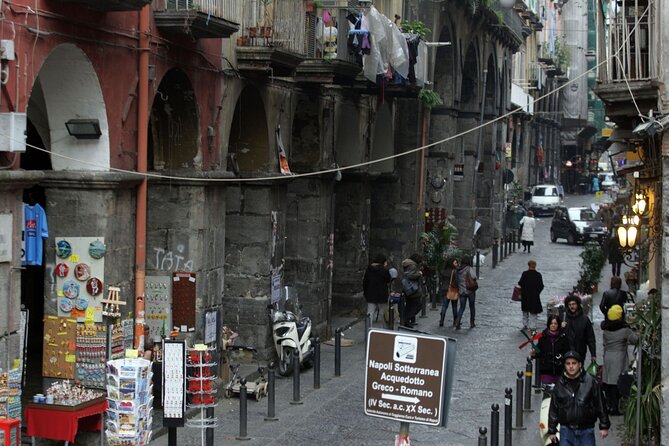
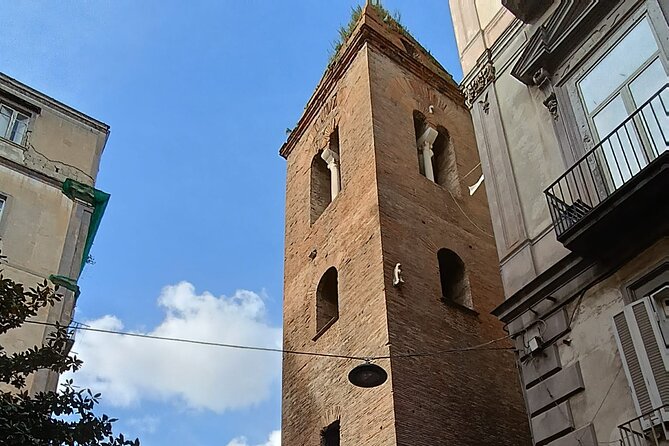
Next is the Campanile della Pietrasanta, the bell tower of the Pietrasanta church. Here’s the specific detail I love: it’s described as the only remnant of the primitive version of the church, and it sits isolated with facades open to via Tribunali and also via del Giudice.
That “two-street visibility” is a nice trick for your senses. You can look one direction and then immediately pivot and see how the tower interacts with the surrounding streetscapes. It gives you a more three-dimensional sense of the neighborhood than you’d get from just looking at facades at street level.
One consideration: bell towers are tall, and Naples streets are close. You might want to keep your phone handy for a couple quick shots, but don’t stare down your camera the whole time. The tower works better when you also take in the street alignment around it.
Fontanelle Cemetery in a hillside cave: where folklore becomes architecture
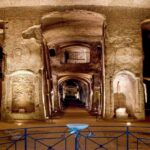
This tour’s off-the-beaten-path angle comes through with a stop at the Fontanelle Cemetery, described as set in a hillside cave. Even if you’ve heard general things about this site before, being there with a guide changes the feel. The setting—carved space in a hillside—means you’re not just learning facts; you’re seeing how the physical environment shapes the stories people attached to it.
This is also where the “local folklore and architecture” promise matters most. The tour doesn’t treat the cemetery like a checklist item. It frames it so you understand why people responded to it in the way they did, and how Naples turns even difficult spaces into part of its identity.
Because this is a cave-like environment, plan for cooler or more enclosed conditions than the street. Wear layers you can manage, especially if the day swings in temperature.
Coffee and sfogliatella: the included break that makes the timing work
Included with the tour are coffee and/or tea plus a sfogliatella. That’s a practical little gift because it helps you keep energy up during a concentrated 2-hour walk.
Sfogliatella is one of those Naples specialties that’s easy to overthink and hard to beat. The value here isn’t only the snack—it’s that the break keeps the pace comfortable, so you don’t spend the back half of the tour speed-walking from stop to stop.
And yes, the tour notes Neapolitan coffee as a highlight. Whether you’re a coffee person or not, you’ll at least get a local taste of the city’s morning-and-midday rhythm.
Price and value: what $120.68 buys you in Naples center
The price is $120.68 per person for about 2 hours. That’s not “cheap,” so the question becomes: what makes it worth it?
First, you’re paying for a professional and local guide who can connect the dots between street names, old urban planning concepts, craft traditions, and a cave cemetery stop. If you try to DIY this, you’ll likely pick some places and miss the connections that make the walk feel cohesive.
Second, it’s capped at 20 travelers, which keeps it from turning into a herd. In Naples, crowd density can be a problem fast, and a smaller group helps you ask questions and actually hear answers.
Third, the tour includes the coffee/tea and sfogliatella. Even if you buy snacks on your own, this inclusion makes the experience feel more “package complete” for the time you’re spending.
Finally, the stops listed have free admission tickets for those specific components, so you’re not stacking entrance fees on top of the price. That’s part of the value math.
One practical note: the tour is commonly booked about 23 days in advance on average. If you have fixed plans, lock in early rather than waiting for a last-minute price drop.
Who should book this walk (and who might want a different plan)
This tour is best for you if you want Naples with context. You like small-group experiences, and you enjoy learning why streets and landmarks matter—especially when the guide ties them to local ways of thinking.
It’s also a smart choice if you’re interested in craftsmanship. Via San Gregorio Armeno is a strong fit for anyone who likes handmade objects and wants to see how nativity figures connect to Naples’ sense of humor and timing.
You might consider a different plan if you have limited mobility or you don’t handle uneven historic streets well. The tour is described as most travelers can participate, but it’s still a walking experience with several short stops.
Should you book this Naples Historical Center walking tour?
Yes, I’d book it if you want a tight, organized way to understand the Historical Center instead of wandering without a thread. The combination of Spaccanapoli, San Gregorio Armeno craft culture, San Lorenzo Maggiore’s museum link, and the cave setting at Fontanelle Cemetery makes the experience feel more like a story than a route.
If you can handle a couple hours on foot and you want a small group with real guidance, this is a strong value at its price point—especially with the included coffee/tea and sfogliatella doing real work for your energy.
FAQ
How long is the Naples Walking tour of the Historical Center?
The tour lasts about 2 hours.
Where does the tour start, and does it end nearby?
It starts at Piazza San Domenico Maggiore (P.za S. Domenico Maggiore, 80134 Napoli, Italy) and ends back at the meeting point.
Is the tour offered in English?
Yes, it’s offered in English.
What is the maximum group size?
The tour has a maximum of 20 travelers.
What’s included during the walk?
You get a professional and local guide, plus coffee and/or tea and a sfogliatella.
Does the experience include Fontanelle Cemetery?
Yes. The tour highlights include exploring Fontanelle Cemetery, set in a hillside cave.
Can children or service animals join?
Children must be accompanied by an adult. Service animals are allowed.