REVIEW · NAPLES
Pompeii and Herculaneum led by an Archaeologist with private transport
Book on Viator →Operated by Askos Tours · Bookable on Viator
Pompeii plus Herculaneum in one day is a big ask. What makes this tour work is the archaeologist-led pacing through standout houses and monuments, paired with private, air-conditioned transport so you’re not fighting trains, buses, or lines between sites. My favorite part is that the guide points out details you’d likely miss on your own, like why certain rooms matter and what the volcanic evidence really means. The main drawback to plan for is a long, walking-heavy day with lots of short stop times, so comfortable shoes and stamina matter.
Here’s the practical appeal for your trip: you get pickup around Naples, Salerno, Sorrento, or the Amalfi Coast area, then you start at Herculaneum before moving to Pompeii, with a lunch break in between that you can keep simple. If you want a route built around the key sights (and not wandering), this one is built for that. Also, Herculaneum entry is listed as 16 euros for adults, so double-check what your ticket bundle covers at booking so nothing surprises you.
In This Review
- Key points to know before you go
- A one-day combo that actually makes sense
- Private pickup and A/C rides across the coast
- Herculaneum: the quieter park that shows the details
- House of the Deer and the statue detail you’d miss
- La Terrazza di M. Nonio Balbo: power written into stone
- College of the Augustales: public religion in a civic setting
- Central Thermae: baths with separate doors
- Casa del Rilievo di Telefo: a house with a private edge
- House of the Skeleton and House of the Black Salon: tragedy and preservation
- The wooden partition and the layout of daily life
- One big value of Herculaneum on this tour
- Pompeii: iconic stops you’ll actually place in context
- Lupanar: the famous brothel lane
- Foro de Pompeya and the main street stroll
- Granaries of the Forum: everyday infrastructure with human stories
- Basilica and Stabian Baths: civic life and older thermal complexes
- House of Menander and House of the Faun: large homes, strong signals
- Teatro Grande and a quick look at Teatro Piccolo
- How the archaeologist guide changes what you notice
- Tickets and timing: what to plan for on a 7-hour day
- Price and value: why $666.75 can still be a smart buy
- Who should book this tour
- Should you book this tour?
- FAQ
- How long is the Pompeii and Herculaneum tour?
- Where can I be picked up?
- Is transportation private and air-conditioned?
- Does the price include admission tickets?
- Do I need to buy lunch during the tour?
- Is this tour only for my group?
- What language is the tour guide available in?
- What should I wear or bring?
- Are service animals allowed?
- Can I get a refund if I cancel?
Key points to know before you go
- Herculaneum first: you’ll see more while the crowds are lower, since Pompeii usually gets busier.
- Archaeologist guide on the ground: stop-by-stop context for houses, baths, forums, and theaters.
- Private A/C Mercedes transport: comfortable transfers between sites in Campania.
- Focused sight list: quick hits on famous spaces like the Lupanar and Pompeii’s forum area.
- Lunch break built in: you get time to eat on your own between Herculaneum and Pompeii.
- Pompeii Express admission included: your tour handles entry for both parks through that ticket arrangement.
A one-day combo that actually makes sense
If you only have one day in the Naples area, this is the kind of plan that can feel either genius or exhausting. The reason it can be genius here is timing and sequencing: you start at Herculaneum, then go on to Pompeii, rather than doing it the other way around and losing the quieter hours.
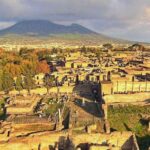
You’ll spend the day moving through two different preserved towns, each showing the eruption impact in a slightly different way. In conversations with guides who’ve run this route, you’ll often hear the comparison like this: Pompeii was hit by superheated ash that fell like a violent cover, while Herculaneum experienced destruction from fast-moving, high-temperature volcanic flows that produced a different kind of preservation. That contrast isn’t just dramatic—it changes what you can actually see when you walk through rooms, streets, and public spaces.
You can also read our reviews of more private tours in Naples


Private pickup and A/C rides across the coast
This tour leans hard into comfort and logistics. You can be picked up at your accommodation (or at the cruise port, train station, or airport), then transferred between sites in a private Mercedes with a professional driver. That matters because the time sink in this region is rarely the attraction itself—it’s getting from one place to the other without stress.
You’re also not stuck assembling a group or piecing together separate tickets and transport. You’ll start your Herculaneum walk by meeting the guide at the Herculaneum ticket office, and you’ll end with a return drop-off back to Naples, Salerno, Sorrento, or the Amalfi Coast area.
Practical tip: bring water and sunglasses. Even in a big shaded ruin site, summer sun can still get to you fast, and you’ll be outside during parts of both tours.
Herculaneum: the quieter park that shows the details
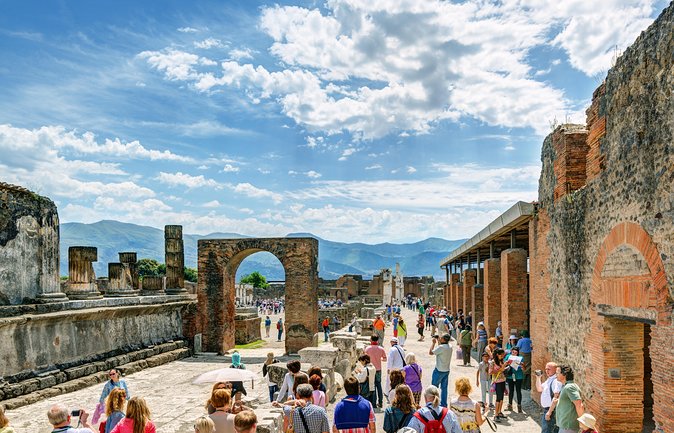
Herculaneum is smaller than Pompeii and often feels more intimate. That’s a good thing on a one-day schedule, because it gives the archaeologist space to point out specifics instead of just steering you along a giant crowd route.
You’ll begin with entry to the archaeological park, then continue through a series of focused stops—many around 10 to 15 minutes each. The goal is quality over quantity: you hit a range of houses and civic buildings so you understand how daily life worked.
House of the Deer and the statue detail you’d miss
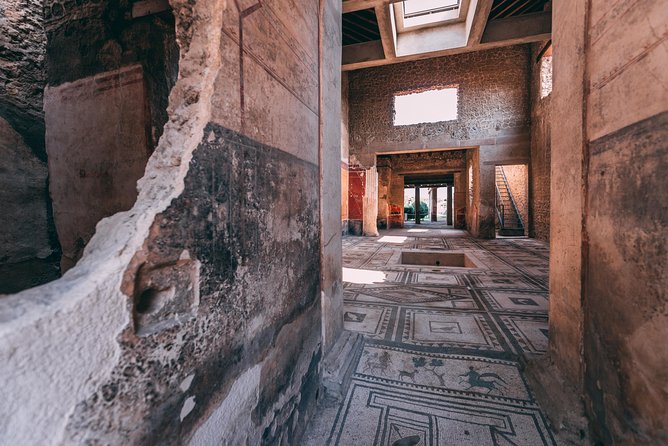
The House of the Deer gets its name from marble stag/deer statues in the peristyle area. If you’re used to thinking of Roman houses as plain walls and mosaics, this kind of stop reminds you that decoration wasn’t decoration-only. It was status and identity.
La Terrazza di M. Nonio Balbo: power written into stone
This stop ties a major benefactor to the city’s built environment. The long inscription on a funeral altar is the clue here—names, honors, and public contributions literally preserved in text. It’s the sort of thing that can be confusing if you’re self-guiding, because you might not know what the inscription is trying to prove.



College of the Augustales: public religion in a civic setting
The College of the Augustales is associated with the cult tied to Emperor Augustus and the Collegium Augustalium. Even if you don’t care about Roman politics, this helps you map how religion and civic life overlapped—especially through buildings that weren’t just temples, but community hubs.
Central Thermae: baths with separate doors
The Central Thermae were built around the start of the 1st century AD and were divided into men’s and women’s bathing areas, each with separate entrances. That’s a detail that changes your interpretation of the site. It’s not just a place to wash—it’s a social machine with rules baked into the building layout.
Casa del Rilievo di Telefo: a house with a private edge
Casa del Rilievo di Telefo is notable partly because it’s unusual in having private access to adjoining suburban baths. That private connection is the type of architectural quirk an archaeologist guide can explain in plain terms: how wealth showed up in everyday movement through the city.
House of the Skeleton and House of the Black Salon: tragedy and preservation
The House of the Skeleton takes its name from human remains found in a second-floor room in 1831. The House of the Black Salon is one of Herculaneum’s more luxurious mansions, including a monumental entrance where you can still see carbonised remains of doorposts and lintel.
Walking from one to the other, you get a strong emotional and historical contrast: the city’s refinement and the eruption’s violence, both present in the building fabric.
The wooden partition and the layout of daily life
Partem Domus lignea (Casa del Tramezzo di Legno) highlights an important wooden partition. Roman domestic life wasn’t only about stone and marble—it relied on materials that could survive in rare circumstances.
Then you’ll move through additional houses that show different cultural and architectural choices, including:
- Casa Sannitica: a layout typical of the Samnites, with a splendid atrium and a gallery with Ionic columns plus fresco decoration.
- Casa del Bel Cortile: an original plan with a courtyard, stairway, and stone balcony instead of a traditional atrium.
- House of the Grand Portal: a central-area domus with carved environments, frescoes, and charred remains of wooden parts.
One big value of Herculaneum on this tour
The big payoff here is understanding that Herculaneum isn’t just a set of ruins. It’s a series of preserved homes, baths, and civic structures where details help you reconstruct routine—where people walked, what they viewed, how they gathered, and how “private” and “public” were actually separated.
Pompeii: iconic stops you’ll actually place in context
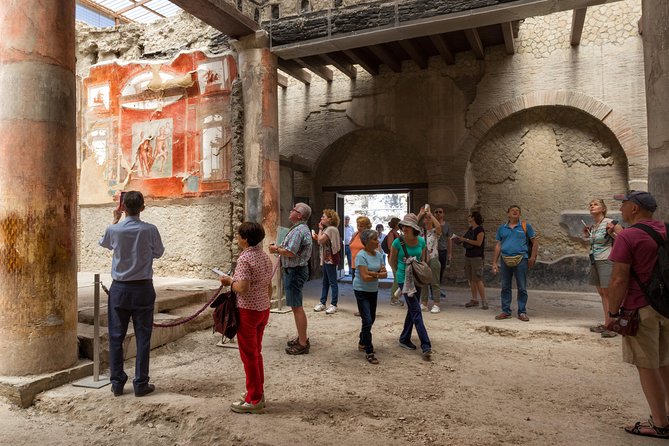
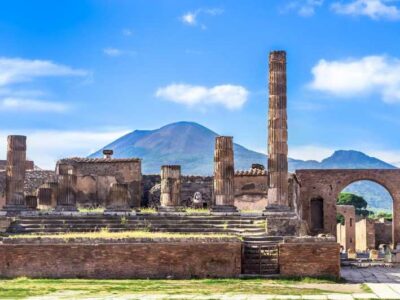
Pompeii is the headline. It’s larger, louder, and usually more crowded. That’s why this tour’s archaeologist-led rhythm matters: you’re less likely to get lost in the scale and more likely to connect what you see to why it exists where it does.
You’ll have free time to eat lunch on your own between the two sites. If you want to keep momentum, this is one place where you can make the day easier on yourself: eat, then use the remaining hours to keep moving through Pompeii’s key zones instead of lingering.
Lupanar: the famous brothel lane
The Lupanar is one of Pompeii’s best-known brothels. It’s also one of the places where a guide’s framing matters. Without context, you might only see shock-value details. With context, you start to understand how the city’s commerce and social systems fit into the built environment.
Foro de Pompeya and the main street stroll
You’ll look at Pompeii’s main square and then walk through the city’s main street. These are your orientation stops. They help you grasp Pompeii’s urban design so the homes and civic buildings start to feel connected, not random.
Granaries of the Forum: everyday infrastructure with human stories
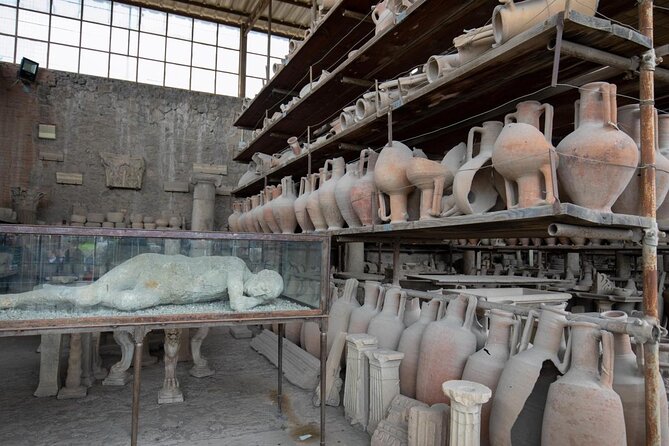
The granary shows marble tables and fountain basins at entrances, plus casts related to the eruption—victims, and even a dog and a tree. It’s unsettling, but it’s also powerfully instructive because it connects agriculture, supply chains, and daily survival to the eruption’s sudden end.
Basilica and Stabian Baths: civic life and older thermal complexes
The Basilica is described as an open portico where merchants and other activities took shelter. Then the Stabian Baths (Terme Stabiane) show a vast thermal complex and are noted as the city’s oldest thermal complex.
These stops do something simple but valuable: they show how public life worked before cars, before indoor work schedules, and before modern public buildings. You’re seeing spaces built to handle crowds, conversation, and routine.
House of Menander and House of the Faun: large homes, strong signals
The House of Menander is described as one of the richest and most magnificent residences in Pompeii, both architecturally and in decoration and contents. The House of the Faun is among the largest and most impressive private residences.
In your head, you might label these as “fancy houses.” A good archaeologist guide turns them into evidence: what wealth funded, how rooms were arranged, and what decoration signaled.
Teatro Grande and a quick look at Teatro Piccolo
You’ll visit Teatro Grande, Pompeii’s most important theater, then have a look at the Teatro Piccolo. Even if the time is short, theaters tell you how the city spent leisure and how entertainment fit into civic culture.
How the archaeologist guide changes what you notice
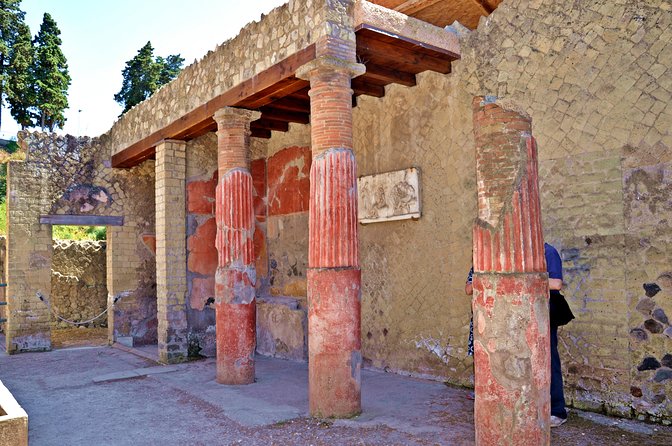
The biggest difference between a tour like this and going alone is not the transport. It’s the guide’s decision-making: where to stop, what to point out, and how to explain what you’re seeing in a way that sticks.
In the run of this day, you’ll get explanations tied to each kind of place:
- Houses with names linked to statues or construction quirks
- Civic buildings tied to cults, power, or community organization
- Baths with architectural evidence of gender-separation and routine
- Forum spaces that show the city’s “systems” (commerce, water, supplies)
- Theaters and streets that reveal leisure and flow
And you’ll likely hear the story from a working archaeologist rather than a generic script. Names you might encounter on this route include guides such as Lucio, Alfredo, Daniela (including Dr. Daniela), Ivan, and Benedetto, with drivers like Luigi and Giovanni also popping up in examples of past days. You won’t control which guide you get, but the pattern is consistent: people who understand excavation and daily Roman life are leading the walk.
Tickets and timing: what to plan for on a 7-hour day
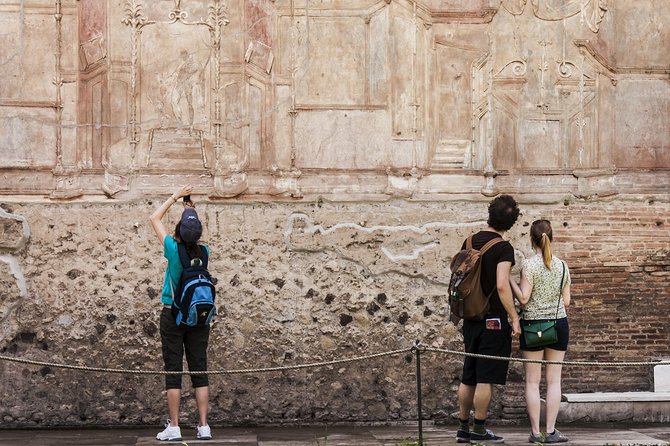
This is set up as a roughly 7-hour experience. That time includes pickup, transfers, and a guided walk with many short stops at both sites.
On tickets, the tour includes entry via a Pompeii Express ticket arrangement for both parks, but you should still pay attention because some details around admission are listed separately in the tour description. Also, the Herculaneum entry fee is listed as 16 euros for adults (and 2 euros for EU citizens 18–25). The safest move: when you book, confirm exactly what the Pompeii Express entry covers for your age and status so you don’t end up paying twice.
Timing reality check: many stops are around 10 to 15 minutes. That’s not a problem if you accept the goal: you’re seeing a curated slice of the sites, guided and explained, not trying to read every wall inscription on your own.
Price and value: why $666.75 can still be a smart buy
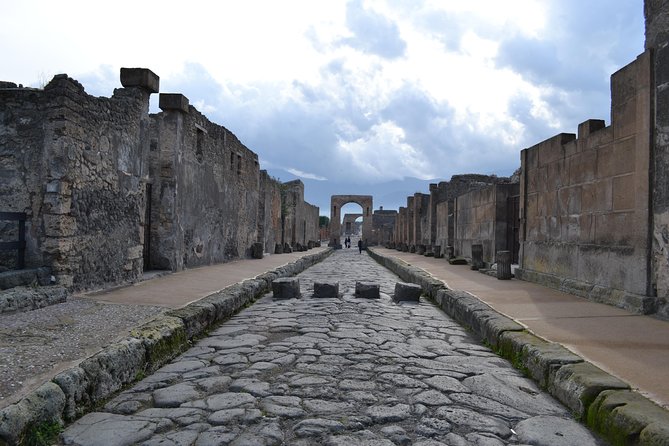
At $666.75 per person, this is not a budget outing. But value comes from the mix of things you’re getting together:
- Private A/C transport between two major UNESCO sites
- Pickup and drop-off around the Campania coast (not just one fixed hotel location)
- An archaeologist guide who handles interpretation and stop selection
- Included entrance tickets using the Pompeii Express arrangement
- A day that runs on a schedule, instead of you stitching together train lines, buses, and timed entry
If you’re traveling as a couple, a small family, or a group of friends who want the “see the best parts with context” approach, paying for private logistics can actually save time and stress. And time is money when you’re on a tight Italy itinerary.
Where value gets better: if you’re the sort of traveler who likes to ask questions and wants the sites to feel understandable. Where it gets worse: if your priority is long solo wandering and you love setting your own pace with no structure.
Who should book this tour
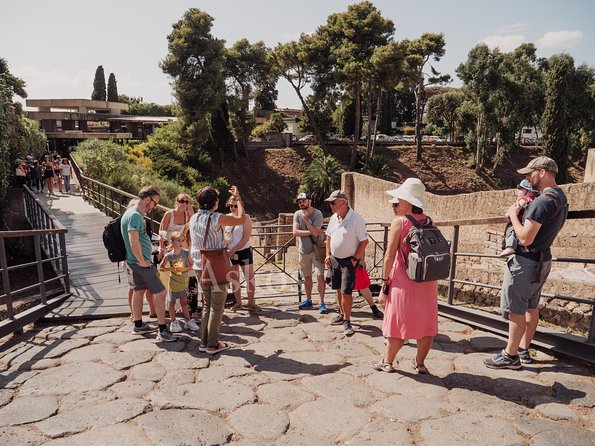
This tour fits you if:
- You have one day and want both Herculaneum and Pompeii without turning it into a logistical project
- You prefer guided interpretation over reading alone
- You want a plan built around major highlights like the Lupanar, forum area stops, baths, and famous houses
- You’d rather ride comfortably in A/C and spend your energy walking the ruins instead of transit
It’s also a solid choice for cruise days, since pickup can work from the cruise port and the company can adjust timing when ships arrive later, based on past examples from similar tours.
Should you book this tour?
I’d book it if you want a high-impact one-day Pompeii + Herculaneum plan that uses a real archaeologist to make sense of the buildings. The day’s structure—Herculaneum first, then Pompeii, with a lunch break in between—helps you get the key sights without chaos.
Skip it or reconsider if you dislike long walking days, because you’ll be on your feet for a while. Also, if you’re coming for deep, slow museum-style reading, this route is more “guided hits” than “everything at your own speed.”
FAQ
How long is the Pompeii and Herculaneum tour?
The tour lasts about 7 hours.
Where can I be picked up?
Pickup is offered from your accommodation in Naples, Salerno, Sorrento, or the Amalfi Coast, and it can also be arranged from the cruise port, train station, or airport.
Is transportation private and air-conditioned?
Yes. You travel in a private Mercedes with a professional driver.
Does the price include admission tickets?
The tour includes admission via the Pompeii Express ticket arrangement, including Herculaneum entry tickets and Pompeii Express entry tickets.
Do I need to buy lunch during the tour?
Meals are not included. Lunch time is built in as free time for you to have lunch on your own between Herculaneum and Pompeii.
Is this tour only for my group?
Yes. It’s a private tour/activity, so only your group participates.
What language is the tour guide available in?
The tour is offered in English.
What should I wear or bring?
Wear comfortable shoes. In summer, avoid flip flops. Bring sunglasses, sunscreen, and water.
Are service animals allowed?
Yes, service animals are allowed.
Can I get a refund if I cancel?
Free cancellation is available if you cancel at least 24 hours before the experience starts, for a full refund.