REVIEW · POMPEII
Pompeii Archaeological Small-Group tour for 15 people
Book on Viator →Operated by Askos Tours · Bookable on Viator
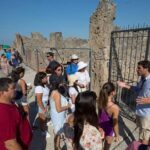
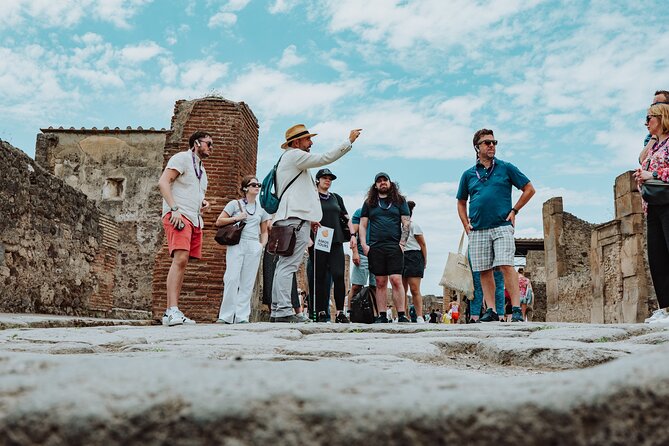
Pompeii hits harder when someone explains it. This 15-person small-group tour runs about two hours and threads you through the forum, houses, baths, and the city’s theater with an archaeological guide. I especially like how the tour names real places (like Porta Marina and Teatro Grande) so you stop feeling like you’re just wandering stones, even when the crowd is thick. Guides in this program include Mario Celebtano, Rafaelle, Antonella, Camillo Sorrentino, Nicoletta, Hugo, and Teresa, and the common thread is clearly their energy and preparation.
Two things I really like: the pacing (short stops, then move) and the way the walk connects everyday life—shopping in porticoes, public bathing, and even the Lupanar—to what you’re actually seeing. You also get Pompei Express entrance included plus headsets for groups of 10 or more, which helps a lot when Pompeii is noisy and crowded.
One possible drawback: this is not a full-day Pompeii plan. If you want every major site (like the Villa dei Misteri), you may need to add extra time on your own, because the tour finishes inside the ruins after its main circuit.
In This Review
- Key Points You’ll Care About
- A 2-Hour Pompeii Walk That Actually Feels Manageable
- Meeting at Porta Marina: Finding Your Guide Without Stress
- Porta Marina and the Merchant-Portico Feeling
- The Forum Square: Pompeii’s Main Public Stage
- Granaries, Marble Tables, Fountains, and the Casts
- House of Menander: Why the Decorations Matter
- Stabian Baths: The Oldest Thermal Complex in Town
- Lupanar: The Most Famous Brothel
- House of the Faun: Big, Impressive, and Tied to Status
- Teatro Grande: Pompeii’s Most Important Theater
- Headsets, Crowds, and Why Small Groups Matter Here
- Tickets and Price Value: What You Get for $77.06
- Where It Ends: Keep Exploring Without Starting Over
- Who Should Book This Pompeii Tour
- Should You Book It?
- FAQ
- FAQ
- What’s the duration of the Pompeii archaeological small-group tour?
- How big is the group?
- Is the tour offered in English?
- What’s included in the ticket price?
- What is not included?
- Where do I meet the guide?
- Where does the tour end?
- Does the tour provide headsets?
- Is cancellation free?
- Is the tour suitable for most people?
Key Points You’ll Care About
- Small group (max 15) keeps the pace human and questions possible.
- Included Pompeii entry (Pompei Express) saves time and hassle.
- Headsets for 10+ help you hear a licensed guide with an archaeological background.
- Forum to houses to baths to brothel to theater covers a wide slice of daily Pompeian life in 2 hours.
- Short 10–15 minute stop format makes it easier to stay focused when it’s hot or crowded.
- You end inside the ruins so you can keep exploring immediately afterward.
A 2-Hour Pompeii Walk That Actually Feels Manageable
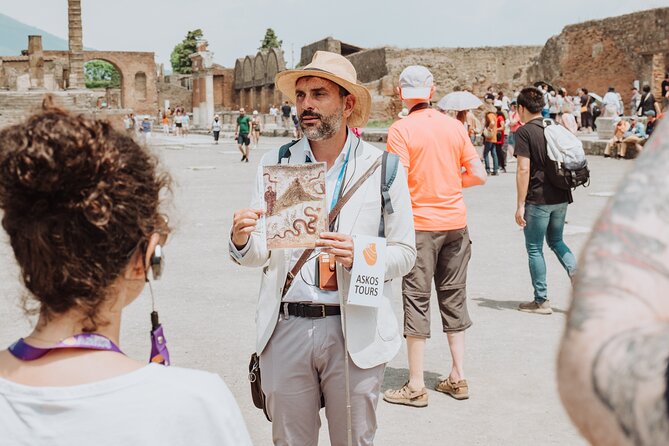
Pompeii can be overwhelming fast. It’s huge, uneven, and full of details competing for your attention. I like this tour format because it’s long enough to give you real structure, but short enough that you don’t leave feeling like you got steamrolled by the site.
At about two hours, you get a sequence that makes sense: city gate area → main square and forum spaces → impressive homes → thermal complex → Lupanar → major theater. That order matters. It nudges you from the public parts of town to private life, then back to the kinds of places where people gathered—bathhouses and performance spaces.
And since it’s built for a maximum of 15 people, you typically spend less time stuck waiting. That’s not a minor detail in Pompeii. Crowds can make even a good guide feel inefficient, so the small group size helps keep your walking flow.
You can also read our reviews of more tours and experiences in Pompeii.

Meeting at Porta Marina: Finding Your Guide Without Stress
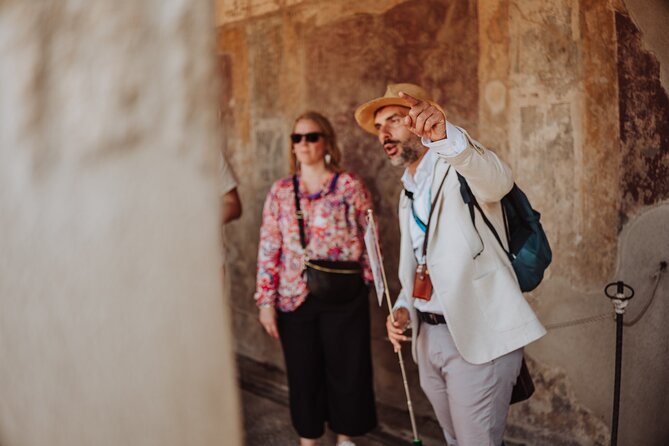
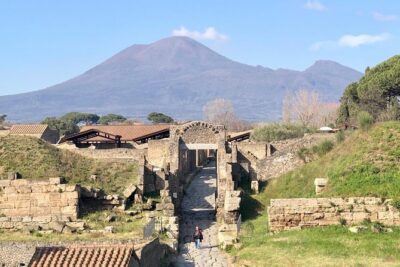
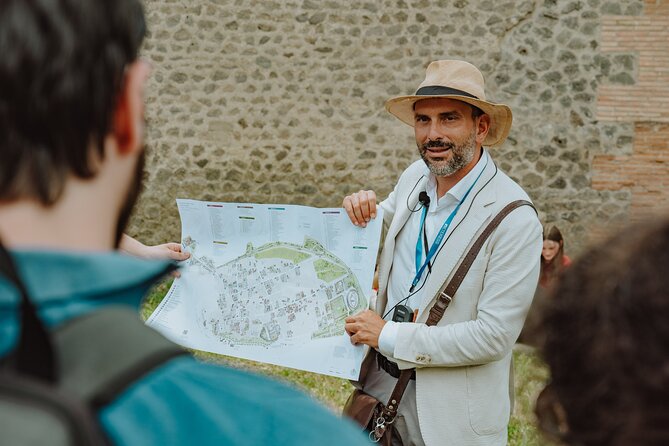
The tour starts at the main entrance of the archaeological site called Porta Marina Superiore. Your guide holds an Askos Tours sign (so you’re not trying to guess which group is yours), and you meet in front of the Hortus bar & Restaurant area.
The meeting point shown for the start is Via Villa dei Misteri, 2. The practical thing to know is that this tour is routed to begin at Porta Marina, not at the far corners of the ruins. That’s good news if you want to start coherent rather than guessing your way into Pompeii’s layout.
If you’ve ever arrived at Pompeii feeling like every tour group has its own secret handshake, this approach is straightforward: sign up, meet, go in. And because the tour is offered in English, you don’t have to worry about understanding gaps.
Porta Marina and the Merchant-Portico Feeling
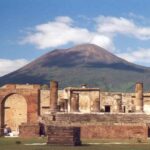
Your first stop is in the area of Piazza Porta Marina. You’re looking at the city’s gateway zone and getting your bearings right away. A short stop here works because it sets the tone: Pompeii wasn’t built for museum visitors; it was built for living, trading, and moving.
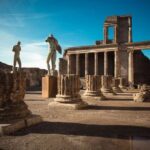
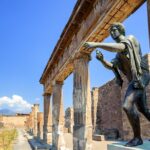
Next comes Vicolo delle Terme, 2, where you’ll see the Basilica as an open portico—a sheltered space where merchants and other activities happened. This is the kind of detail that makes Pompeii click. Instead of treating buildings like isolated ruins, you start seeing how people used covered public space to keep functioning even when the weather or crowds got annoying.
One thing I appreciate: the stops here are brief (around 10 minutes each). You get enough time to look and understand, then you move before your attention drops off.
The Forum Square: Pompeii’s Main Public Stage
Then you’re into the Foro de Pompeya, Pompeii’s ancient main square. This is where you really feel the city’s civic rhythm. Even in ruins, a forum tells you where power, commerce, and public life concentrated.
From a value perspective, this part is the core of any Pompeii visit. If you only have a couple of hours (which is often the real-world limit), spending time in the forum zone gives you the biggest payoff per minute.
After that, you head toward the Granaries of the Forum, a stop that’s more than just architectural viewing.
Granaries, Marble Tables, Fountains, and the Casts
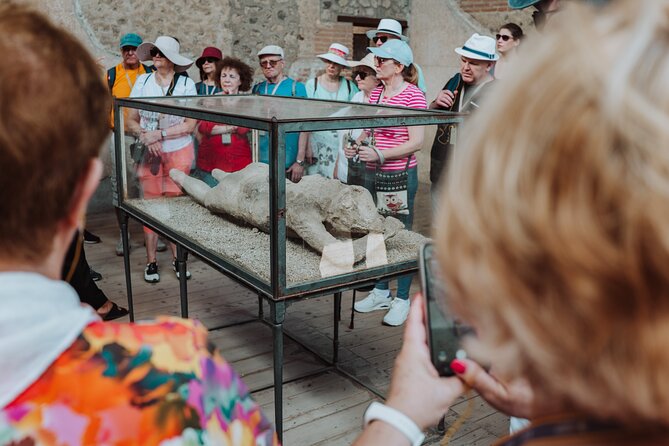
In the granaries, you’ll see marble tables and features connected to fountains at house entrances. You’ll also come across casts related to the eruption—victims, plus details like a dog and a tree.
This is where the tour’s archaeological grounding matters most. Pompeii can become either too abstract (look at walls) or too emotionally heavy (shock without context). A good guide helps you hold both ideas: what these spaces were for, and why the eruption left such specific traces.
One practical note: this section can feel emotionally intense. If you’re the type who gets rattled, it can help to take in the information first, then step back for a breath when you’re ready. The tour’s pacing makes that easier than a long stop-only visit.

House of Menander: Why the Decorations Matter
Next you visit the House of Menander, one of Pompeii’s wealthier homes. It’s described as rich in architecture, decoration, and contents, and that matches how these grand houses actually work: their value isn’t only in size, it’s in what the owners chose to show off.
You’ll want to pay attention to the contrast between public Pompeii and the private Pompeian world. In the houses, you start seeing how status was performed through layout and decorative choices. That shift helps you understand Pompeii as a social system, not just a collection of ruins.
You also get a 15-minute window here—enough time to notice key parts without feeling like you have to “finish” the house. That’s a big deal for first-time visitors. Pompeii’s famous houses are tempting to over-study.
Stabian Baths: The Oldest Thermal Complex in Town
The Stabian Baths (Terme Stabiane) take you into a massive thermal complex area. This stop is highlighted as the oldest thermal complex in the city.
Bathhouses were social hubs. They weren’t just about cleanliness. They were about schedules, conversation, and routines—people spending time together in a structured public setting.
In practical terms, this stop also gives you a change of scenery. You go from home interiors and civic spaces into a broader area where scale becomes part of the story. For many visitors, this is the point where Pompeii feels less like a “ruin of the past” and more like a lived-in town with systems and daily habits.
Lupanar: The Most Famous Brothel
Then comes the Lupanar, described as the most famous brothel in Pompeii. This is one of the most recognizable sites in the city, but it’s also one of the easiest to misunderstand if you treat it like a scandal museum.
A strong archaeological guide helps you view the space as part of how the city operated—an actual business environment within a real urban fabric. The tour’s design places it after civic and domestic areas and before the final performance stop, so it feels like another piece of the social puzzle, not a random detour.
If you’re traveling with teens or adults who can handle blunt topics, this is a memorable stop. If you prefer a lighter pace, just know it’s included and it’s built to be factual, not sensational.
House of the Faun: Big, Impressive, and Tied to Status
After the baths and the Lupanar, you head to the House of the Faun, described as one of the largest and most impressive private residences in Pompeii.
This is a good “closing act” for the home section. Menander introduced you to wealth through decoration. House of the Faun reinforces that wealth through scale and overall presence. It helps you understand that in Pompeii, “private life” still had visible status.
You’ll likely notice how the tour’s pacing keeps your eyes moving. That matters in houses because your brain wants to settle. You’re given enough time to look, then pushed onward so the tour stays energetic.
Teatro Grande: Pompeii’s Most Important Theater
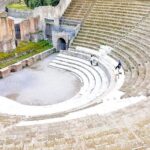
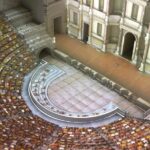
Finally, you reach Teatro Grande, described as the most important theater in Pompeii. This stop is only around 10 minutes, but it’s a smart use of time. A theater gives you the city’s public culture in one snapshot: entertainment, gatherings, and performance.
When I walk through a place like this with context, it stops being “a stage in ruins.” It becomes a place with crowd energy—people arriving, finding seats, and turning the day into an event.
And since the tour ends inside the ruins, you can linger here or in nearby areas after your structured time ends. That flexibility is part of the value.
Headsets, Crowds, and Why Small Groups Matter Here
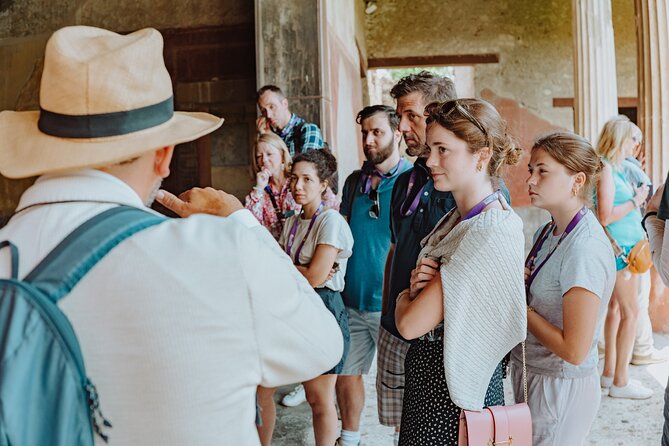
The tour provides headsets for groups of 10 or more. That’s a practical upgrade in a place where wind, footsteps, and crowd noise can crush a normal conversation.
The guide is described as licensed with an archaeological background, and multiple guide names linked to the program show up repeatedly in high ratings. Some guides also shine at steering people through heavy foot traffic. Even when the site is packed, the best guides keep your route moving and keep the important viewing moments from turning into a long wait.
If you’re sensitive to crowds or you hate losing your place in a group, this setup helps. You aren’t in a cattle line. You’re in a managed, walk-and-look rhythm.
Tickets and Price Value: What You Get for $77.06
At $77.06 per person, this tour is positioned as a mid-value, high-structure Pompeii option. The big reason it feels worthwhile is what’s included:
- Licensed guide with archaeological background
- Pompei Express entrance ticket
- Guidance and assistance for the entire duration
- Small group (max 15)
- Headsets when the group reaches 10+
Also, the stops tied to included entry are built into the circuit, so you aren’t paying for separate moments inside the ruins.
What’s not included: food and drinks and private transportation. So plan for the real Pompeii day logistics yourself. If you’ll be out during midday heat, bringing water snacks is the simplest way to keep your energy up during the structured tour and your extra wandering afterward.
One “watch out” detail: the Villa dei Misteri area is relevant to the meeting point, but it’s not included as a tour stop in the main circuit. If that villa is your top priority, you’ll want to add time on your own or choose a different tour that covers it directly.
Where It Ends: Keep Exploring Without Starting Over
The tour ends inside the ruins. That’s a great way to keep momentum. You don’t have to regroup at the end like some tours; you can keep wandering right away while the information is still fresh in your head.
The end point provided is Piazza Esedra, 80045 Pompei NA, Italy. From there, you can move deeper into Pompeii on your own.
In one example experience, the guide also suggested continuing to the amphitheatre and necropolis after the formal tour. Even if your guide doesn’t give the same suggestion, the idea is smart: use the 2-hour guided circuit to build structure, then choose one or two extra areas afterward based on what grabbed you most.
Who Should Book This Pompeii Tour
This works especially well if you:
- Want a 2-hour plan that covers major Pompeii highlights without forcing a full-day commitment.
- Like tours where the guide has an archaeological background and can explain what you’re seeing, not just point at it.
- Prefer small-group dynamics and the comfort of headsets when noise is high.
- Want enough detail to understand Pompeii’s spaces—public forums, baths, houses—then roam afterward with confidence.
It may be less ideal if you’re chasing a complete Pompeii checklist. The tour is focused, and it doesn’t try to do everything.
Should You Book It?
If you want a high-clarity Pompeii visit that fits into a tight schedule, I’d book it. You’re paying for structure, expert guidance, and included entry—not just for walking around.
My “yes, do it” checklist:
- You’re comfortable doing Pompeii in about two hours plus self-guided time.
- You want a broad sampling of daily life: forum, homes, baths, theater.
- You value small group attention more than trying to squeeze in everything.
My “maybe plan differently” note:
- If the Villa dei Misteri is your must-see, confirm whether your extra time includes it, since it isn’t part of this main circuit.
FAQ
FAQ
What’s the duration of the Pompeii archaeological small-group tour?
It runs for approximately 2 hours.
How big is the group?
The group is a small group with a maximum of 15 travelers.
Is the tour offered in English?
Yes, it’s offered in English.
What’s included in the ticket price?
The price includes guidance for the entire duration, the Pompei Express entrance ticket, and headsets for groups of 10 or more, plus a licensed guide with an archaeological background.
What is not included?
Food and drinks and private transportation are not included.
Where do I meet the guide?
You meet at the main entrance called Porta Marina Superiore, in front of the Hortus bar & Restaurant, where the guide holds an Askos Tours sign.
Where does the tour end?
The tour ends inside the ruins at Piazza Esedra. You are free to keep wandering on your own after.
Does the tour provide headsets?
Yes. Headsets are provided for groups of 10 or more.
Is cancellation free?
Yes. There is free cancellation up to 24 hours in advance for a full refund.
Is the tour suitable for most people?
It says most travelers can participate, and service animals are allowed. It’s also near public transportation.