REVIEW · NAPLES
Naples Skip-the-Line San Martino National Museum and Charterhouse Ticket
Book on Viator →Operated by Weekend in Italy · Bookable on Viator
A monastery. A museum. And Vesuvius in view. This skip-the-line ticket gets you into the San Martino National Museum and Charterhouse on the Vomero hill, where a 14th-century monastery complex turns into a very practical sightseeing win. You’ll move room to room at your own pace, with the added bonus of terraced gardens above the city.
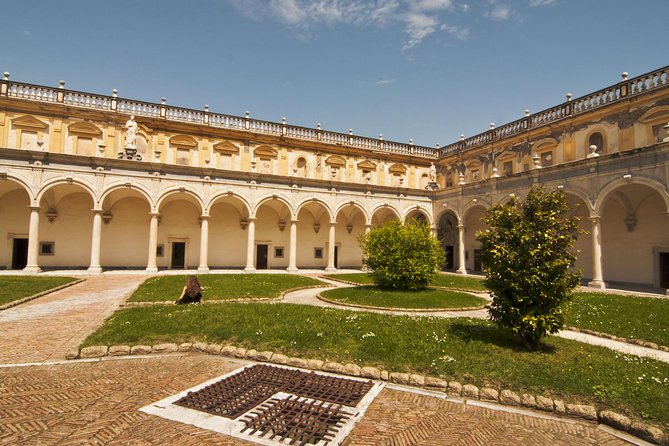
I especially love the two cloisters: the Great Cloister is stunning, and the monks’ cemetery details add an eerie, unforgettable touch. I also like the church-and-museum combo, from Giovanni Lanfranco’s ceiling frescoes to the famous Neapolitan nativity scenes in the museum, including the colossal Cuciniello’s Crib.
One possible drawback: the ticket is designed to speed things up, but you still redeem at the site. If you’re hoping for zero fuss at a peak hour, plan for some waiting at the entry desk and have your paperwork ready.
In This Review
- Key things to know before you go
- Naples San Martino: why this hilltop ticket works so well
- What your $12.80 pays for (and why it’s decent value)
- Getting to the Charterhouse on Vomero Hill
- Fast-track entry vs reality: how to avoid ticket-entry headaches
- Procurators’ Cloister and the Great Cloister: the part you’ll remember
- The church spaces: frescoes by Lanfranco and a Judith mural
- Inside the San Martino Museum: paintings, maritime items, and nativity cribs
- Terraced garden time: Naples and Vesuvius from above
- Timing your self-guided visit: how to fit 2 to 3 hours
- Who should book this ticket (and who might skip it)
- Quick heads-up on rules and practicalities
- Should you book this Naples San Martino skip-the-line ticket?
- FAQ
- What does the Naples San Martino ticket include?
- How long should I plan for the visit?
- Where is the San Martino Charterhouse located?
- Do I need to print anything for admission?
- What if my selected entry time is not available?
- Is the visit self-guided or guided?
- Is a mask required?
- Are there discounts for younger EU visitors or teachers?
- Can I change or refund the ticket?
- Where do I meet the group?
Key things to know before you go

- Vomero hill location: a hilltop monastery above Naples, near public transportation
- Two major cloisters: Procurators’ Cloister and Great Cloister, plus the monks’ cemetery with skulls on the balustrades
- Art highlights in the church: ceiling frescoes by Giovanni Lanfranco and a Triumph of Judith mural by Luca Giordano
- Nativity focus: museum rooms with famous Neapolitan cribs, including the Cuciniello’s Crib
- Self-guided pacing: multiple entry times, and you explore as you wish within opening hours
- Mask required: the site requires masks indoors, and staff may measure body heat
Naples San Martino: why this hilltop ticket works so well
San Martino is one of those Naples stops that feels like a shortcut. Instead of bouncing between separate attractions, you get a monastery complex, a major museum, decorated church spaces, and garden views—often all within the same 2 to 3 hours.
What makes it click for you is the mix of scale and variety. The cloisters give you architectural calm. The church lifts your eyes to major fresco work. Then the museum drops you into Naples’ art and cultural story, including the famous obsession with nativity scenes.
And yes, the views matter. Even if you’ve already seen Naples from other viewpoints, getting them from this terraced garden adds a different angle—higher up, quieter, and more atmospheric.
You can also read our reviews of more tours and experiences in Naples


What your $12.80 pays for (and why it’s decent value)
At about $12.80 per person, this isn’t a budget-buster tour. It’s basically paying for three things: priority entry, a focused museum visit, and access to the full monastery complex (cloisters, church spaces, and museum rooms), all on a ticket you can use at your chosen date.
You’re not paying for a sit-down guided program. You’re paying for time savings and a clean way to plan a self-guided visit. That’s why the “skip-the-line” angle is the real value here—especially if you’re traveling in busy season.
One note on value math: the price can feel more worthwhile if you’ll actually enjoy both art and religious spaces. If you only want views or only want a museum, you may feel like you’re paying for sections you don’t care about. But if you like architecture, church art, and Naples traditions, it’s a strong use of time.
Getting to the Charterhouse on Vomero Hill
This is on the Vomero hill above Naples. The complex is listed as near public transportation, but no hotel pickup is included, and there’s no pickup or drop-off service.
That means you should plan to handle transit yourself: take public transport toward the Vomero area, then walk the final portion uphill. Wear good shoes. Even if you’re not “hiking,” you are moving around a hilltop complex.
If you’re also visiting other high points, it helps to know that San Martino is near the highest area of Naples, associated with Sant’Elmo. That’s useful when you’re building a day with multiple viewpoint stops.
Fast-track entry vs reality: how to avoid ticket-entry headaches

The ticket is sold as guaranteed to skip long lines, and the experience is set up for priority access. Still, the site redemption process matters.
Here’s what you can do to keep things smooth:
- Print and bring the Weekend in Italy confirmation voucher, since the voucher needs to be shown to redeem your tickets at the moment of the visit.
- Use your selected time as your preferred entry window. If that exact time is no longer available, the provider will automatically confirm the closest available time during opening hours on your selected date.
- Arrive with extra buffer if you’re traveling right at opening or during a peak arrival wave.
In plain terms: the priority ticket helps, but you should treat it like “faster entry,” not “magic portal with no desk checks.”
Procurators’ Cloister and the Great Cloister: the part you’ll remember
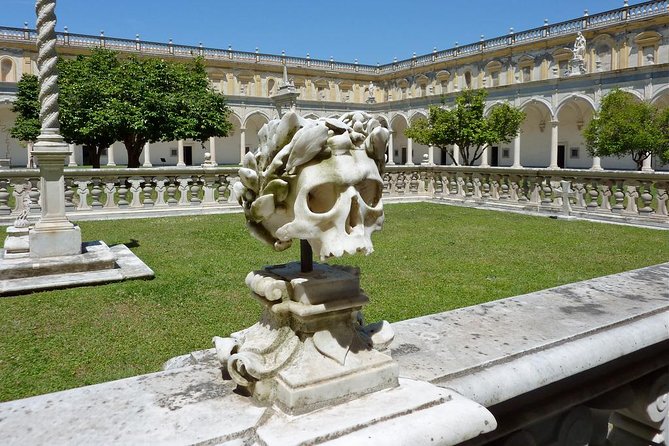
The Charterhouse of San Martino was consecrated in 1368, originally in a Gothic style, with later changes that eventually bring Baroque elements into the story. That long architectural evolution is part of the charm: you’re looking at centuries stacked into one walk.
Inside the monastery, you’ll focus on two standout cloisters:
- Procurators’ Cloister: a beautiful place to pause and reset your brain. The cloister layout gives you rhythm—look up at stone, then look across at the surrounding structure.
- Great Cloister: the one people talk about most. It includes the monks’ cemetery area, with human skulls set on the balustrades. It’s unsettling, but also extremely memorable.
These cloisters are also a good “rest moment” if your Naples day has already included heavy walking. The space slows you down, and you can get your bearings fast.
You can also read our reviews of more museum experiences in Naples




The church spaces: frescoes by Lanfranco and a Judith mural
If you only do one church stop, make it this one. The church includes ceiling frescoes by Giovanni Lanfranco, and the art is the kind you want to see without rushing—because it changes how you experience the whole room.
You’ll also encounter the Chapel of the New Treasury, crowned by an 18th-century mural titled Triumph of Judith by Luca Giordano. Even if you don’t know the story behind Judith, the mural’s presence gives you a clear payoff for the time you spent walking cloisters first. You’re seeing the monastery’s decorative ambition shift from quiet stone to dramatic visual religion.
Other church-related areas you may see include spaces like the Maddalena Chapel and areas such as the Conversi Choir and sacristy. The overall effect is that the complex isn’t one “pretty room.” It’s a chain of decorated spaces.
Inside the San Martino Museum: paintings, maritime items, and nativity cribs

After the monastery sections, the museum brings you back to Naples as a city—its tastes, its traditions, and its historical identity.
The museum includes paintings, artifacts, and maritime exhibits, which help broaden the story beyond church art alone. It also centers on the Neapolitan tradition of nativity scenes—one of the most distinctive cultural signatures of Naples during the holiday season and beyond.
This is where you’ll likely spend real time: the museum includes famous nativity examples, including the massive Cuciniello’s Crib (Presepe Cuciniello). The scale alone is the hook. It’s the kind of detail that makes you want to stand still, look at the figures, and trace how someone built a whole world inside one scene.
One extra piece of context that I think adds meaning: in 1866, Giuseppe Fiorelli founded the National Museum of San Martino as a collection meant to preserve the memories of Naples and southern kingdom identity. That’s why the museum feels more purposeful than just a storage place for art.
Terraced garden time: Naples and Vesuvius from above
If the museum and cloisters are your “indoor Naples,” the terraced garden is the outdoor release valve.
This is where you can take a slow stroll and enjoy sweeping views over the Bay of Naples and Mt. Vesuvius. Even if you’ve already seen Vesuvius from another angle, the garden viewpoint gives you a different feel: it’s calmer, and you’re surrounded by a built terrace system that frames the view.
I like using this time as a reset. If you’ve been focused on small artistic details (and you will be), the garden lets your eyes and mind relax before you head back down.
Timing your self-guided visit: how to fit 2 to 3 hours
The total time is listed as about 2 to 3 hours, and the visit is largely at leisure. That’s good, because it lets you control your pace.
A simple way to plan your flow:
- Start with the cloisters so you can enjoy the “quiet architecture first” feeling.
- Then hit the church and fresco spaces while the art is still fresh in your mind.
- Finish with museum rooms, especially the nativity scenes, since those often take longer than expected.
- If you still have energy, end with the terraced garden for the view payoff.
Also, because the mask rule applies inside, you might want to factor in that you’ll be wearing it the whole time you’re in indoor rooms. It doesn’t change the value of the visit, but it does affect comfort.
Who should book this ticket (and who might skip it)
I think this ticket is best for you if you like:
- Art in church spaces, especially major ceiling frescoes and chapel murals
- Architecture that’s more than one “pretty postcard”—two cloisters plus cemetery details
- Naples traditions, especially Neapolitan nativity scenes
It may be less satisfying if you only want quick panoramic viewpoints. Yes, you’ll get great views, but the core of the experience is the monastery complex and the museum content.
It also helps if you’re comfortable doing self-guided exploring. The experience isn’t described as a guided walk through every room, so you’ll get the most from it if you enjoy wandering, reading, and deciding what to linger on.
Quick heads-up on rules and practicalities
A few practical points matter here:
- The mask is mandatory for visitors and museum staff during time spent inside the museum.
- The site has adopted measures like limited entries/exits, distancing signage, sanitizers, and daily cleaning.
- Staff may measure body heat using a thermometer.
None of this is unique to San Martino, but it can affect how smooth the experience feels during busy moments.
Also, bring your voucher. The instruction is clear that you must print and present the Weekend in Italy confirmation voucher to redeem your tickets at the moment of the visit.
Should you book this Naples San Martino skip-the-line ticket?
My take: book it if you want a compact, high-reward Naples stop that mixes architecture, major church art, museum rooms, and those Vesuvius views—without spending half your day in transit.
Skip it only if you strongly dislike religious spaces or if you’re expecting a fully guided, speaker-led experience. This is about letting you move through a complex at your own pace, using the ticket to reduce waiting.
One last smart move: choose your time thoughtfully. Since the provider confirms the closest available time if your first choice isn’t available, plan for a time that matches your energy level. If you’re fresh, mornings can feel easier. If you’re tired, pick a later slot so you’re not sprinting up a hill.
FAQ
What does the Naples San Martino ticket include?
It includes skip-the-line entry to the San Martino National Museum and Charterhouse complex. You can explore the cloisters, church areas, chapels, and the museum, plus the terraced gardens.
How long should I plan for the visit?
Plan about 2 to 3 hours for a self-guided visit.
Where is the San Martino Charterhouse located?
It’s on the Vomero hill above Naples, near public transportation.
Do I need to print anything for admission?
Yes. You must print and present the Weekend in Italy confirmation voucher to redeem your tickets at the time of the visit.
What if my selected entry time is not available?
Your selected time is your preferred time. The provider will automatically confirm the closest available time during opening hours on your chosen date if the exact time isn’t available.
Is the visit self-guided or guided?
The experience is described as exploring the complex at leisure, so it functions as a self-paced visit rather than a structured guided walk.
Is a mask required?
Yes. The use of a mask is mandatory for visitors and museum staff during the time spent inside the museum.
Are there discounts for younger EU visitors or teachers?
Reduced price tickets may be available for European Union citizens aged 18 to 24, and for EU state teachers. Free tickets are available for people under 18.
Can I change or refund the ticket?
This experience is non-refundable and cannot be changed for any reason.
Where do I meet the group?
A meeting point is not included with the experience, since the focus is on independent arrival to redeem your voucher at the site.