REVIEW · POMPEII
Explore Pompeii with an Archaeologist
Book on Viator →Operated by Askos Tours · Bookable on Viator
Pompeii hits fast when you have a plan. This 2-hour, archaeologist-led walk gets you in with skip-the-line admission and an expert guide who explains what you’re looking at along the way. I like the tight, highlight-heavy route through the Forum, houses, baths, and theatre, and I especially like that the group stays small enough for real questions with guides such as Mario Celentano or Alexandra. The one watch-out: you’ll move at tour speed, so it’s not ideal if your goal is slow wandering or extra time in specific rooms.
English commentary keeps things moving, and headsets (for groups of 16 or more) help when the crowds pack in around the main sights. The route is designed so you’re not just staring at walls; you get quick context stop after stop, with time to ask what anything means. Still, Pompeii is big, and the walking is real, uneven, and hot in summer, so bring smart gear.
From the start at Via Villa dei Misteri, 2, you’ll follow your guide to Porta Marina Superiore, then finish at Piazza Esedra. A bunch of people praise the guides for pacing, clear explanations, and patience, but one solid tip stands out from the field: pack water and plan for sun, rain, or both. Also, you might want a little extra time after the tour, since you can keep exploring on your own when you’re done.
In This Review
- Key reasons this Pompeii walk works
- Price and what you really get for $35.67
- Getting in at Porta Marina Superiore (and staying sane)
- The Forum area: Foro de Pompeya and Basilica in quick hits
- Foro de Pompeya (main square)
- Basilica (court house)
- Granaries, plus the details you’d miss on your own
- Lupanar: a brothel stop with real context (not just shock)
- Houses on the route: Menander, Faun, and the House of Vettii
- Tip for making house stops less “samey”
- Stabian Baths and Teatro Grande: rest points that still teach
- Via dell’Abbondanza and Thermopolium VI: street life in two quick scenes
- The walking reality: what to pack so you enjoy the tour
- Listening with headsets: when they help (and when you still need patience)
- Who this tour suits best
- Booking timing and your best move
- Should you book Askos Tours for Pompeii with an archaeologist?
- FAQ
- How long is the Pompeii with an Archaeologist tour?
- Is Pompeii admission included, and is it skip-the-line?
- What language is the tour offered in?
- How big is the group, and are headsets provided?
- Where do we meet and where does the tour end?
- Are dogs or service animals allowed?
- What is the cancellation policy for a full refund?
Key reasons this Pompeii walk works
- Skip-the-line admission to reduce time lost before you even start seeing things.
- Archaeologist-guided explanations that turn names like Foro de Pompeya into something you can actually picture.
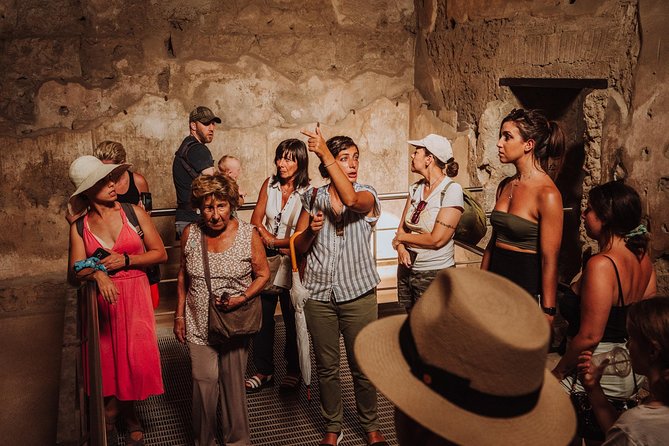
- Small groups (max 20) for better pacing and more chances to ask questions.
- Headsets for 16+ to keep the guide audible in the busiest spots.
- A focused highlights loop: Forum square, court house, brothel, granaries, houses, baths, street scenes, thermopolium, and Teatro Grande.
- End where you can keep going at Piazza Esedra, instead of dropping you far from your next move.
Price and what you really get for $35.67
At $35.67 per person for about 2 hours, this tour is priced like a smart “start here” option. The key value is that Pompeii admission is included, so you’re not piecing together entry fees while also trying to meet your group on time.
You’re also buying something harder to price: a guide who can explain what you’re seeing on the ground. Multiple people singled out guides such as Julia, Diego, Rosanna, Antonio, Rafaela, Teresa, Sergio, and Ilaria for turning the ruins into clear, story-driven explanations. That’s the difference between collecting photos and actually understanding a city layout, even with a tight schedule.
The trade-off is focus. This is a “see many highlights with context” tour, not “linger in every corner.” If you’re the type who wants to stop for long stretches, read everything slowly, and chase side paths, you may feel the clock more than you expect.
You can also read our reviews of more tours and experiences in Pompeii.


Getting in at Porta Marina Superiore (and staying sane)
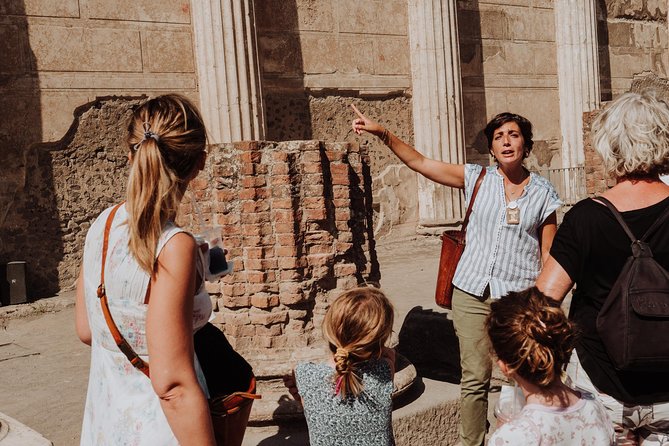
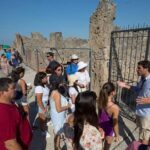
Your tour begins at the main entrance area called Porta Marina Superiore, with your guide holding a sign that says Askos Tours. The meeting address is Via Villa dei Misteri, 2, 80045 Pompei NA, Italy, and your tour ends at Piazza Esedra, 80045 Pompei NA, Italy.
Two practical things make this smoother than most DIY attempts:
- You get skip-the-line admission tickets, which matters because the busiest entry moments can chew up your morning.
- You get headsets (for groups of 16 or more), so you can hear explanations even when you’re not standing in the front row.
You’ll also use a mobile ticket, which is great if you’re traveling light and don’t want to shuffle paper. And it’s easy to find your group because the company name is visible at the meeting point, so you’re less likely to wander the entrance area trying to decode where your people are.
One more thing: Pompeii is famous for crowds, and the ruins sit in a large open archaeological zone. Even with headsets, it can still get loud, especially around the big central stops. I’d plan to ask your main questions early, while you still have enough quiet to hear the answer.
The Forum area: Foro de Pompeya and Basilica in quick hits
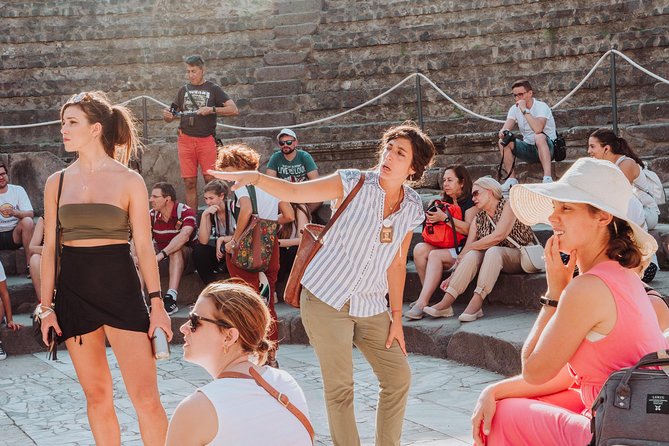
The tour’s early rhythm is straightforward: short stops, tight explanations, and a walking pace that keeps you moving between big landmarks.
Foro de Pompeya (main square)
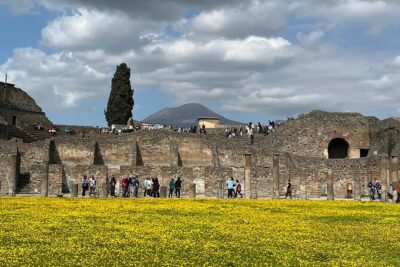
This is the classic starting point for understanding how a city functions day to day. Even if you’ve seen photos before, being in the real square with an archaeologist guide helps your brain map the space. You’ll get context for why this kind of central area matters and how other sights connect back to it.
A common benefit here is timing. You’re seeing the heart of Pompeii while you’re still fresh and before the tour fatigue sets in.
Basilica (court house)
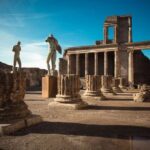
Then comes the Basilica, described as the court house. In a guided setting, this kind of building stops being just a label. Your guide’s job is to point out how civic life shaped the city’s rhythm, and why this space sits in the broader story.
The only drawback is that these central zones are usually where crowds gather. If you’re hoping for silence, you might not get it. But if you want the best shot at understanding the main civic layout in a short visit, this is exactly where you go first.

Granaries, plus the details you’d miss on your own
The next stop is the Granaries of the Forum, listed as ancient granaries. This is the kind of sight that’s easy to gloss over if you only scan ruins for dramatic moments.
With a guide, you learn how to look differently. You start asking questions like: What does a space like this tell you about organization and daily life? How does it connect to the square and civic core? In a two-hour tour, that’s where guidance pays off most—because you can’t stop long enough to solve the puzzle solo.
This is also one of those stops where the “small group” element really matters. With up to 20 people, you’re not constantly pressed into a wall of silence. If you’re the type who asks follow-ups, you’ll have a better chance of actually getting answers.
Lupanar: a brothel stop with real context (not just shock)
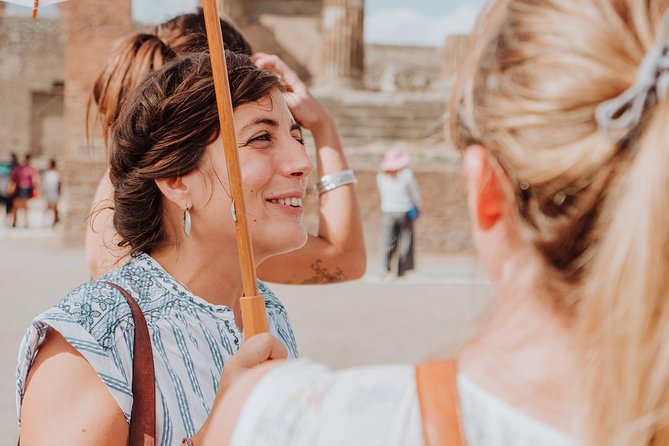
One of the more surprising stops is the Lupanar, explicitly described as the brothel. If you’re worried the tour will treat this like salacious sightseeing, don’t. People praise these guides for making Pompeii understandable in a normal, clear way—facts first, explanations second, no weird theatrics.
The benefit of including the Lupanar on a highlight loop is that it rounds out the picture. Pompeii isn’t only squares and baths. A city has private spaces and blunt realities, and this stop helps the story feel complete.
The consideration here is pacing and comfort. Since it’s a fixed short visit, you’ll have limited time to linger. If this topic is sensitive for you, you may want to mentally prepare for a quick but focused stop and then move on.
Houses on the route: Menander, Faun, and the House of Vettii
Then you hit the domestic side of Pompeii: House of Menander, House of the Faun, and Casa dei Vettii (House of Vettii). These are listed as houses, and the whole point of walking between them is to see how everyday space differs from civic space.
In practice, a guided tour is what helps these buildings click. A guide can connect what you’re seeing—how houses are organized, why different homes matter, and what details suggest about the people who lived there. Multiple reviews highlight guides for being patient and for answering questions, which is exactly what you want when the ruins look similar at first glance.
Tip for making house stops less “samey”
Since you’re only stopping about 10 minutes per location, don’t try to absorb everything as architecture. Instead:
- Listen for what your guide says makes each house distinct.
- Choose one question to ask at each house, not five. Your guide can actually answer them when you keep it focused.
If you’ve ever toured ruins on your own, you know how quickly everything starts to blur. The houses are where you feel that most. Guided explanations reduce that blur.
Stabian Baths and Teatro Grande: rest points that still teach
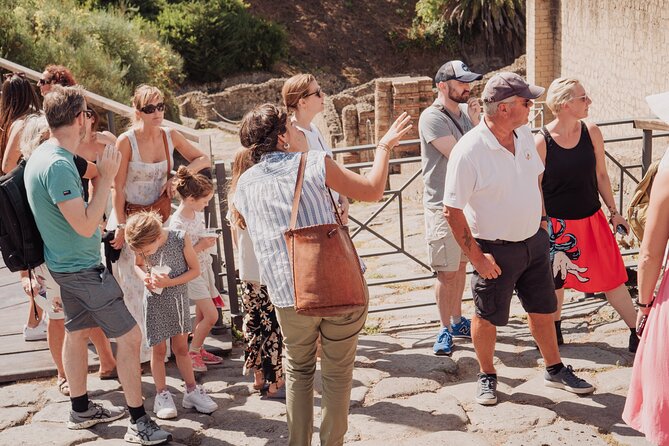
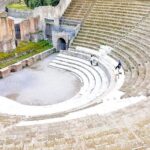
The Stabian Baths (Terme Stabiane) are next, followed by Teatro Grande (the theatre). Both stops are included with admission listed, and each is only about 10 minutes.
This is a smart pairing because it mixes body and mind. Baths shift your understanding from civic and domestic spaces to leisure and public routine. The theatre stop shifts you again, toward how crowds gathered for performances and social life.
The theatre can be especially effective with a guide because ruins often feel abstract. When someone explains the role of the space, it becomes more than stone outlines.
One practical consideration: even though the stops are short, the whole day adds up. Many people note that the walking over uneven surfaces is substantial. So treat these as short “checkpoint” rests, not long breaks.
Via dell’Abbondanza and Thermopolium VI: street life in two quick scenes
Two stops stand out because they’re about flow rather than buildings:
- Via dell’Abbondanza (the street called Via dell’Abbondanza)
- Thermopolium VI (the Thermopolium)
Even though they’re quick (about 10 minutes each), these parts are useful because they help you picture movement through the city. Streets tell you where you would have gone, and a thermopolium stop gives you a glimpse of where people might have grabbed something while out and about.
This is also where you feel the “tour format” most. You won’t have time to wander the street endlessly, but you will get a guided sense of why this street matters and how everyday life connected to the larger sights.
The walking reality: what to pack so you enjoy the tour
Pompeii ruins look cool in photos. In real life, you’ll be on uneven ground in a large archaeological zone, and that takes energy.
Based on practical tips from people who did this tour:
- Bring a fan in summer.
- Bring a refillable water bottle. Water is available from fountains.
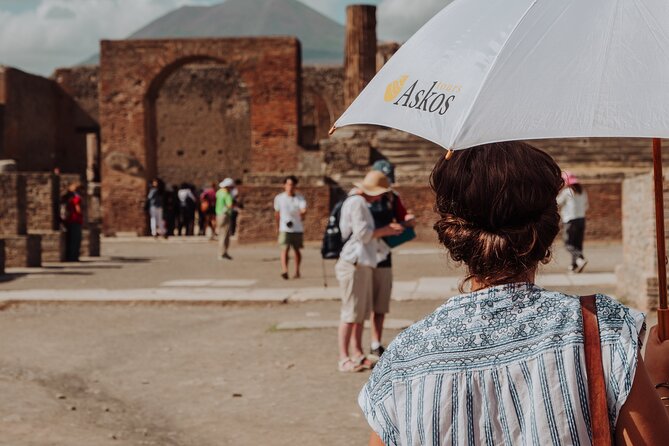
- Consider an umbrella or hat for sun or weather.
And wear shoes you trust. One review called out how much uneven-surface walking you face, and I agree with the spirit of that advice. If your shoes are uncomfortable on cobbles or rough ground, your tour experience won’t match your excitement.
If you’re traveling with kids, this is still doable. Reviews call it family-friendly for children of many ages, mainly because the guide explanations help keep attention from drifting.
Listening with headsets: when they help (and when you still need patience)
Headsets are included for groups of 16 or more, which is a big deal in Pompeii. People mention that the earphone amp helps a lot, and that’s exactly what you want when you’re standing in open-air crowds.
But here’s a balanced expectation: crowded stops can still make hearing tricky, even with headsets. If you notice sound issues, stand closer to the guide when possible, and ask questions during a pause rather than while you’re all walking.
Also, guide styles can vary. Most guides earn praise for being clear and answering questions, with examples like Mario Celentano, Julia, Alexandra, Rosanna, and Antonio. Still, if you’re the type who needs a highly interactive format, be ready to ask early and ask clearly. Some guides do better with Q&A when the group energy supports it.
Who this tour suits best
This Pompeii experience works well if you want:
- A guided overview that hits major highlights in about 2 hours.
- Archaeologist explanations that help you connect names to spaces.
- A route that’s easy to follow without getting lost in a huge site.
It’s also a strong pick for families and kids, since the small-group vibe and short stops keep the pace from dragging.
If you want a slow, museum-style visit, or you’re hunting for less-famous areas and ongoing excavations in depth, you may find the schedule too tight. In that case, consider pairing this with additional time on your own afterward.
Booking timing and your best move
This tour is commonly booked around 30 days in advance, so I’d treat it like a popular timed ticket. If your dates are fixed, lock it in early and plan to arrive with a buffer.
Also, remember the “two-hour” label is an average. Pompeii crowd flow and your group’s pace can slightly stretch the experience. Build in a little margin so you don’t feel rushed when it matters.
Should you book Askos Tours for Pompeii with an archaeologist?
If you want the best value for your first Pompeii visit, I’d book it. The combination of skip-the-line admission, small group size, and archaeologist-led explanations is exactly what makes a short visit feel smarter, not shorter.
Skip it only if you’re determined to see Pompeii at a very slow pace, or if you need lots of unstructured time to wander and linger in specific rooms. For that style, you’d likely prefer a slower, more flexible format.
Either way, come ready for walking, bring water, and ask at least one question at each major stop. That’s how you turn a highlight loop into a real understanding of the city.
FAQ
How long is the Pompeii with an Archaeologist tour?
It runs for approximately 2 hours.
Is Pompeii admission included, and is it skip-the-line?
Yes. Pompeii admission is included, and the tour offers skip-the-line admission tickets.
What language is the tour offered in?
The tour is offered in English.
How big is the group, and are headsets provided?
The tour is limited to a maximum of 20 travelers. Headsets are included for groups of 16 or more.
Where do we meet and where does the tour end?
You meet at Via Villa dei Misteri, 2, 80045 Pompei NA, Italy. The tour ends at Piazza Esedra, 80045 Pompei NA, Italy.
Are dogs or service animals allowed?
Service animals are allowed. Only dogs under 10 kg and no more than 40 cm in height are permitted, and they must be on a leash, held in the arms inside buildings, and you must collect their excrement.
What is the cancellation policy for a full refund?
You can cancel for free up to 24 hours in advance for a full refund. If you cancel less than 24 hours before the start time, the amount paid is not refunded.