REVIEW · POMPEII
Guided Private Tour in Pompeii
Book on Viator →Operated by Capri Top Tours · Bookable on Viator
Pompeii feels bigger when someone guides you. This private tour takes about 2 hours 30 minutes and is led by an authorized archaeologist who tells the story of Roman daily life as you walk the streets. I like the small-group, up-to-5 setup because it keeps the pace human, and I really like the mix of big public sights (Forum, temples, basilica) with everyday places (baths, a termopolium, the food market). One possible drawback: it’s a tight schedule with lots of stops, so if you want long, slow wandering, you may feel a bit rushed.
What makes it especially worth it is the way the tour is built around how people actually lived. You’re not just looking at ruins—you’re moving through places tied to work, food, hygiene, entertainment, and social life, with context that makes the stones feel specific instead of generic. Also, the guide’s style matters here; multiple repeat highlights point to Tony’s careful preparation and story-driven teaching, with humor when it fits.
You’ll meet at Ristorante Suisse, Piazza Esedra, 10/13, and the tour ends back there. Expect a best-time window during the listed daytime hours, and plan for the fact that the Pompeii site ticket is extra even though the tour includes the guide and access planning.
In This Review
- Key things that make this Pompeii tour work
- Pompeii in private: why an archaeologist changes the feeling
- Entering the archaeological park with a smarter first stop
- The Forum, basilica, and temples: where Romans talked and decided
- Baths, termopolium, and the food world: daily life made visible
- Pompeii’s adult life and luxury homes in the same 2.5 hours
- Roman entertainment and the Teatro Grande viewpoint plan
- A practical schedule: what 2 hours 30 minutes feels like
- Who this Pompeii private tour suits best (and who should adjust expectations)
- Should you book this Pompeii guided private tour?
- FAQ
- What’s the tour length?
- How many people are in a group?
- Are Pompeii entrance tickets included?
- Where do we meet, and where does it end?
- Is the tour run by an archaeologist?
- What time is the tour available?
- What’s the cancellation policy?
Key things that make this Pompeii tour work
- Archaeologist-led storytelling that connects buildings to everyday habits, not just dates
- Private group (up to 5), so you can ask questions and set the pace a bit
- A well-packed route that hits public power, religion, and daily routines in one go
- Roman-style tastings and a villa-garden wine moment, built into the experience
- Real stop-and-look time at places like the Stabian Baths, the Macellum, and major houses
Pompeii in private: why an archaeologist changes the feeling
Pompeii can be overwhelming fast. You walk in, see walls, columns, fresco fragments, and think, Great—where do I even start?
This tour fixes that. An authorized archaeologist guide leads you through the city like a living place. Instead of treating the site as a checklist, you get a sense of what mattered to Romans: where they gathered, how they bathed, what they ate, how they entertained themselves, and what was considered public versus private life.
The private format is a big part of the value. Up to five people means you aren’t competing for attention, and you can steer the conversation toward what you care about—architecture, religion, food, or how daily routines likely worked. If you’ve ever done a bus tour where your question gets answered by someone else’s time slot, this is the opposite.
And the guide’s teaching style shows up again and again in the experience descriptions: meticulous preparation, strong storytelling, and a sense of humor that helps you remember what you just saw. When the guide is the difference, the tour cost feels easier to justify.
You can also read our reviews of more guided tours in Pompeii

Entering the archaeological park with a smarter first stop
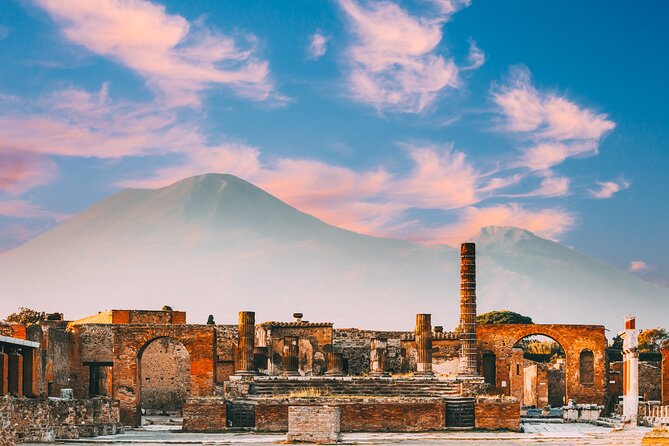
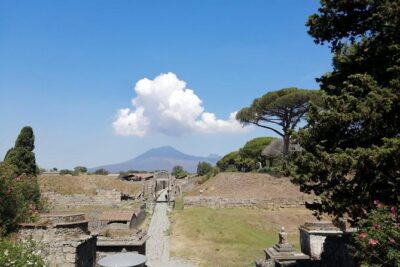
Your tour starts at Ristorante Suisse in Piazza Esedra, then moves to the Pompeii Archaeological Park entrance at Piazza Esedra / Porta Marina Inferiore. This is a practical choice: the idea is to help you start without getting bogged down in waiting, and it also puts you in a position to take in the view toward Pompeii’s ancient port area.
That first setup matters. Pompeii is easier when you get your bearings early. You’ll get that early spatial context before the walking becomes a blur of forums, temples, and homes.
Another plus: you’re not just arriving—you’re arriving with a plan. The route is designed to move from major public landmarks to daily-life sites, which keeps the “story” coherent. You’ll spend enough time at each area to understand what it was used for, instead of sprinting past and hoping it all clicks later.
The Forum, basilica, and temples: where Romans talked and decided
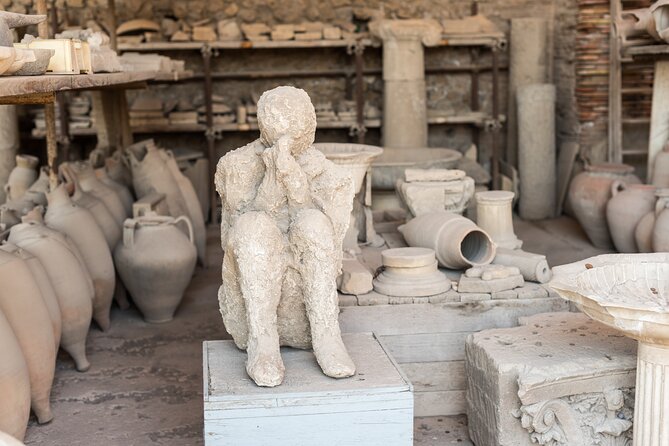
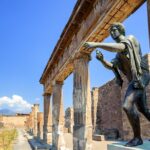
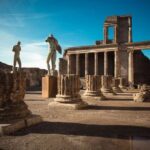
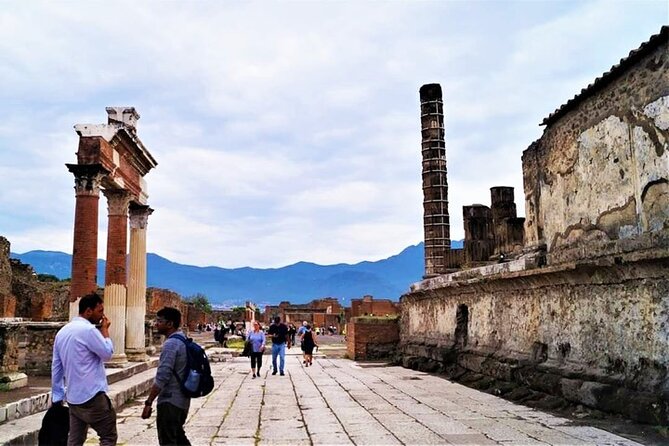
The heart of the city is the Foro de Pompeya, and your route brings you there with time for it to land. The Forum is where civic and social life overlapped: speeches, ceremonies, public movement, and the daily theater of power.
Along the way you also visit key anchors that clarify the political and religious mix:
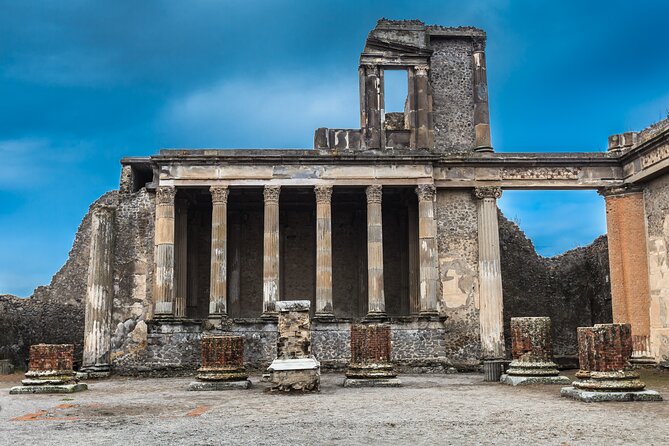
- Pompei La Basilica (described as the Roman parliamentary space) with its impressive marble decoration
- Temple of Apollo (Apollo’s Sanctuary), where you see how art and religion worked together
- Tempio di Giove Capitolino (Jupiter’s sanctuary), tied to public speech in the Forum area
- Tempio di Venere (Venus’ sanctuary), highlighted as a scenery moment
Even if you’re not a Roman-scholar type, this set of stops helps you understand why Pompeii felt like one blended world. Religion wasn’t tucked away; it shaped public spaces. Civic life wasn’t separate; it ran through the same dramatic architecture.
A practical note: some stops are short (around 5 minutes each), so what you get depends on your guide’s narration. If you want more time at the Forum, ask early in the tour. With a small group, it’s often easier to adjust where the guide spends your attention.
Baths, termopolium, and the food world: daily life made visible
This tour does a good job of balancing the big-ticket monuments with places that answer the question: what did people do day to day?
One standout is the Stabian Baths (Terme Stabiane). You get about 20 minutes here, which is the right length to understand the idea of a Roman bathing complex as more than a “spa.” In Roman life, baths were social space, routine care, and a place where people stayed part of the rhythm of the day. The tour frames it as a public complex with a sense of safety and procedure—useful context because it changes how you picture the rooms.
Then there’s the Termopolio di Vetuzio Placido, described as an early fast-food stop with impressive fresco work. Termopolia matter in a Pompeii tour because they’re the food layer of the city—what people grabbed without going home, and how commercial life looked in a street setting.
And food continues at the Macellum, the market where you get to see high-quality fresco decoration and body casts. That combination is intense, but it’s also one of the most educational parts of Pompeii: it connects everyday commerce with the human reality of what happened here.
If you’re a foodie or you just like how food reveals culture, this section is where Pompeii stops feeling like stone and starts feeling like a place with routines you can picture.
Pompeii’s adult life and luxury homes in the same 2.5 hours
You don’t have to work hard to find Pompeii’s contrast: sex, money, status, comfort—sometimes in adjacent spaces.
The tour includes the Piccolo Lupanare, described as the red light district and a visit to the brothel. This is one of those stops where a guide makes a huge difference. You’re not looking for shock; you’re learning about the social reality behind the walls, and why certain areas existed in the way they did.
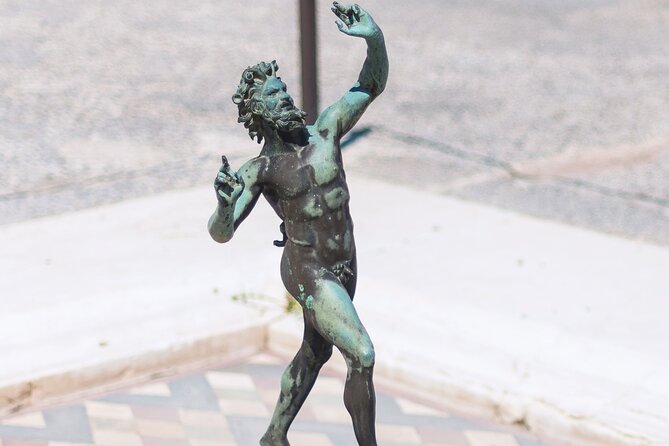
Then you shift to wealth and domestic power with Casa del Fauno (about 20 minutes). It’s presented as one of the best examples of luxury in Pompeii. What you should look for here is how luxury shows itself through space, layout, and decoration. Even with a short visit, a good archaeologist guide can help you see how daily habits in a wealthy home likely differed from street-level routine.
You’ll also get a Roman villa garden moment, including a glass of wine and a chance to admire frescoes on the walls. That’s a smart pairing with the luxury-house stop: it reinforces the idea that the elite did not experience Pompeii as separate from art, comfort, and private gathering.
One consideration: because this segment includes more sensitive subject matter (the Lupanar), you may want to ask the guide to keep it respectful and stay focused on interpretation rather than sensational details.
You can also read our reviews of more private tours in Pompeii




Roman entertainment and the Teatro Grande viewpoint plan
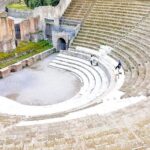
The itinerary includes Teatro Grande, plus the “Big Theatre and Little Theatre,” but with an important caveat: the entertainment area is not accessible at the moment. What that means for you is that you’ll still get a panoramic view plan, but you won’t be walking through everything you might imagine from photos online.
This is worth treating as a normal part of visiting Pompeii: parts of the site can be closed or restricted, and the best guides adapt without losing the point. In this case, the guide’s job is to explain the theatre’s role in city life even if you can’t fully access every space.
If your heart is set on the theatre area specifically, you may want to double-check what access is like on your travel day. The tour description makes it clear that a “view from outside” approach is part of the experience right now.
A practical schedule: what 2 hours 30 minutes feels like
A tour with this many landmarks can either feel great or feel like a race. Here, the timing is built around bite-sized stops:
- Major public anchors get short framing moments (some around 5 minutes)
- Key “life” spaces get longer attention (notably the Baths, the Lupanar, and the luxury house)
- The Forum gets a proper segment (about 15 minutes), so you don’t just flash through it
That pattern is smart. Pompeii isn’t evenly interesting in every corner; some areas simply need more narration time to connect the dots. The schedule tries to give the high-impact everyday sites enough attention to stick.
Also, you’re getting included entry for certain stops on the plan, but the important part for your budget is that the Pompeii Archaeological Park ticket costs 18 euros per person (free under 18). The tour price is $326.72 per group up to 5, and if you split that with four others, the guide portion can work out to around $65 per person before the site ticket. That’s how private guiding becomes reasonable: the cost is group-based, while the ticket is per person.
If you’re traveling solo, the tour is still convenient because it’s private and efficient—but you’ll feel the guide cost more. If you’re a couple or small family, it tends to land in a sweet spot.
Who this Pompeii private tour suits best (and who should adjust expectations)
This is a great fit for people who want:
- A guided story through Pompeii, not just self-guided photos
- A balance of public monuments and daily-life settings
- A guide who uses humor and clear context to make ruins easier to remember
- A short trip (2.5 hours) that still covers meaningful highlights
It may be less ideal if:
- You want lots of free time to roam without a set sequence
- You prefer deep architectural analysis with long stays in one place
- You’re sensitive to the tour covering an adult-life site (the Lupanar), even though it’s handled as historical interpretation
If you’re planning to visit nearby sites too, this tour also makes sense because it doesn’t swallow the whole day. That flexibility shows up in how the guide handles different time constraints—useful when your schedule is tight.
Should you book this Pompeii guided private tour?
If you want Pompeii to feel like a place, not a photo album, I’d book it. The big value is the archaeologist guidance plus the way the route mixes power, religion, food, hygiene, and private life—so you walk away with a mental map that makes sense.
Book this if your group is up to 5, you’re traveling during the listed daytime window, and you don’t mind that it’s a packed 2.5-hour overview. If you can afford private guiding, this tour gives you a high return on time: you hit the essential “types” of Roman spaces and you get explanations that connect them.
If your budget is tight, a self-guided visit can work—but you’ll miss the layer that turns individual ruins into a coherent day in Pompeii. For most people, that interpretive layer is the difference between seeing Pompeii and understanding it.
FAQ
What’s the tour length?
It runs for about 2 hours 30 minutes.
How many people are in a group?
It’s a private tour for your group, with a maximum of up to 5 people.
Are Pompeii entrance tickets included?
No. The Pompeii Archaeological Park ticket fee is 18 euros per person (free under 18). The tour includes the archaeologist guide service.
Where do we meet, and where does it end?
You meet at Ristorante Suisse, Piazza Esedra, 10/13, 80045 Pompei NA, Italy, and the tour ends back at the meeting point.
Is the tour run by an archaeologist?
Yes. The guide service is described as an authorized archaeologist.
What time is the tour available?
During the listed period (05/28/2025–06/16/2026), it operates Monday through Sunday from 9:00 AM to 3:00 PM.
What’s the cancellation policy?
You can cancel for a full refund if you cancel at least 24 hours in advance. If you cancel within 24 hours, the amount paid isn’t refunded.
—
If you tell me your travel month and group size, I can help you sanity-check whether 2.5 hours will feel perfect—or whether you should plan extra time for self-guided wandering after the tour.