REVIEW · POMPEII
Pompeii Guided Group Tour with Entry Ticket and Archaeologist
Book on Viator →Operated by Pompei Tour Organizer_Tempio Travel · Bookable on Viator
Pompeii hits fast, and this tour keeps up. You get express entry plus a guide who links big ruins to real Roman routines, from meals to bathing. Two things I really like: the tour moves you efficiently through major sights, and the headsets help you stay in sync with the group even when crowds thicken. One possible drawback: the meeting spot can feel confusing if you rely on maps—arrive early and go to the exact station office.
You’ll be in English, for about 2 hours (give or take), and you can pick the departure time that fits your day. The group is capped at 35 people, so it’s not a tiny private tour, but it also isn’t a cattle-car sprint.
This route starts at Porta Marina Superiore and strings together the Foro, the Macellum market area, forum baths, and two famous houses—then finishes with Via dell’Abbondanza and a thermopolium stop. You’ll leave with a clearer sense of where people gathered, shopped, ate, and showed off status.
In This Review
- Key highlights you’ll care about
- Pompeii Guided Tour: what your $59.13 really buys
- Where you meet at the Circumvesuviana station (and how not to waste time)
- Porta Marina Superiore to the Foro: the city’s main square, explained
- Macellum and the Market of meat and fish
- Forum baths behind the Temple of Jupiter: Romans and the art of hygiene
- Casa del Fauno: the “big house” vibe and Alexander’s mosaic
- Casa dei Vettii: Roman art, a buried home, and a room with erotic paintings
- Via dell’Abbondanza to the thermopolium: the Roman fast-food stop
- Headsets, pace, and group size: making sure you can actually hear
- Price and value: guided, ticketed, and time-efficient
- Logistics that matter: shoes, crowds, and picking a time
- Should you book this Pompeii guided group tour?
- FAQ
- How long is the Pompeii guided group tour?
- Is the tour in English?
- What is included with the tour price?
- Where do I meet the guide?
- Is the Villa of Mysteries ticket included?
- Does this tour include admission tickets?
- What group size should I expect?
- Do I need good weather for this experience?
- Can I cancel for free?
- Are service animals allowed?
Key highlights you’ll care about
- Express Archaeological Park entry saves time so you start seeing instead of waiting
- Headsets are provided for groups over 15, which matters in a windy, echo-y site
- Foro + Macellum + baths covers everyday life, not just monuments
- Casa del Fauno and Casa dei Vettii show how elite homes looked and felt
- Via dell’Abbondanza gives you an easy way to connect the city’s main areas
- 2-hour timing is realistic for a huge site (then you can wander after)
Pompeii Guided Tour: what your $59.13 really buys
At around $59.13 per person, this is a mid-range way to experience Pompeii. The key value isn’t just the guide—it’s the package feel: a guided walk, an included site entry ticket (express), and headsets if the group is larger.
You’re also buying structure. Pompeii is big, and most people lose time doing the wrong “first stops.” This tour is designed to hit a concentrated set of high-impact areas in a short window, so you’re not stuck mapping your own route while other visitors surge past.
The one “watch this” point: the tour includes the main Pompeii highlights, but it does not include a separate Villa of Mysteries plus ticket. If Villa of Mysteries is on your must-see list, you’ll want to plan it separately.
You can also read our reviews of more tours and experiences in Pompeii


Where you meet at the Circumvesuviana station (and how not to waste time)
Plan to arrive 15 minutes before your listed time. The meeting point is on the first floor of the Circumvesuviana station stop called Pompei Scavi villa dei Misteri, at Via Villa dei Misteri 1.
Look for the office named Tempio Travel / Pompeii Tickets inside a red station building—it’s about 100 meters from Porta Marina Superiore. This is exactly the kind of detail that can make or break the start of your tour, especially during peak hours.
If you’re traveling with kids or if your phone’s GPS is unreliable, don’t “close enough” it. Show up early, find the red building office, then relax. One common complaint is that directions that work in one map app might point you somewhere else—so take the time to verify the station and the office name before your departure.
Porta Marina Superiore to the Foro: the city’s main square, explained

Your tour begins at Porta Marina Superiore, then it quickly leads into Pompeii’s core. The first entry into the Archaeological Park is brief (about 2 minutes), but it’s enough to get you oriented right where you need to be.
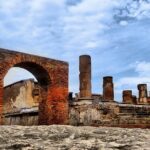
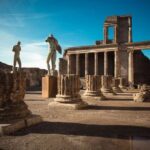
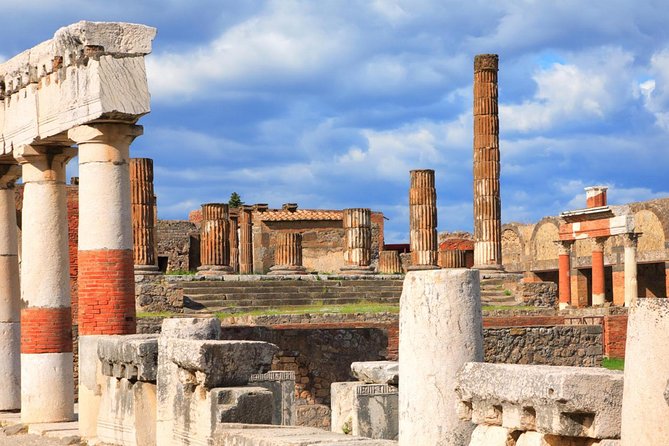
Next comes the Foro di Pompei, Pompeii’s main plaza. Here you’re not just looking at stone. You’re getting the “why it mattered” story: the Foro functioned as the city’s political, economic, and religious center, so it’s where power showed itself and daily life overlapped.
You’ll spend about 30 minutes in this area, which is smart pacing. The Foro can feel intimidating if you’re solo—so a guide’s explanation helps you stop seeing it as scattered buildings and start seeing it as a system.
A practical tip: take a minute to locate where the Macellum sits relative to the Foro. Once you understand that layout, the next stops click fast.
Macellum and the Market of meat and fish
The Macellum stop sits on the Foro and connects directly to what people ate and bought. This was the market area for meat and fish, and you’ll get a close look at frescoes that show foods Romans ate in the 1st century AD.
You’ll have about 10 minutes here. That short time can feel tight if you’re the type who loves to hover over details, but it’s still useful because the guide points out what to notice. Without guidance, the market area is easy to walk past thinking it’s just another set of ruins.
If you want to see more after the tour, this is a great place to circle back. You already have the context, so your second look becomes more rewarding.
Forum baths behind the Temple of Jupiter: Romans and the art of hygiene
Next up: the Terme del Foro—forum baths located behind the Temple of Jupiter. This is one of my favorite categories of Pompeii stops because it’s so human. People didn’t only shop and pray; they washed, cooled down, and socialized.
You’ll spend about 15 minutes here, and you get specifics:
- the bath sector covered about 410 square meters
- there were separate male and female areas with independent entrances
- water came from the Serino aqueduct, with a well as backup if water was short
- the original ceiling and stucco survive, and the calidarium includes a marble basin plus a mosaic floor
That’s a lot of information for a short stop, but it’s the good kind. The baths help you visualize daily routines instead of only big events and elite houses.
If you’re sensitive to echo or audio issues, this is also where headsets can matter. One visitor noted headset quality felt poor with echo—so if you notice problems, ask the guide or staff for a quick adjustment rather than toughing it out.
You can also read our reviews of more guided tours in Pompeii



Casa del Fauno: the “big house” vibe and Alexander’s mosaic
From baths, you walk into a different world: status and space. The tour includes the Casa del Fauno, one of the larger, more luxurious aristocratic homes from the Roman republic era.
You’ll have about 10 minutes in the house. The headline item is the Mosaic of Alexander—but there’s an important catch. You’ll see a copy here, while the original is preserved at the MANN (Museo Archeologico Nazionale di Napoli).
That distinction matters because Pompeii is famous for art, and it’s easy to assume the most visible mosaic is the original. This stop clears that up fast, and it makes your later museum plans (if you have them) feel more intentional.
Look closely at how the home is laid out and how decoration fits daily use. Even in ten minutes, you’ll start seeing homes as functional spaces, not just photo backdrops.
Casa dei Vettii: Roman art, a buried home, and a room with erotic paintings
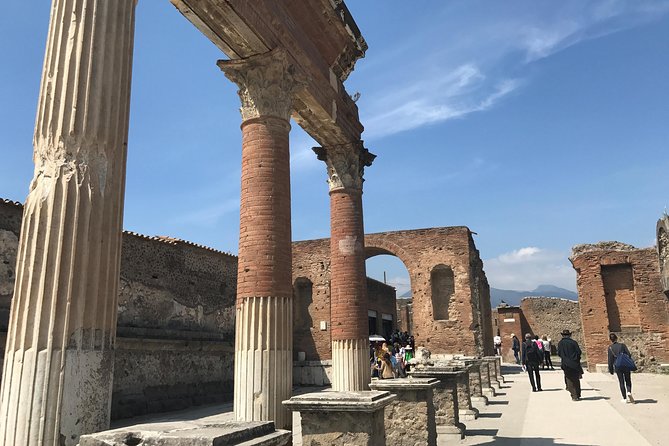
The last major “house” stop is Casa dei Vettii. It’s described as a Roman domus buried during the 79 eruption of Vesuvius and found through excavations later on.
You’ll spend about 10 minutes here, and the key story is its naming: it’s called for Aulo Vettio Restituto and Aulo Vettio Conviva. The guide also points out why the house is so talked about today—its Roman art and painted rooms.
One room includes erotic paintings, and the tour explanation ties those images to the context of a woman who worked in that setting within the household. I’m keeping that phrasing close to how it’s presented on this tour because it’s exactly the kind of “how did people really live?” moment that makes Pompeii stick in your head.
A heads-up: the tone of these kinds of scenes can vary depending on the guide. If you’re traveling with teens or want a more neutral explanation, it’s fine to ask the guide how they approach sensitive material.
Via dell’Abbondanza to the thermopolium: the Roman fast-food stop
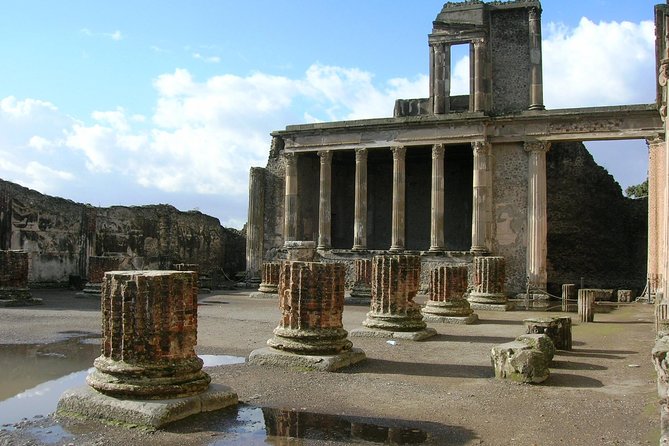
After the houses, the tour continues along Via dell’Abbondanza, the main street linking major city areas between the Foro and Porta Sarno. This is where you start to feel the city’s scale and direction—an “aha, that’s how the route works” moment.
Then you reach the Thermopolium stop: specifically Regio VI, Insula VIII, 8. A thermopolium is literally a place where hot food is sold, and this one helps you visualize take-away meals in Roman street life.
You’ll have about 10 minutes here. Think of it as Pompeii’s older cousin to modern quick service food—people stopping by for something hot and ready instead of sitting down for a full meal.
Even if you don’t remember every name of every building, you’ll remember the idea—food on the street, not only behind closed doors.
Headsets, pace, and group size: making sure you can actually hear
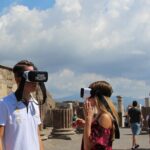
The tour provides headsets for groups over 15, which is a practical benefit at Pompeii. Ruins are open-air, wind is common, and sound can bounce around. Headsets reduce the “I can’t hear you” problem when you’re a few steps behind.
Still, audio can vary. Some people report the headset sounded echo-y or low-quality. If you run into that, ask for help quickly. With a tour like this, half the value is the explanation, so it’s worth fixing early rather than waiting until the end.
The pacing is built for a busy day: it’s long enough to connect major areas, but short enough that you still have energy to explore on your own afterward. One plus from the experience reports: the pace often feels workable for mixed ages when the guide keeps things moving in open areas.
Price and value: guided, ticketed, and time-efficient
If you’re deciding between going solo and booking a guided group tour, the price makes sense when you factor in what’s included.
You get:
- the guided route through the most important “spines” of Pompeii
- an included express entry ticket
- headsets if you’re in a larger group
For a place as sprawling as Pompeii, this structure saves you the mental load of planning. It also prevents the classic mistake of wandering into less relevant zones while the real anchor sites are right nearby.
That said, this is not the “see everything” option. Pompeii is enormous, and no two-hour walk can cover it all. So if you want total control over timing, you might prefer an independent ticket and a self-made route. If you want context fast, this is a solid fit.
Logistics that matter: shoes, crowds, and picking a time
This is Pompeii, so wear comfortable, sturdy shoes. You’ll be walking between multiple stops, and the ground can be uneven. A lot of people leave Pompeii with sore feet—your future self will thank you for planning for that.
Crowds are real. One practical lesson: book earlier, especially for morning slots during peak periods. The site can get chaotic when everyone tries to enter at the same time, and having a guided entry rhythm helps you avoid some of that stress.
Also, pick a time that matches the rest of your day. The tour length is about 2 hours, and you’ll likely want extra time afterward if you’re the type to linger.
Should you book this Pompeii guided group tour?
Book it if you want:
- a fast, high-impact way to understand Pompeii’s city layout and daily life
- a guide-led route that helps you know what you’re looking at
- express entry and headsets to reduce waiting and improve listening
Skip it (or consider a different style of tour) if:
- you need extremely detailed time in one specific house or site (this tour is short by design)
- you’re very sensitive to audio quality and don’t want to rely on headsets
- you’re likely to arrive late or depend on vague directions—this works best when you show up early and meet at the exact station office
If you can handle meeting the group on time, this tour is a smart “first Pompeii” experience. You’ll get the big story fast, then you can spend the rest of your day doing what Pompeii does best: letting you wander and connect the dots.
FAQ
How long is the Pompeii guided group tour?
It’s about 2 hours (approximately).
Is the tour in English?
Yes, it’s offered in English.
What is included with the tour price?
The tour includes a 2-hour guided experience, an express entrance ticket to the Pompeii Archaeological site, and headsets for groups with more than 15 people.
Where do I meet the guide?
Meet at Via Villa dei Misteri, 1, Pompei NA, Italy. The meeting is at the first floor of the Circumvesuviana station stop called Pompei Scavi villa dei Misteri, at the Tempio Travel / Pompeii Tickets office (in the red station building), about 100 m from Porta Marina Superiore. Arrive about 15 minutes before the listed time.
Is the Villa of Mysteries ticket included?
No. An entrance ticket “plus” for the Villa of Mysteries is not included.
Does this tour include admission tickets?
Yes. Admission to the Pompeii Archaeological site is included via the express ticket.
What group size should I expect?
The maximum group size is 35 travelers.
Do I need good weather for this experience?
Yes. This experience requires good weather. If it’s canceled due to poor weather, you’ll be offered a different date or a full refund.
Can I cancel for free?
Yes. You can cancel up to 24 hours in advance for a full refund.
Are service animals allowed?
Yes, service animals are allowed.