REVIEW · NAPLES
Private Transfer: Naples to Sorrento with Pompeii Guided Tour
Book on Viator →Operated by IAMME IA! - Gray Line Amalfi Coast · Bookable on Viator
Pompeii-to-Sorrento sounds hard, but it works. This private transfer pairs a professional driver with an official guide so you can see Pompeii’s main stops and still reach Sorrento without juggling buses. I especially like the flexible pickup in Naples and the fact that Pompeii entry is handled with skip-the-line access.
My second big win: the ride itself is built for real travel days. You’re in an air-conditioned vehicle with room for luggage, and you get dropped at your chosen address in Sorrento instead of leaving you to figure out the last mile.
One thing to keep in mind: this is a short, efficient Pompeii plan. With several highlights covered in roughly 10-minute bursts, you’ll have less time to linger, and summer heat can make the pace feel faster.
In This Review
- Key highlights worth planning for
- Private Naples to Sorrento Transfer That Actually Saves Your Day
- Pickup in Naples: Flexible Options, Clear “Where Do We Meet?” Setup
- How the Pompeii Time Slot Works (and Why It’s Efficient)
- Skip-the-Line Pompeii Entry: Getting In Without Losing Momentum
- The Official Guided Walk: What You’ll See in the Archaeological Park
- Forum Highlights: The Fast Route Through Pompeii’s Civic Life
- Foro de Pompeya
- Tempio di Giove Capitolino
- Basilica
- Macellum
- Via dell’Abbondanza: The Main Street Feel in a Short Stop
- Stabian Baths: Real Routine, Not Just Pretty Stones
- Lupanar and Casa del Fauno: Social Life, Status, and a Shock of Preservation
- Lupanar (Official Brothel)
- Casa del Fauno (House of the Faun)
- Teatro Grande and the Basilica Area: How Pompeii Entertained Itself
- Teatro Grande (Large Theater)
- Basilica (again, in the itinerary)
- Dropped in Sorrento: Door-to-Door Means Less Walking
- Price and Value: Is $492.76 Per Person Fair for This Plan?
- Luggage and Comfort Tips That Will Actually Help You
- Who This Tour Is Best For
- Should You Book This Naples to Sorrento + Pompeii Guided Tour?
- FAQ
- How long is the tour from Naples to Sorrento with Pompeii?
- Where can the driver pick me up in Naples?
- Is Pompeii admission included?
- Is lunch or drinks included?
- What luggage can I bring?
- Can I cancel and get a full refund?
Key highlights worth planning for
- Flexible Naples pickup to match your hotel, port, airport, or train schedule
- Skip-the-line Pompeii entry plus an official local guide for the core walk
- Air-conditioned private transport with luggage space and a pro driver
- Spotlight stops at Pompeii’s Forum and main monuments (fast but focused)
- Door-to-door drop-off in Sorrento at the location you specify
- Mobile ticket included to reduce last-minute friction
Private Naples to Sorrento Transfer That Actually Saves Your Day
If you’re moving between Naples and Sorrento, you’ve got two choices: either you rush your logistics or you build a plan around time, not guesswork. This tour does the practical thing. You start in Naples, then Pompeii becomes a scheduled stop rather than an optional detour, and you finish in Sorrento with door-to-door drop-off.
The value here isn’t just that it’s private. It’s the way it compresses several headaches into one smooth workflow: pickup, guided time in Pompeii, then a direct transfer to your Sorrento address. That’s the kind of plan that lets you enjoy the sites instead of managing connections and walking uphill in unfamiliar areas with tired legs.
You’ll also appreciate the small travel-day details that matter in real life: air-conditioning for the ride, luggage space, and a driver who’s waiting with a sign in Naples. These are the unglamorous pieces that make the day feel calm.
You can also read our reviews of more guided tours in Naples


Pickup in Naples: Flexible Options, Clear “Where Do We Meet?” Setup
Naples can be chaotic, especially if you’re arriving by cruise, train, or a late flight. This experience is set up to meet you where you actually are. You can arrange pickup from your hotel, airport, train station, or port in Naples, and your driver waits holding a board with the lead passenger’s name.
Two planning tips help this go smoothly:
- Provide your exact pickup details and (if arriving by airport or train) include your flight/train number, so the driver can track timing.
- Give the drop-off address in Sorrento at booking. This tour works best when they deliver you close to where you’ll start walking from.
That flexibility is a real advantage if you’ve got a specific itinerary already set, like an afternoon check-in window in Sorrento or a cruise schedule you can’t control.
How the Pompeii Time Slot Works (and Why It’s Efficient)
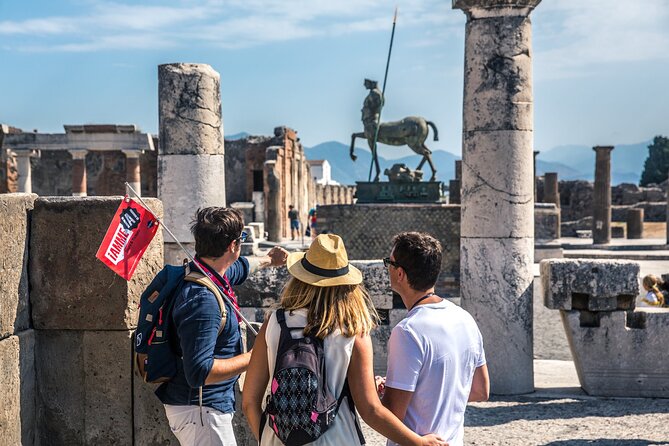
The Pompeii portion is designed to be fast, guided, and high-impact. You get about 2 hours with an official guide inside the Archaeological Park of Pompeii, and admission ticket time is included. After that, the itinerary continues through key stops with shorter time windows.
This setup is ideal if your goal is to see the “greatest hits” of Pompeii—Forum area, Baths, major public buildings, and standout houses—without spending an entire day there. If you love archaeology and could happily spend half a day reading stones (I get it), this might feel a bit brisk. But if you want depth without losing your whole travel day, this format is a smart compromise.
You’ll also notice the itinerary is structured around what the spaces meant: civic life in the Forum, religion and government symbolism near the Temple of Jupiter, commerce in the Macellum, daily street life along the main road, and social routines in the baths.
Skip-the-Line Pompeii Entry: Getting In Without Losing Momentum
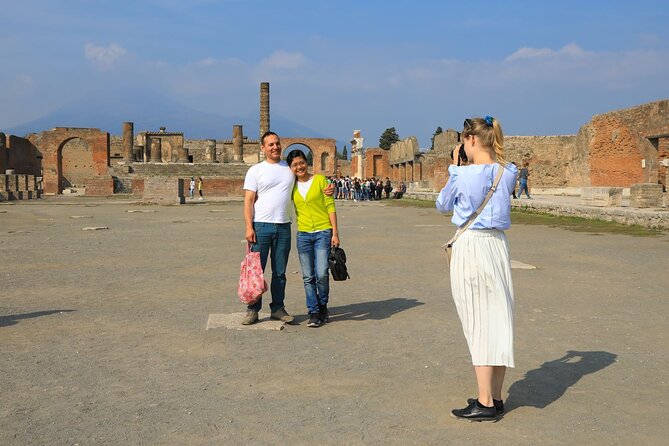
Pompeii is popular, and lines can eat up your energy before you even reach the ruins. This tour includes skip-the-line entrance fees, which matters because your guided time starts once you’re inside.
In practical terms, skip-the-line access helps you:
- Start walking with less waiting
- Keep the guide schedule on track
- Feel like you’re spending time seeing, not queuing
Even if you’re the type who doesn’t mind lines, the guided approach makes your timing more valuable. The fewer pauses you have, the more the guide can connect the buildings into a story.
The Official Guided Walk: What You’ll See in the Archaeological Park

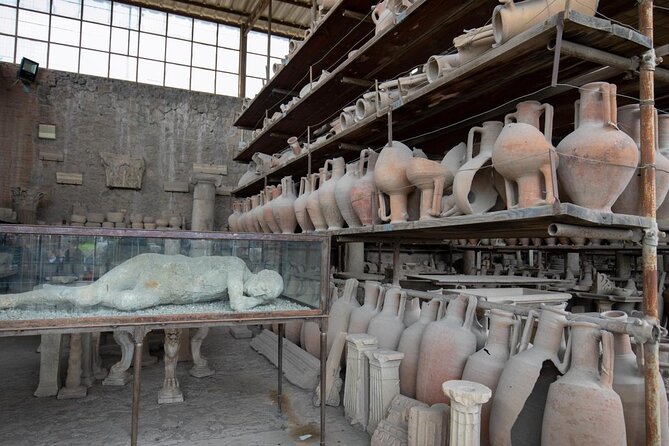
The heart of the experience is the official guided walking tour through Pompeii’s preserved ruins. Pompeii’s big idea is simple and mind-bending: after the eruption of Mount Vesuvius in 79 AD, the city was covered and effectively preserved—manufacts, infrastructures, and daily settings remained frozen in time.
With a guide, you don’t just see scattered walls. You get orientation and context—how streets and public spaces relate, where civic power sat, and why certain buildings were built the way they were. For most visitors, that’s the difference between seeing ruins and understanding a city.
Plan on comfortable footwear. Even if you’re only out for a few hours, Pompeii terrain can be uneven, and the sun can be strong. The tour even suggests sunscreen and comfortable shoes for a reason.
You can also read our reviews of more private tours in Naples






Forum Highlights: The Fast Route Through Pompeii’s Civic Life
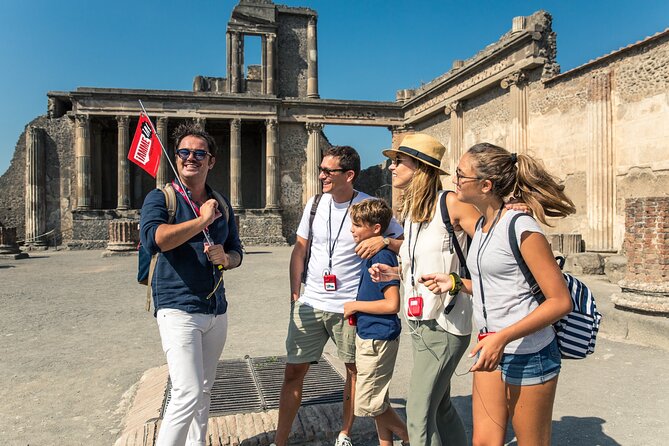
Once your guided walk starts, the itinerary quickly moves into the Forum area—Pompeii’s civic center. This is where daily life, administration, justice, business management, and trade activities converged.
Foro de Pompeya
This stop is about the core of public life: a focal point surrounded by the major civic buildings and also tied to worship. Even with limited time, standing in this space helps you understand how government and religion braided together in Roman cities.
Tempio di Giove Capitolino
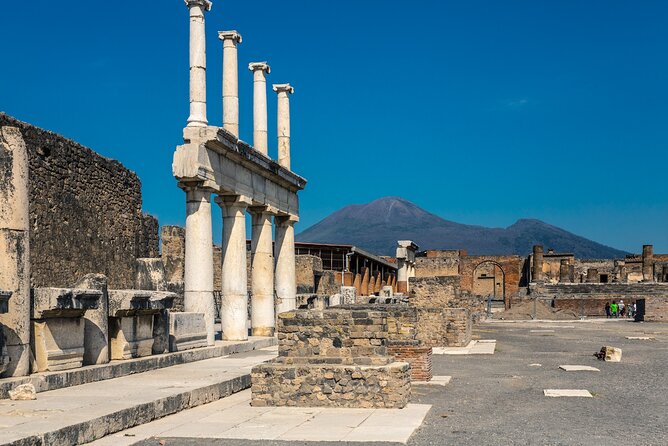
The Temple of Jupiter sits prominently at the north side of the Forum, with Mount Vesuvius visible behind the scene. When the colony was founded, the temple was renovated and became a true Capitolium-type setting with statues of Jupiter, Juno, and Minerva placed to be visible to anyone passing through the Forum square.
If you like symbolic places—buildings that teach you what rulers wanted people to believe—this stop is a good one.
Basilica
The Basilica was Pompeii’s large administrative and justice hub, with space for business and legal functions. It’s impressive not just because of size (about 1,500 square meters), but because it shows how “public life” wasn’t a side activity—it was the city’s engine.
Macellum
This marketplace complex (the Macellum) tells a different story: commerce, food, and even imperial cult influences. It includes an elevated worship hall aligned with the entrance and features niches that held copies of marble statues and references to the emperor cult (with the broader imperial context indicated by fragments found in the area).
Together, these Forum-adjacent stops give you a tight logic: governance, worship, trading, and social structure all overlap in one walkable zone.
Via dell’Abbondanza: The Main Street Feel in a Short Stop
After the Forum core, the itinerary follows the famous street: Via dell’Abbondanza. In ancient Pompeii, this was the main east-west decumanus maximus, lined with shops, workshops (officinae), snack-bars, and restaurants for food and drink.
What makes this useful for you isn’t that you’ll suddenly hear Roman chatter again. It’s that the street layout helps you picture the rhythm of a city: movement from public power toward commerce, and then outward again toward gates and neighborhoods.
This is a great stop for photos too, because it shows the street as a corridor of daily activity rather than only the big standalone monuments.
Stabian Baths: Real Routine, Not Just Pretty Stones
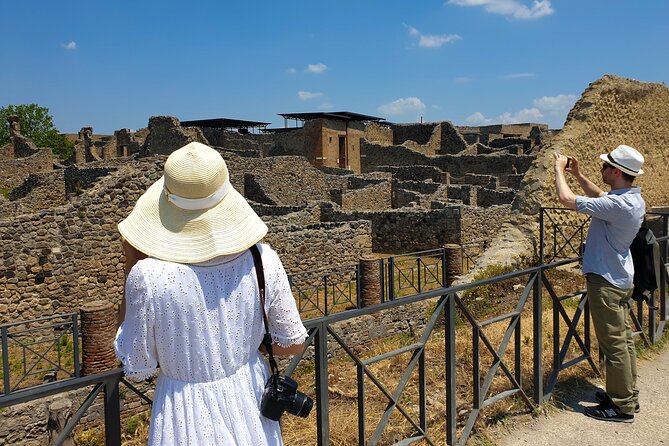
One of my favorite types of archaeological stops is when a ruin helps you understand a routine. The Stabian Baths (Terme Stabiane) do that. They’re located behind the Temple of Jupiter and date back to the early years after Pompeii’s founding.
Even in a short visit, the baths make Roman life feel more human:
- Separate entrances for women and men
- Room sequence including an apodyterium (dressing room) that also served as a tepidarium
- Then areas for cold and hot bathing (frigidarium and calidarium)
The itinerary notes the baths were heavily damaged by the earthquake of 62 AD, so you can read the ruins not just as “old,” but as scars from real events.
If you want Pompeii to feel like a living city, add a little extra attention here. It’s one of the stops most likely to connect to daily life rather than only politics.
Lupanar and Casa del Fauno: Social Life, Status, and a Shock of Preservation
Pompeii isn’t shy, and neither are its standout sites.
Lupanar (Official Brothel)
The Lupanar is one of the most famous official brothels in Pompeii. It’s a small two-story stone building with five rooms on the ground floor and built-in masonry beds. The reason it’s famous is the preservation: erotic frescoes above the doors likely acted like a visual menu, and graffiti left by visitors shows raw glimpses into language and social behavior.
This stop isn’t for everyone, and it can feel like a lot in a short timeframe. But for many people, it’s exactly what makes Pompeii different from other ruins. You see how ordinary people navigated desire, commerce, and social spaces—right down to what they wrote on the walls.
Casa del Fauno (House of the Faun)
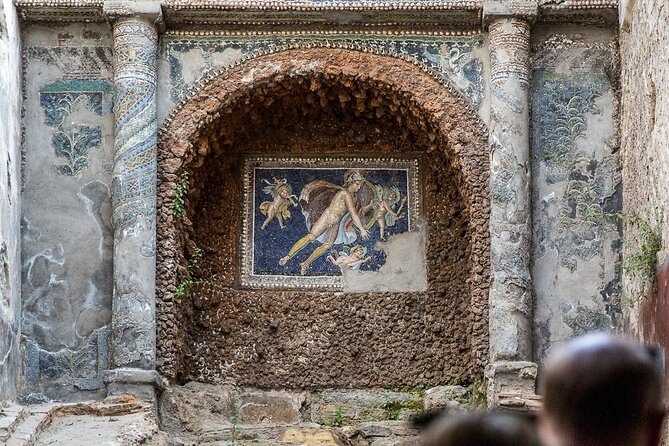
On the flip side, the Casa del Fauno represents aristocratic wealth. Built during the 2nd century BC, it’s one of the largest private residences in Pompeii and housed major pieces of art. The house is described as one of the most luxurious aristocratic homes from the Roman Republic period, and it reflects that era exceptionally well.
If the Forum gives you power and the baths give you routine, Casa del Fauno gives you class. The contrast is the point.
Teatro Grande and the Basilica Area: How Pompeii Entertained Itself
The itinerary doesn’t stop at civic functions. It also includes spaces built for culture and public gathering.
Teatro Grande (Large Theater)
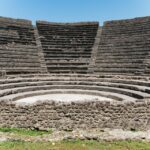
This theater was built into a hillside slope, using the natural depression of the mountain to shape a grand auditorium divided into sectors. The theater’s stage hosted tragedies in the Greco-Roman traditions.
Even if you don’t have a lot of time here, the theatre’s design helps you picture audience flow and the way performances mattered in civic life.
Basilica (again, in the itinerary)
You already saw the Basilica in the civic cluster, but it’s worth noting: Pompeii’s public buildings weren’t just impressive. They made the city function. This stop reinforces that.
Together, these sites help you understand that Pompeii was not only about work and worship. People gathered, watched, argued, traded, and socialized in built spaces meant for those purposes.
Dropped in Sorrento: Door-to-Door Means Less Walking
The end of the tour is also where value shows up. Instead of dropping you at a central bus or train stop, you’ll be taken to Sorrento and delivered directly to your accommodation or your chosen address.
That matters because Sorrento can be hilly, and getting from a drop-off point to lodging can turn into a workout you didn’t plan. Door-to-door service helps your legs and your schedule.
Plan to keep your luggage organized and easy to grab when you arrive. You’ll have transported it all the way through Naples and Pompeii, so it’s worth treating the final minutes as part of the effort.
Price and Value: Is $492.76 Per Person Fair for This Plan?
At $492.76 per person, this isn’t a bargain-basement transfer. But it also isn’t just a taxi ride with a stop sign at Pompeii.
You’re paying for a package that includes:
- Private transportation with an air-conditioned vehicle and a professional driver
- Pickup from Naples and drop-off in Sorrento at your address
- An official local guide at Pompeii for about 2 hours
- Pompeii admission ticket time
- Skip-the-line entrance fees
- Mobile ticketing
For many visitors, that combination is what makes the day feel worth it. One of the most expensive things in travel is time you can’t get back—waiting in lines, trying to match bus schedules, or spending hours on directions instead of sights.
If you’re traveling with someone and you split costs, the value gets more compelling. If you’re solo, it’s still reasonable when you consider how much guided time and entrance handling you’re getting, plus the fact you’re not stuck finding your own way between Naples and Sorrento.
What you don’t get is lunch or beverages. That’s normal for many half-day tours, but it changes how you should plan your day. If you’re prone to getting hangry (join the club), plan on eating right after the drop-off or building a snack into your schedule.
Luggage and Comfort Tips That Will Actually Help You
The tour includes a luggage allowance of 1 medium or big suitcase per passenger seat + 1 small item (like a laptop bag, camera bag, or small shoulder bag). The supplier notes you should double-check vehicle capacity, which is smart because vehicles and seat counts can vary.
Comfort tips that match what the tour setup implies:
- Wear comfortable shoes. Pompeii ground can be uneven.
- Bring sunscreen. The tour specifically suggests it, and summer heat is real.
- Keep water in mind, since lunch and beverages are not included.
And yes: Pompeii in a short schedule means you’ll move more than you expect. If your idea of a perfect museum day is slow and sit-down heavy, you might feel rushed. If you like seeing a lot with a guide and then continuing your trip refreshed, you’ll likely love this format.
Who This Tour Is Best For
This is a strong fit if you:
- Want a stress-free way to get from Naples to Sorrento without DIY transfers
- Prefer a guide to help you understand Pompeii in a limited time window
- Like efficient plans that still feel authentic, especially for first-time Pompeii visits
- Have luggage and want it handled by a private vehicle rather than bus carriers
It may not be the best choice if you:
- Want to spend hours lingering in one area (this itinerary is time-efficient)
- Need long breaks for meals during the day (lunch isn’t included)
- Are sensitive to heat and walking pace during summer
Should You Book This Naples to Sorrento + Pompeii Guided Tour?
I think this is worth booking if you want Pompeii without derailing your travel schedule. The private transfer plus guided Pompeii time plus skip-the-line entry is a practical mix, and the door-to-door drop-off in Sorrento is the kind of convenience that pays off the moment you arrive.
But be honest with yourself about timing. If you’re the type who wants to linger in the most famous spaces and read every inscription, this may feel like a highlight sprint. If your goal is to see the essentials with a guide, get the story behind the ruins, and still enjoy your evening in Sorrento, then this plan is a smart match.
FAQ
How long is the tour from Naples to Sorrento with Pompeii?
It runs about 4 to 5 hours (approx.).
Where can the driver pick me up in Naples?
Pickup is offered from the hotel, airport, train station, or port in Naples.
Is Pompeii admission included?
Yes. The tour includes the Pompeii admission ticket(s) and skip-the-line entrance fees.
Is lunch or drinks included?
No. Lunch and beverages are not included.
What luggage can I bring?
You can bring 1 medium or big suitcase per passenger seat plus 1 small item (like a laptop bag or small shoulder bag). You should double-check vehicle capacity with the local supplier.
Can I cancel and get a full refund?
Yes. You can cancel up to 24 hours in advance for a full refund. Cancellation cutoff is based on local time.