REVIEW · POMPEII
Skip the Line Private Pompeii Guided Tour
Book on Viator →Operated by CIAO TOURS · Bookable on Viator
Pompeii can feel overwhelming fast. This private skip-the-line guided tour helps you get inside the ancient city quickly so you can focus on what you came for. I like that the route is tight enough to cover major highlights without turning your day into a walking endurance test.
What really makes this work is the private attention. You get an expert guide to point out what matters—then you can ask questions as you go, instead of shouting over strangers at group speed. One caution: Pompeii admission fees aren’t included, so your real total cost may be a bit higher than the $82.65 you see first.
You’ll start at Porta Marina, then spend about 2 hours moving through some of Pompeii’s best-known stops. If you’re hoping to linger all day and wander randomly, a 2-hour highlights format may feel a little quick.
In This Review
- Key things I’d bookmark before you go
- Why Pompeii feels big—and how this tour keeps you moving smart
- Price and value: the $82.65 question you should actually ask
- The logistics that matter: where you meet and how long you’ll be inside
- Pompeii Archaeological Park: the highlights sweep that sets the tone
- Temple of Apollo: a quick stop with a big “why” behind it
- The Forum of Pompeii: the main square you’ll keep recognizing
- Contemporary art at Pompeii: Igor Mitoraj’s monumental sculptures
- Granai del Foro and Terme del Foro: storage and bathing in the same run
- Casa del Poeta Tragico: a mosaic stop that rewards attention
- Casa del Cinghiale: mosaics in another house
- Teatro Grande: theater for tragedies and comedies
- Lupanar: the house with erotic frescoes
- Tempio di Venere and Tempio di Giove Capitolino: the forum’s religious contrast
- What the guide experience feels like (and why it matters)
- Should you book the Skip the Line Private Pompeii Guided Tour?
- FAQ
- Is Pompeii admission included in the tour price?
- How long is the tour?
- Where do I meet the guide?
- Is this a private tour?
- Do I choose a morning or afternoon time?
- What’s included besides skip the line?
- Are there any requirements for tickets?
- Can I cancel and get a full refund?
Key things I’d bookmark before you go
- Skip-the-line entry that saves time right when Pompeii is busiest.
- Private tour means your questions and pace actually matter.
- Two-hour, highlight-focused route across temples, forums, baths, homes, and theaters.
- Forum-area stops with strong variety (museums, baths, markets/storage spaces, and big public buildings).
- Mosaics and erotic fresco art history mix through Casa del Poeta Tragico, Casa del Cinghiale, and the Lupanar.
- Morning or afternoon timing options so you can match your energy level and schedule.
Why Pompeii feels big—and how this tour keeps you moving smart
Pompeii is famous for a reason. It’s not just one photo spot. It’s an entire old city, spread out and easy to lose your bearings in. Without a plan, you can spend a lot of time asking yourself where to go next.
That’s where this tour fits you. It’s designed as a fast, guided route through the “greatest hits,” so you aren’t walking in circles trying to figure out the layout. The private setup also matters here. When you’re not stuck with a large group, the guide can slow down when something catches your interest and speed up when you just want the next landmark.
This is also a good format for people who want context. Seeing ruins is one thing. Understanding why they’re placed where they are—public spaces versus homes versus religious sites—helps the site click faster.
You can also read our reviews of more guided tours in Pompeii

Price and value: the $82.65 question you should actually ask
At $82.65 per person, you’re paying for two big things: a tour guide and skip-the-line access. That’s a real value if your time is limited or if you know you don’t want to spend your precious hours in queue lines.
One wrinkle: admissions fees for Pompeii Ruins are not included. The tour listing separates the general park admission from the scheduled stops. In the itinerary details, you’ll also see that some stops list admission as included and one stop (the main Pompeii Archaeological Park entry) lists admission as not included.
So here’s how I’d budget it: plan on paying for the Pompeii admission separately, then use this paid tour to get guided, timed access through the most important areas.
If you’re the type who loves a slow, self-guided loop and doesn’t mind waiting, you might question whether skip-the-line is worth it. But if you want efficiency plus explanation, this is priced like a time-saver with a human brain attached.
The logistics that matter: where you meet and how long you’ll be inside
You meet at Pompei-porta Marina (scavi80045), Pompeii. Your tour ends back at the same meeting point, which is handy when you’re planning the rest of your day.
The tour runs about 2 hours. Each listed stop is short—often around 5 to 20 minutes—so you’re getting a guided survey rather than a deep, slow study of one house or one temple. That’s not a bad thing. It’s what keeps the experience doable in a couple of hours.
You also have morning or afternoon choices. If you’re juggling a full itinerary around Naples, Sorrento, or the Amalfi Coast, this flexibility can be more valuable than you’d think.
And yes, it’s private: only your group participates. That tends to make tours feel less like a stampede and more like you’ve got a knowledgeable local walking partner.
Pompeii Archaeological Park: the highlights sweep that sets the tone
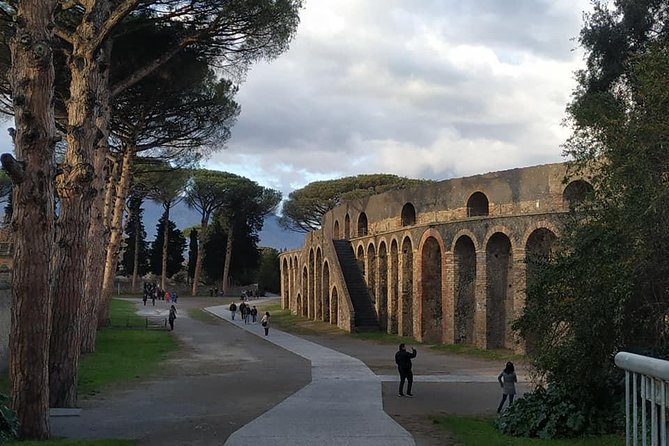
Stop 1 is the Pompeii Archaeological Park itself, with a guide-led overview. The time listed is 2 hours, and this is where the tour’s “you get the story quickly” energy starts.
This isn’t a random wander. You’ll be shown key types of spaces that define how Pompeii functioned as a city, including:
- Theaters
- The Forum
- Temples
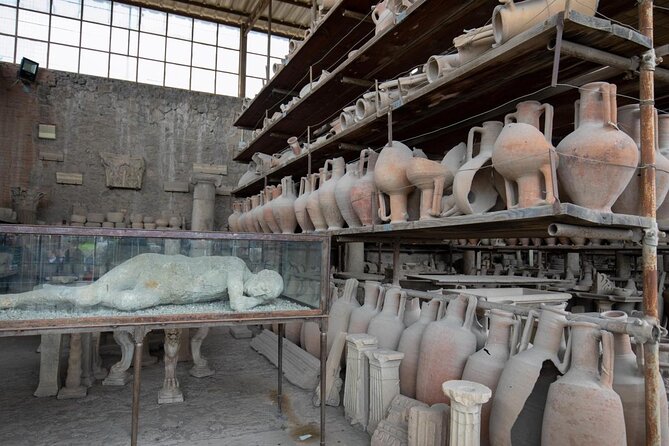
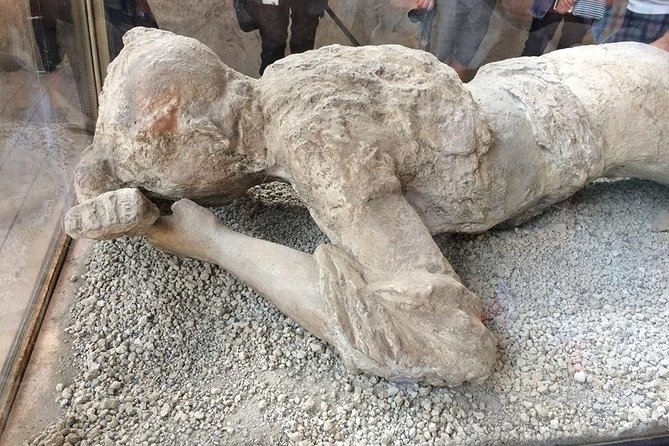
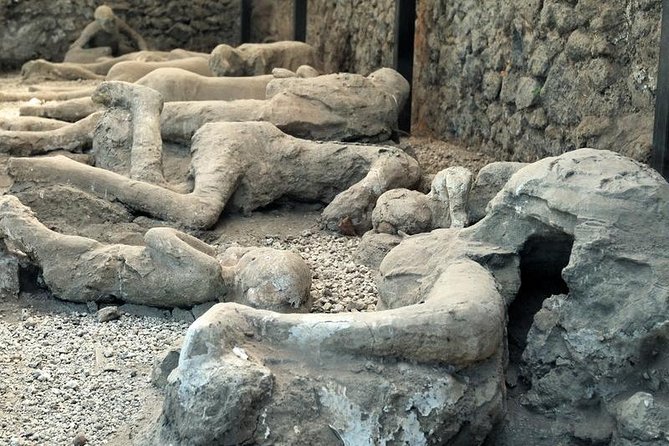
- Plaster casts
- Baths
- The Brothel
- Roman villas
Two practical benefits come from starting with this broad sweep. First, you learn what you’re seeing before you see it. Second, later stops make more sense because the guide has already framed the city’s main layout and themes.
A small consideration: because it’s a highlights format, you’ll get impressions rather than hours of close-up attention. If you love ultra-detailed museum-style study, you might want to plan additional time on your own.
Temple of Apollo: a quick stop with a big “why” behind it
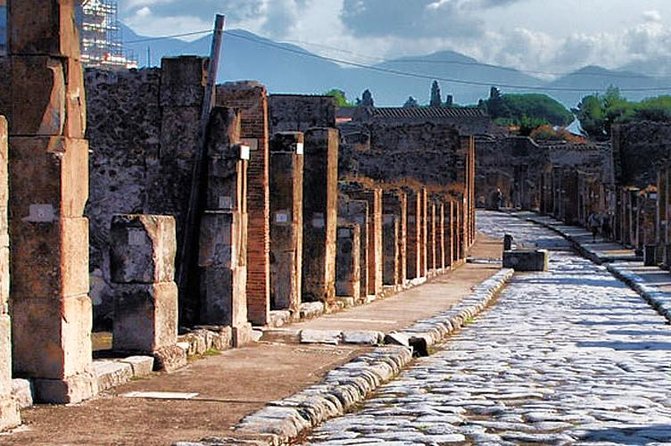
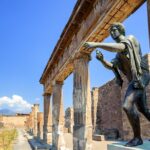
Next is the Temple of Apollo, scheduled for 10 minutes. The tour description points out it as one of the beautiful temples, and the value here is time efficiency: you see a major religious landmark without the tour becoming an endless series of short “check marks.”
Even in a short stop, a guide can help you understand how temples work as focal points in an ancient city. That’s the real win: you’re not just passing by stone, you’re getting the context of what this kind of building meant.
You can also read our reviews of more private tours in Pompeii




The Forum of Pompeii: the main square you’ll keep recognizing
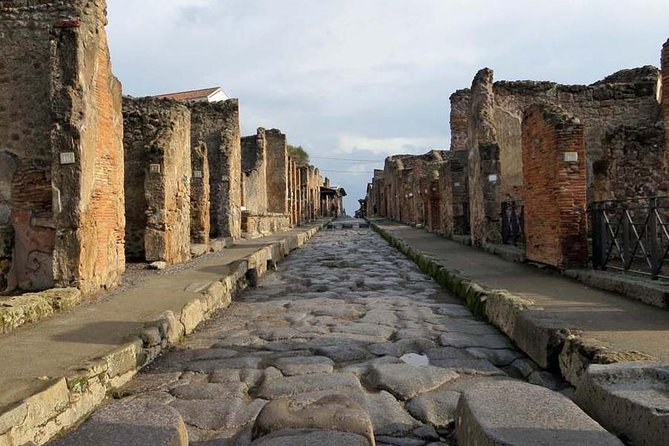
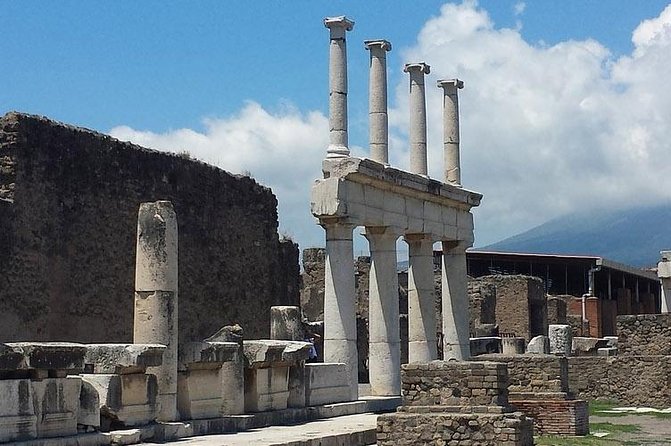
Stop 3 is the Foro de Pompeya (the main square), with 20 minutes. This is where Pompeii starts to feel like a functioning community rather than a scattered set of monuments.
The guide-led forum time is especially useful because the Forum connects themes: civic life, religious presence, public space, and day-to-day movement. If you remember only one area as the heart of Pompeii, this is the one to lock in.
Contemporary art at Pompeii: Igor Mitoraj’s monumental sculptures
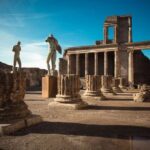
Then you’ll step into a more modern layer of the site: Sculture Monumentali di Igor Mitoraj. This stop is listed as 10 minutes.
Why does this belong on an ancient-city tour? Because it changes how you experience the space. You’re still in Pompeii, but you get a moment where the ruins aren’t only about the past—they’re also about how people today respond to ancient environments.
A practical point: this is short on purpose. Don’t expect a long art critique. Expect a quick “you’re here, look at this, notice how it fits the setting” pause.
Granai del Foro and Terme del Foro: storage and bathing in the same run
Two of the most interesting practical spaces come next:
- Granai del Foro (Granaries of the Forum), a 20-minute museum stop.
- Terme del Foro (Forum Baths), another 20-minute stop, described as one of the best-preserved baths in Pompeii.
This pairing works because it shows two sides of city life. Granaries connect to food supply and daily needs. Baths connect to public routine and the idea of communal spaces that many people used.
One drawback to consider: baths and storage spaces can feel less dramatic than theaters or big mosaicked houses if you’re expecting constant wow-factor photos. But that’s exactly why they’re valuable. They round out the story so Pompeii feels lived-in, not just staged.
Casa del Poeta Tragico: a mosaic stop that rewards attention
Stop 7 is Casa del Poeta Tragico, with 10 minutes. The description calls out a mosaic and it’s a classic example of why a guide helps.
A mosaic can be visually striking on its own, but a guide can help you notice what you’re looking at and place it within the broader idea of the home and its decorative choices.
This is also a good reminder that the most famous features in Pompeii aren’t only buildings. They’re artwork, design, and the way people lived with beauty at home.
Casa del Cinghiale: mosaics in another house
Stop 8 is Casa del Cinghiale, also 10 minutes, and it’s described as a house full of mosaics.
If you like mosaics, you’ll probably enjoy this stop. If you don’t, it still works because the guide-led comparison between two house stops helps you see variety in how Pompeii’s wealthy (or at least well-off) homes displayed art and style.
Teatro Grande: theater for tragedies and comedies
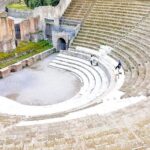
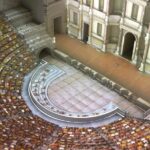
Stop 9 is Teatro Grande, scheduled for 20 minutes. The tour notes it as the theater for comedies and tragedies.
This part tends to be more emotional for many people because you can imagine crowds, performances, and public gathering. Again, a guide keeps it from becoming just visual sightseeing by explaining what kind of performance spaces these theaters served.
If you’re a fan of architecture or public spaces, spend your attention here. It’s one of those “this is why people built places like this” stops.
Lupanar: the house with erotic frescoes
Stop 10 is the Lupanar, listed as 20 minutes. The tour describes it as an ancient house known for erotic frescoes.
This stop is for people who want to see the less-polished side of Pompeii’s everyday life. It’s also the kind of location where having a guide’s framing can help you process it historically rather than just as shock value.
It’s short enough to keep things moving, but long enough to actually see what’s there and understand the significance.
Tempio di Venere and Tempio di Giove Capitolino: the forum’s religious contrast
Stops 11 and 12 wrap up the route with two temples:
- Tempio di Venere for 5 minutes, described as one of the first temples of Pompeii.
- Tempio di Giove Capitolino for 5 minutes, described as the temple of the forum.
These are quick hits, which makes sense because the tour is designed to cover many major locations. Still, they’re useful for giving you that “religious layer” of the city immediately after you’ve been in the forum and before you head back.
What the guide experience feels like (and why it matters)
One of the strongest signals from the experience is how personal and complete the guiding felt. One review specifically thanked Paolo for making the tour very interesting, complete, and enriching. That kind of feedback is exactly what you want from a Pompeii guide: not just facts, but clarity.
In practice, that means you’re not left staring at ruins with no idea what matters. You’re getting a map in your head as you walk. And because it’s private, the guide can adjust when you ask questions.
Even if you’re comfortable traveling solo, this kind of guidance often saves you from common Pompeii frustrations: standing in the wrong area, missing a key landmark, or learning something after you’ve already walked past it.
Should you book the Skip the Line Private Pompeii Guided Tour?
Book this tour if:
- You want efficient Pompeii highlights in about 2 hours
- You’d rather spend your time looking than waiting in lines
- You like guided context and the chance to ask questions
- You want a private experience instead of a crowded shuffle
Skip it (or add extra independent time) if:
- You want to stay at Pompeii for most of the day
- You prefer roaming freely with no structure
- You’re only interested in one or two sites and don’t care about the broader sweep
If you’re on a tight schedule and you want Pompeii to feel coherent instead of chaotic, this is a strong, practical choice. The skip-the-line piece plus expert guiding is a simple recipe: more ruins, less time lost.
FAQ
Is Pompeii admission included in the tour price?
The tour listing says admissions fees Pompeii Ruins are not included. However, the itinerary notes that admission tickets are included for several specific stops.
How long is the tour?
The tour runs about 2 hours (approx.).
Where do I meet the guide?
The meeting point is Pompei-porta Marina (scavi80045), Pompeii.
Is this a private tour?
Yes. It’s described as a private tour/activity, so only your group participates.
Do I choose a morning or afternoon time?
Yes. You can choose morning or afternoon tour times to match your schedule.
What’s included besides skip the line?
The listing includes tour guide service and skip the line.
Are there any requirements for tickets?
Confirmation is received at booking, and the tour offers a mobile ticket. You’ll still need to account for Pompeii admission fees listed as not included.
Can I cancel and get a full refund?
Yes. You can cancel for a full refund up to 24 hours in advance of the experience start time.