REVIEW · POMPEII
Late Afternoon Best time to visit Pompei on a private tour
Book on Viator →Operated by Alex Tour · Bookable on Viator
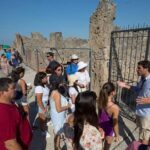
Pompeii in softer light feels different. This late-afternoon private tour helps you see the big moments without the early start, with golden-hour walking through the UNESCO site while your guide brings the AD 79 eruption to life. I love the focus on the main stories and the quick, smart pacing that still leaves room for questions and pauses. I also like that the guide works around real crowds by choosing where to spend time, including options for a standout house when it is less busy. One thing to consider: you still need an entrance ticket (18 euros for adults) and the tour depends on good weather.
With only your group, you get personal attention at every stop. You’ll move between signature sights like the Forum, the Temple of Apollo, the Stabian Baths, and the House of Menander, plus the plaster casts that show what the victims looked like in their last seconds. The possible drawback is timing: because you visit later in the day, you should plan for a sunset feel, but also accept that your exact light and comfort level depend on weather and how quickly the site feels crowded.
In This Review
- Key highlights you’ll actually notice on this tour
- Why late afternoon is the smart move for Pompeii
- Getting your bearings at Porta Marina (sea gate) and AD 79 context
- Stop-by-stop: what you see and what to watch for
- The Forum (main square) and how public life shows up in ruins
- Temple of Apollo: myths, symbolism, and what people valued
- Stabian Baths (Terme Stabiane): Roman engineering with human habits
- Teatro Grande: the Greek theatre that hosted Roman audiences
- House of Menander: frescoes and mosaics with real decorative storytelling
- Panificio di Popidio Prisco: a 2,000-year-old bakery in action
- Termopolio di Vetuzio Placido: ancient street food culture
- Orto dei Fuggiaschi: plaster casts that force you to feel the scale
- Why the guide’s choices matter more than you think
- Timing, pace, and the comfort reality check
- Price and value: is 249 dollars a good deal?
- Who should book this late-afternoon Pompeii tour?
- A few practical details that affect your day
- Should you book it? My straight answer
- FAQ
- How long is the Pompeii private tour?
- Where does the tour start?
- Where does the tour end?
- Is the entrance ticket included in the price?
- What is included besides the guide?
- Can the guide help with skip-the-line tickets?
- Is this a private tour?
- What does the tour cover at Pompeii?
- Is the tour dependent on weather?
- Are service animals allowed, and is it near transit?
Key highlights you’ll actually notice on this tour
- Golden light timing that makes Pompeii easier on your eyes and feet
- A private licensed guide (Alex Tour) who adjusts the route to crowd levels
- AD 79 explanation early on, so the site makes sense as you walk
- Victim plaster casts that turn the tragedy into something you can picture
- Stop-by-stop Roman life: baths, theatre, water system, shops, and household art
- Entrance tickets separate, with optional skip-the-line support on request
Why late afternoon is the smart move for Pompeii
Pompeii can be intense. The site is huge, the stones can be hot, and the best viewpoints tend to get crowded first. That’s why I like this timing: you’re not waking up at an hour that feels designed to test your willpower. Instead, you’re arriving when the air is often cooler and the crowds can be thinner than earlier slots.
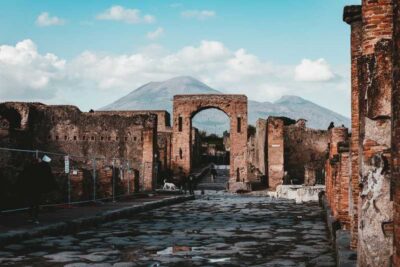
The other big benefit is light. This tour specifically calls out Pompeii washed in golden light during sunset, and that matters more than it sounds. When you see the Forum, the baths, and the streets in warmer tones, the place reads like a lived-in city—not just a set of ruins. It also helps photos, sure, but the bigger win is emotional. The textures of stone, the geometry of streets, and the way the plaster casts sit in their space land harder when the lighting is kind.
Finally, a private format changes everything. With only your group, you can ask questions at the moment they pop into your head instead of saving them until the tour ends. Your guide can also choose which house makes sense based on what the site looks like that day.
You can also read our reviews of more private tours in Pompeii


Getting your bearings at Porta Marina (sea gate) and AD 79 context
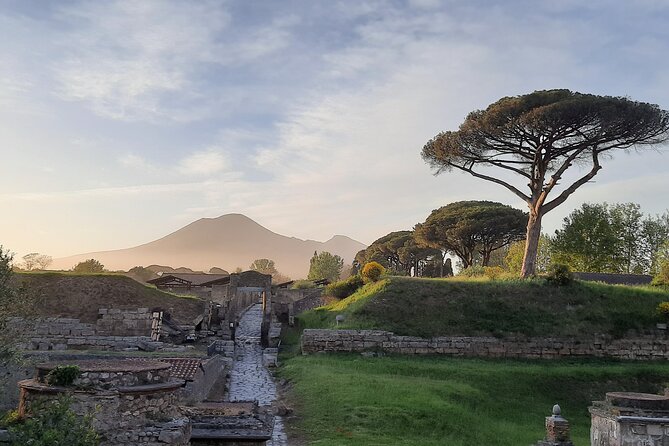
The tour starts at Via Villa dei Misteri, 2, 80045 Pompei NA, and you begin at Porta Marina, the sea gate. That’s a useful first step because it places you at the edge of how people moved in and out of the city. It is also a good mental warm-up: you get an intro to the dynamics of the eruption and the historical background before you jump into rooms, streets, and buildings.
This is where the guide’s story work pays off. You’re not just collecting facts. You’re learning the chain reaction—what happened in AD 79 and what people would have felt in the moment—so later stops make immediate sense. If you’ve ever toured a major archaeological site and felt lost halfway through, this kind of setup helps prevent that.
Practical note: Stop 1 is where you’ll likely cover the densest “big picture” ground. It also includes a mix of architecture and everyday life, so it sets the tone for the rest of the walk.
Stop-by-stop: what you see and what to watch for
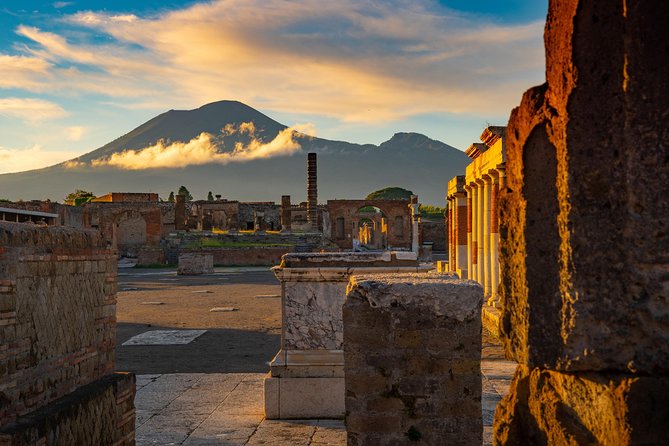
The Forum (main square) and how public life shows up in ruins
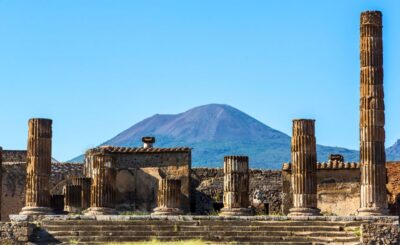
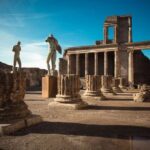
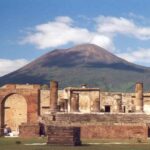
Next you hit the Forum, described as Pompeii’s main square and the center of political, economic, religious, and social life. This is the heart of the city’s routine—where civic decisions happened, where people gathered, and where the city’s power was visible in stone and steps.
A good guide helps you see the Forum as an operating system, not a postcard. Watch for how the layout channels movement and attention. When you understand who used which spaces, the Forum stops feeling like a big empty stage and starts feeling like a place that once ran every day.
This stop is short on paper, but it is the type of stop where a minute of explanation can save you from wandering in circles.
Temple of Apollo: myths, symbolism, and what people valued
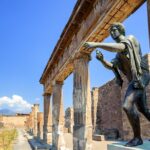
Then comes the Temple of Apollo. This is a mythology stop, but it is really about how religion and civic identity intertwined. When you stand in front of it, you can usually connect the idea of gods to the way the city organized its public life.
If you like seeing how ancient people explained the world, this one clicks. Even if your interest is mostly practical (life, trade, engineering), it still adds a layer: it shows what Pompeii’s leaders and citizens believed mattered enough to build and maintain.
Time is brief here, so keep an eye out for standout details your guide calls attention to, because that’s usually where the meaning lives.

Stabian Baths (Terme Stabiane): Roman engineering with human habits
The Stabian Baths are a favorite stop for a lot of people because baths are universal. Everyone understands why people would want heat, water, and a place to talk. This is also where Roman engineering becomes visible in plain sight.
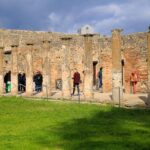
The tour gives you about 15 minutes at this stop. That’s not long, but it is enough to grasp how the bath complex worked and how it fit into daily social life. Think of it as architecture built for routine—rooms arranged for warmth and movement—and not just a preserved building.
If you’re the type who likes to picture crowds doing ordinary things, this stop is a strong candidate to slow down for a moment and really scan the space.
Teatro Grande: the Greek theatre that hosted Roman audiences
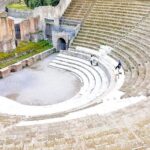
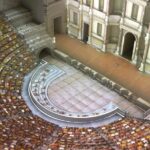
Next is Teatro Grande, the Greek theatre. Pompeii’s theatre scene is a big part of why people remember the site as more than a tragic snapshot. The city had public entertainment, and the theatre is one of the clearest expressions of that.
You’ll have about 15 minutes here. That may sound short, but theatre spaces work like theaters anywhere: a little framing from your guide helps you understand how sightlines and the shape of the room affected the experience.
If you’re visiting with teens or kids, theatre often turns into an instant hook. It is one of the easiest places to connect the past to something familiar.
House of Menander: frescoes and mosaics with real decorative storytelling
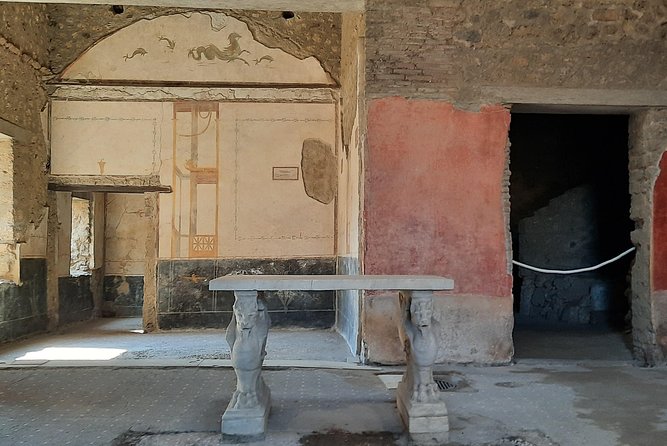
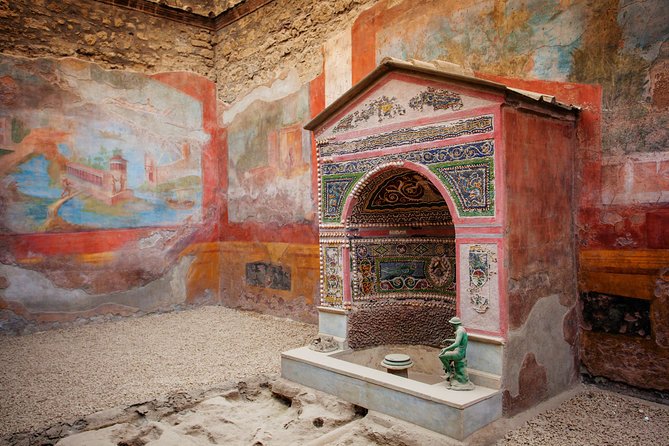
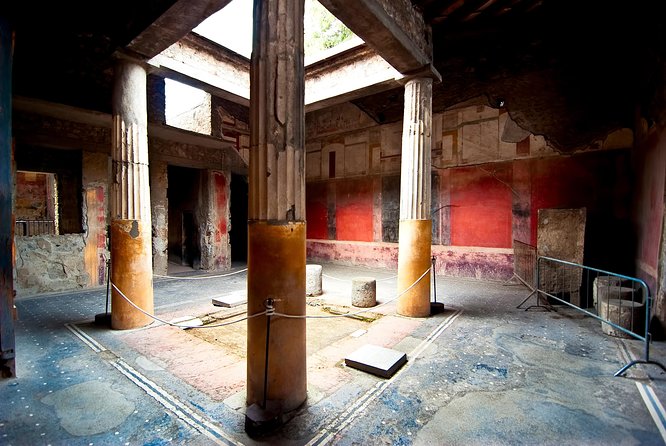
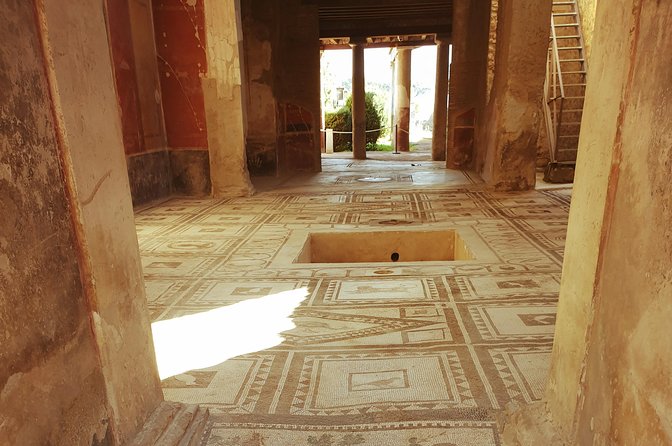
Then you step into Casa del Menandro, a rich Roman domus with fresco paintings and mosaics. This stop is about how wealth and taste showed up inside private rooms—where art wasn’t just decoration, but a way of signaling status and values.
You get around 20 minutes, which is better than the quick look you get on some tours. In this home, the pacing matters because you’ll want time to notice multiple details rather than just snapping one impressive picture.
A practical tip: take your time on the first room your guide points out. Once you understand the “language” of the decoration style, the rest of the house becomes easier to read.
Panificio di Popidio Prisco: a 2,000-year-old bakery in action
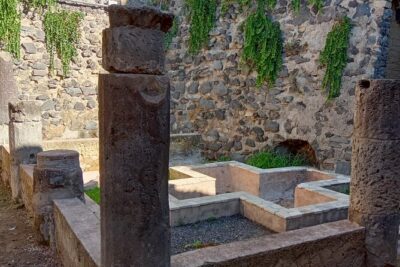
Next is Panificio di Popidio Prisco, described as a bakery that dates back roughly 2,000 years and includes an oven and mills. This is the kind of stop that makes Pompeii feel real again. People ate. People worked. Machines turned flour into food.
It’s short (about 10 minutes), but that’s perfect for this type of site. Milling and baking gear can be visually confusing if you don’t have someone framing what you’re looking at. Your guide’s job here is to help you connect the physical pieces to the daily process.
If you love food history, this one alone can make the whole afternoon feel worth it.
Termopolio di Vetuzio Placido: ancient street food culture
Then you’ll see Termopolio di Vetuzio Placido, described as ancient street food. Termopolia were like quick-service places—stop in, get a hot drink or a fast bite, keep moving.
This is only about 5 minutes, so it is more of a “flash” moment than a deep inspection. Still, it does something important: it shows Pompeii as a city of habits and shortcuts, not just temples and palaces.
If you want a tour that touches daily life rather than only big monuments, these food stops are a big part of why this format works.
Orto dei Fuggiaschi: plaster casts that force you to feel the scale
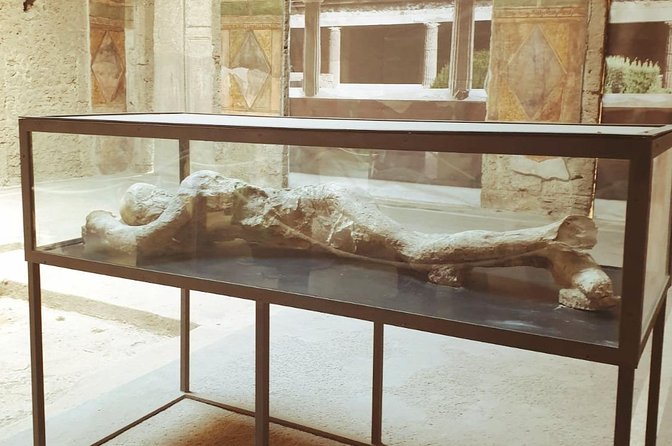
The tour ends with Orto dei Fuggiaschi, the plaster casts of the victims of the eruption. This is the emotional center. You’re not just reading about disaster—you’re looking at preserved forms created from the tragedy, placed so you can understand what happened.
Expect to feel it. Pompeii is already moving, but this stop is different. Even if you’re emotionally tough, it is hard not to react. The guide context matters here, too—because it helps you remember that these weren’t skeletons or generic figures. They were people caught in a specific moment.
Time is about 15 minutes. That may not sound long, but it is enough to take it in without turning it into a checklist.
Why the guide’s choices matter more than you think
This tour includes a private licensed guide, and that shows up in the way the route is paced. In particular, the “rich house” portion is described as a choice based on crowd levels, opening rotation, or your request. That’s smart.
Large sites like Pompeii can turn slow if you’re stuck waiting, weaving, or detouring. When a guide picks a house that is actually workable on the day you’re there, you save time and you see more of the details that made the house special in the first place.
This is also where private format feels worth the money. You’re not trapped behind a group pace. If you want extra time at the baths or a minute more at the mosaics, your guide can usually adjust without turning the tour into chaos.
Timing, pace, and the comfort reality check
The tour runs about 2 hours. The stops are short-to-medium lengths, and the order is built to keep you moving while still hitting the major themes: civic life, religion, daily work and food, Roman entertainment, and the eruption’s aftermath.
Late afternoon pacing is a plus, but I’ll tell you the honest part: footwear still matters. Pompeii is uneven. You’ll be walking a fair amount over cobblestones and stone paths. Bring shoes that can handle that without your feet complaining by stop three.
Also, plan for weather. The experience requires good weather, and if it is canceled due to poor weather you’ll be offered a different date or a full refund.
Price and value: is 249 dollars a good deal?
The price is listed at $249, and that is for the private tour. Entrance tickets are not included—18 euros for adults, free under 18.
Here’s how I think about value:
- You’re paying for a private licensed guide, not just someone walking you around.
- The itinerary includes a lot of high-interest stops (Forum, Temple of Apollo, major baths, theatre, domus, bakery, termopolio, and Orto dei Fuggiaschi).
- You’re visiting during a time window that helps with heat and crowds, which means you enjoy the experience more, not less.
If you were to do this with no guide, you’d likely spend more time trying to interpret what you’re seeing and you might miss the story connections that turn ruins into a city. For small groups, that interpretive value is often what justifies the price.
If you’re traveling alone, 249 dollars might still feel steep, but private tours can be worth it if Pompeii is a top priority and you want the best use of your limited time.
Who should book this late-afternoon Pompeii tour?
I’d book this if you:
- Want the highlights without a full-day slog
- Care about understanding AD 79, not just seeing walls
- Prefer smaller, more flexible attention (your group only)
- Like a mix of big landmarks and everyday life, including food and household art
- Are traveling with teens who can handle a story-driven walking pace
It is also a strong choice for families who want a meaningful experience without starting at dawn.
A few practical details that affect your day
You’ll start at Via Villa dei Misteri, 2, and the tour ends back at the meeting point. The itinerary notes a mobile ticket, and confirmation is received at booking time.
Service animals are allowed, and the start area is near public transportation.
One more practical item: while entrance tickets aren’t included, the guide can buy skip-the-line tickets on request. If you want that, ask in advance when you book so you’re not scrambling once you arrive.
Should you book it? My straight answer
Book it if Pompeii is your priority and you want a late-afternoon visit that balances emotion, context, and practical pacing. The combination of private guiding, a tight 2-hour flow, and a route that includes both Roman daily life and the AD 79 tragedy makes this feel like a smart use of time.
Pass (or consider another format) if you hate walking on cobblestones, need long stops in every room, or are visiting only for the bare minimum of monuments. This tour is built for efficient, story-first seeing—not slow wandering.
FAQ
How long is the Pompeii private tour?
It runs about 2 hours.
Where does the tour start?
The meeting point is Via Villa dei Misteri, 2, 80045 Pompei NA, Italy.
Where does the tour end?
It ends back at the meeting point.
Is the entrance ticket included in the price?
No. Entrance tickets are not included. Adults are 18 euros, and under 18s are free.
What is included besides the guide?
The tour includes a private licensed guide. You’ll also use a mobile ticket for the experience.
Can the guide help with skip-the-line tickets?
Yes. Skip-the-line tickets can be bought by the guide on request.
Is this a private tour?
Yes. It’s a private tour/activity, and only your group will participate.
What does the tour cover at Pompeii?
You’ll visit major sights such as the Forum, Temple of Apollo, the Stabian Baths, Teatro Grande, Casa del Menandro, a bakery stop, a street food stop, and the plaster casts of the victims.
Is the tour dependent on weather?
Yes. The experience requires good weather. If it’s canceled due to poor weather, you’ll be offered a different date or a full refund.
Are service animals allowed, and is it near transit?
Service animals are allowed. The meeting area is near public transportation.