REVIEW · POMPEII
Pompeii: Guided Tour with Priority Entrance
Book on Viator →Operated by IAMME IA! - Gray Line Amalfi Coast · Bookable on Viator
Skip-the-line changes how Pompeii feels. This guided tour gets you into the Pompeii ruins faster and keeps you on track with headsets, even when the paths get crowded. Still, you’re outdoors on uneven ground with serious heat, so comfortable shoes and a water plan matter.
In about 2 hours 30 minutes, you’ll hit the Pompeii core that most people want first: the Forum sites, the Stabian Baths, the House of the Faun (including the Alexander Mosaic), and the Large Theater.
In This Review
- Key takeaways before you go
- Priority Entrance at Pompeii: Where the Value Shows Up
- Meeting at Camping Zeus: Getting Oriented Fast
- How the Headsets Change the Pompeii Experience
- The Pompeii Forum Route: Basilica, Civil Forum, and Temple of Jupiter
- Civil Forum: City life in one focal square
- Basilica: Where business and justice happened
- Temple of Jupiter: Power with Vesuvius behind it
- Macellum and Via dell’Abbondanza: Market Life You Can Almost Hear
- Macellum: A market with worship built in
- Via dell’Abbondanza: The main street’s old noise
- Stabian Baths and the Lupanar: Routine, Ritual, and Controversy
- Stabian Baths (Terme Stabiane): How people cooled down and warmed up
- Lupanar: The famous brothel and its wall paintings
- House of the Faun and the Large Theater: Art and Entertainment
- House of the Faun: The Alexander Mosaic
- Large Theater: Where crowds gathered for performances
- Walking, Timing, and the Heat Reality Check
- Price and Value: What You Get for About $59
- Should You Book This Pompeii Priority Entrance Tour?
- FAQ
- How long is the Pompeii guided tour with priority entrance?
- Is the tour offered in English?
- What’s included in the price?
- Where is the meeting point?
- What group size should I expect?
- Do I need good weather?
- Can I cancel and get a full refund?
Key takeaways before you go
- Priority entrance helps you start seeing rather than waiting.
- Headsets make it easier to keep up in a loud, busy outdoor site.
- You’ll focus on the Forum and daily-life stops, not just big “pretty” ruins.
- The tour includes high-interest buildings like the Temple of Jupiter, Stabian Baths, and the Lupanar.
- With a max group size of 25, the pacing is usually manageable.
Priority Entrance at Pompeii: Where the Value Shows Up
Pompeii is one of those places where timing matters. Even when you know what you want to see, lines and crowding can eat your day. This tour is built around skip-the-line admission, which means you can use your best energy for the ruins instead of standing around at the gate.
That priority is especially valuable because the site is a wide spread of streets, buildings, and terraces. If you arrive late or get stuck waiting, you lose the chance to enjoy each stop instead of rushing between them. Also, Pompeii tours tend to sell quickly (this one is commonly booked around 42 days in advance), so priority access helps you lock in a smoother arrival.
The tradeoff: priority gets you in faster, not instantly everywhere. You still walk, you still deal with crowds inside the park, and you still want to pace yourself in the sun.
You can also read our reviews of more guided tours in Pompeii

Meeting at Camping Zeus: Getting Oriented Fast
Your meeting point is the Zeus Car Park area at Camping Zeus (Via Villa dei Misteri, 3, 80045 Pompei NA, Italy). The good news is that it’s described as being near public transportation, which makes it easier if you’re not using your own car.
Come early enough to find the group without stress. Pompeii mornings can feel fine, but the walking surfaces are uneven, and getting flustered before you start is a common way to ruin your first impressions. One practical tip I’d borrow from past group experiences: keep your bags light. If you’re hauling anything heavy, every stop feels harder than it needs to.
Once the group is together, you’ll get the system that makes this tour work in real life: headsets for clear guidance while you’re moving through busy sections.
How the Headsets Change the Pompeii Experience
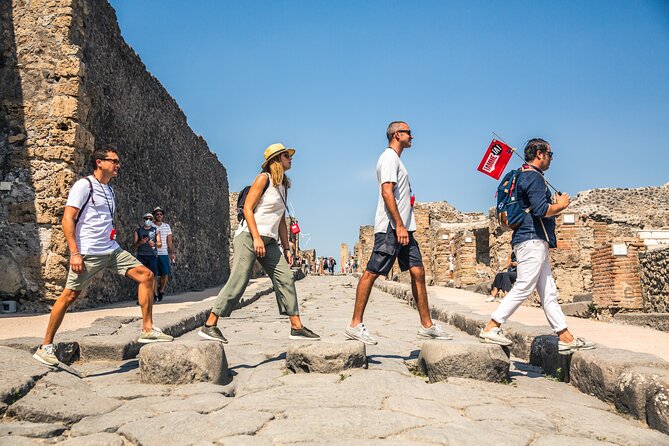
Pompeii is outdoors, and sound bounces oddly between walls and open courtyards. When you’re in a group, you’ll often miss details just because you’re standing a few steps away.
That’s why the headphones in Pompeii matter. They’re provided to help you follow the guide’s commentary clearly for larger groups (over 10 passengers). With headsets, you can listen as you look at architecture, see how spaces functioned, and understand why certain buildings were where they were.
The only caution I’d give: if your headset doesn’t feel right, speak up right away so it can be fixed early. If you wait, you’ll spend the rest of the tour trying to catch up instead of enjoying what’s in front of you.
The Pompeii Forum Route: Basilica, Civil Forum, and Temple of Jupiter
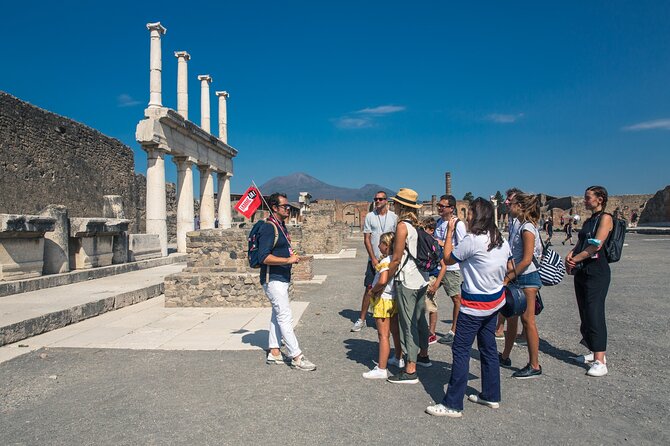
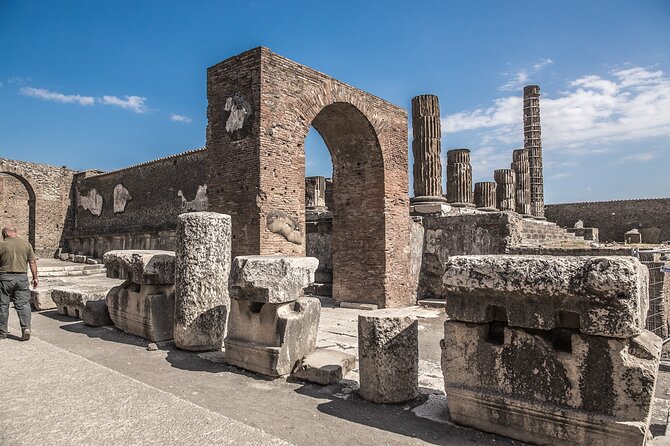
The heart of this tour is the Forum area, the busiest “main character” zone for first-time visitors. You’re not just looking at ruins here—you’re learning how the city organized power, business, law, and worship in one concentrated space.
Civil Forum: City life in one focal square
You’ll learn what the Civil Forum really meant: it was the core of daily life. It tied together administration and justice, business management, and trade. It also connected public worship, so people weren’t only doing civic tasks—they were mixing civic and religious routines in the same general setting.

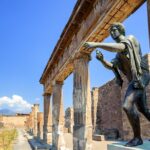
Basilica: Where business and justice happened
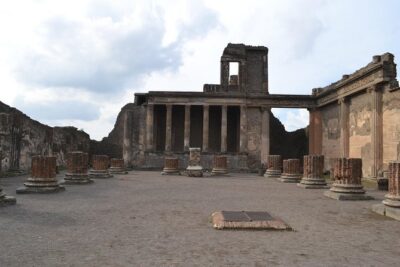
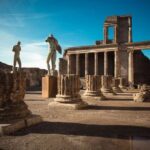
Next, you’ll spend time in the Basilica, described as the most sumptuous building of the Forum. It covered about 1,500 square metres and functioned as a major business and justice space. Architecturally, you enter through multiple openings and then see a large interior organized into three naves, with brick columns and Ionic capitals.
Even if you don’t love architecture for its own sake, this stop helps you “read” the Forum layout. You start to see how Pompeii wasn’t random destruction—it was a functioning system with spaces built for specific roles.
Temple of Jupiter: Power with Vesuvius behind it
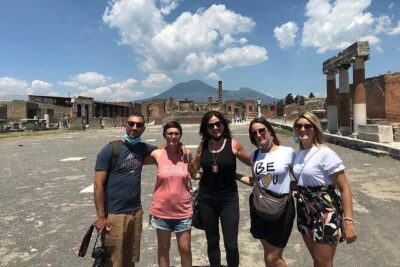
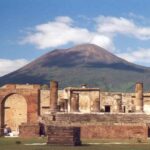
The Temple of Jupiter is the dramatic capstone on the north side of the Forum, with Mount Vesuvius visible in the background. When the colony was founded (80 BC), the temple was renovated into what’s described as a Capitolium-style setup. It included three cult statues: Jupiter, Juno, and Minerva, placed on a high base so they could be seen across the Forum square.
This is one of the stops where a guide really pays off. The building isn’t just impressive because it’s large; it’s important because it shows how Pompeii mirrored Roman political and religious authority.
Macellum and Via dell’Abbondanza: Market Life You Can Almost Hear
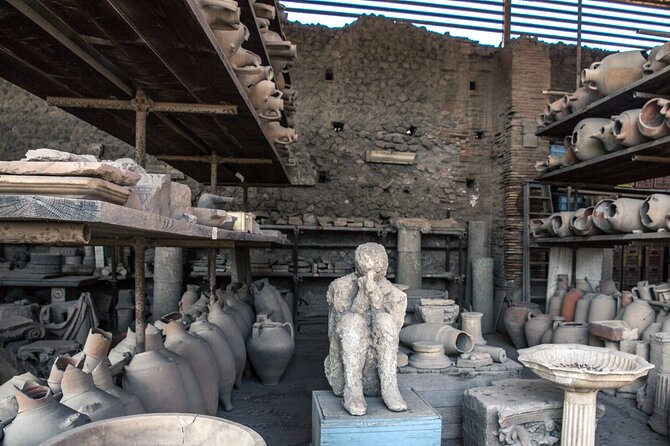
After the power blocks, you get daily-life detail with two stops that make Pompeii feel human.
Macellum: A market with worship built in
The Macellum was a food-market complex with a surprising religious layer. The description includes a tuff quadriporticus, plus an elevated worship hall that lines up with the entrance.
You’ll also hear about statues and cult signals carved into the space—such as two marble statues (a female and a male armed) and fragments that suggest an imperial-cult purpose (linked to an emperor like Titus or Vespasian). There are also references to rooms used for meetings by a sacred board and a masonry counter thought to be connected to fish sales.
This stop is valuable because it shows that “shopping” and “belief” weren’t separate worlds. In Pompeii, they were intertwined in practical spaces.
Via dell’Abbondanza: The main street’s old noise
Then you move onto Via dell’Abbondanza, the ancient main street (the decumanus maximus) running east/west from the Forum toward Porta Sarno. What makes this stretch interesting is the idea that it once felt loud and crowded: shops, workshops (officinae), cafes, snack-bars, and food and drink spots lined the route.
If you’ve ever walked a modern city street and wondered how it compares to the past, this is the answer. You’re seeing how commerce drove street life, just in a Roman costume.
In terms of pacing, this is a good place to let your eyes wander. You’re moving through a “city vein,” not stuck inside a single room.
Stabian Baths and the Lupanar: Routine, Ritual, and Controversy
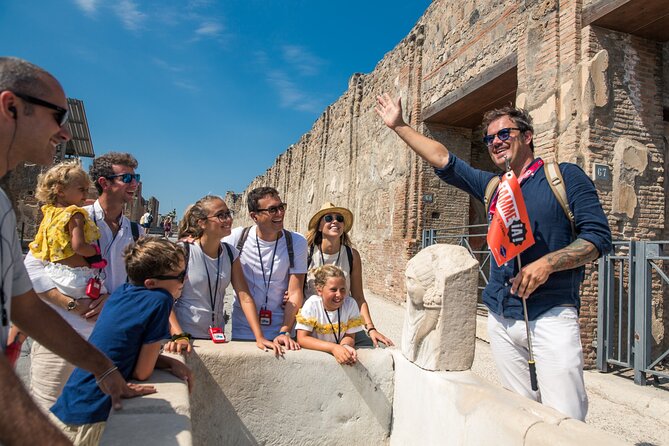
This is where the tour gets real—day-to-day habits, plus the darker side of Pompeii that many people want to see, but few want to linger on.
Stabian Baths (Terme Stabiane): How people cooled down and warmed up
The Stabian Baths are behind the Temple of Jupiter. They date to shortly after the colony of veterans was founded by General Silla (around 80 BC). You’ll hear that men’s and women’s quarters had separate entrances, which makes the bathing experience feel organized rather than chaotic.
For the men’s section, the description connects multiple rooms and temperatures: an apodyterium (dressing room) used also as a tepidarium, plus frigidarium (cold baths) and calidarium (hot baths). These baths were heavily damaged during the earthquake of 62 AD, so they carry both historical use and visible loss.
This stop works well because it’s not just about the building. It’s about routine. You can picture the steps of a normal day in Pompeii—work, public spaces, and then bathing as a social and practical ritual.
Lupanar: The famous brothel and its wall paintings
The Lupanar (also known as Lupanare Grande) is often the “wow, I can’t believe this is here” stop. It’s described as the most famous brothel in Pompeii and notable for erotic paintings on the walls.
The tour also gives a sense of how it operated economically. The description says many prostitutes were Greek and Oriental slaves, and payments ranged between two and eight asses. It even notes that a glass of wine cost one As.
A useful way to think about this stop: it’s not included to shock you. It’s here because Pompeii captured daily life down to its less polite corners. Just remember the tour time is limited here (it’s described as about 10 minutes), so focus on what you can actually absorb rather than trying to read every wall detail on the first pass.
House of the Faun and the Large Theater: Art and Entertainment
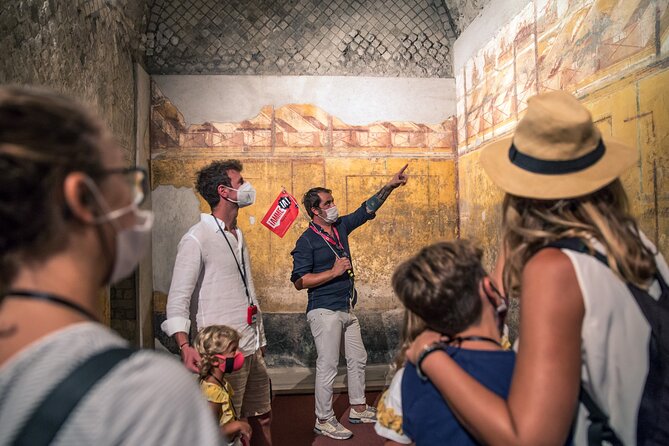
The tour then shifts from civic spaces to what people did when they weren’t in markets or baths.
House of the Faun: The Alexander Mosaic
You’ll step inside the House of the Faun, described as an elegant Roman villa famous for mosaics. The highlight is the Alexander Mosaic, called a striking masterpiece of ancient art and storytelling.
Even if mosaics aren’t your thing, this stop is a strong payoff because Pompeii’s art connects you to emotion and narrative. It’s not only architecture—it’s how people decorated their status and how they told stories with visual design.
Large Theater: Where crowds gathered for performances
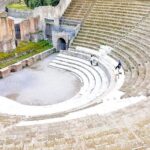
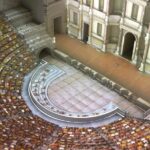
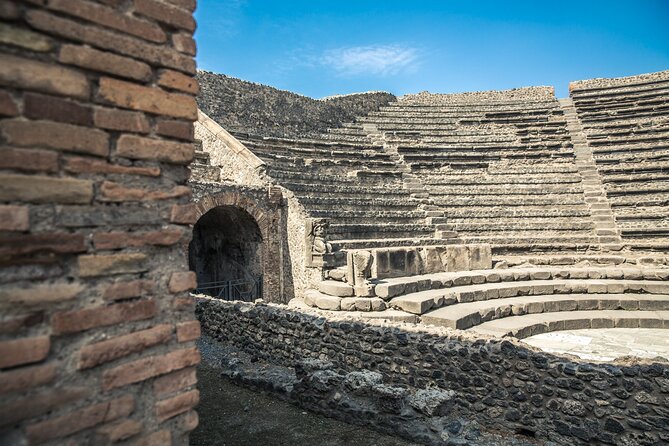
Next is the Large Theater, an open-air venue where crowds once gathered for comedies, dramas, and musical performances.
This is one of the best “mental scene” stops. When you stand in the theater shape, you can start imagining what a night out might have looked like—voices bouncing, people arriving, and entertainment built into the rhythm of city life.
Walking, Timing, and the Heat Reality Check
Pompeii is not hard just because it’s old. It’s hard because it’s outdoors, and your schedule is fixed. The tour is listed at about 2 hours 30 minutes, so you’ll move from stop to stop at a steady pace.
One review-style reality check that’s useful even if you don’t meet the same guide: be ready for walking on uneven surfaces. Also, start thinking about your day around the sun. This tour suggests sunscreen and comfortable shoes, and that’s exactly what you should do. If you’re the type who forgets basics, add a hat and a small umbrella if you like having shade.
If you want an extra practical win, pick a time slot earlier in the day when possible. One experience noted that a 9am start felt like the best way to avoid the worst crowd crush and heat.
Price and Value: What You Get for About $59
At $59.13 per person, this is positioned as a “worth it” Pompeii tour rather than a bare-bones guided walk. Here’s what justifies the price in practical terms:
- Guided tour for about 2.5 hours (not a quick drive-by)
- Skip-the-line admission to the archaeological site
- Headphones to keep the commentary clear in a busy area
- Official, licensed guide
- The tour structure focuses on high-demand stops, so you’re not paying for empty wandering
What’s not included is important too: lunch and transportation aren’t part of the cost. That means you’ll want to plan your food before and after, and you may want water with you even if you can top up on site (some past experiences mention fountains on Pompeii’s grounds).
When is this price a great deal? When you value context and want to see the big anchors without losing time to queues. When might you skip it? If you already have strong plans to explore slowly, or you’d rather control every minute on your own schedule.
Should You Book This Pompeii Priority Entrance Tour?
I’d book this tour if you want a first-rate introduction to Pompeii’s “big meanings”: Roman city design in the Forum, everyday life in the market and baths, and the art and entertainment that made the place feel alive.
I’d think twice if you need maximum flexibility. Pompeii is spread out, and a guided run is still time-structured. If your group needs long breaks, slower pacing, or you plan to roam far beyond the key highlights, a priority ticket plus self-guided exploring might fit better.
My decision rule is simple: if you’re short on time and you’d rather understand what you’re seeing than just photograph it, this tour is a solid buy—especially because priority access and headsets protect your experience from the two biggest Pompeii problems: lines and confusion.
FAQ
How long is the Pompeii guided tour with priority entrance?
It’s about 2 hours 30 minutes.
Is the tour offered in English?
Yes, the tour is offered in English.
What’s included in the price?
The tour includes a guided experience, skip-the-line admission fees to the Pompeii ruins, headphones (headsets) for clearer listening, and an official, licensed guide. Admission tickets are included for stops like the Pompeii archaeological park, and some stops are listed as free.
Where is the meeting point?
You meet your guide at the Zeus Car Park meeting point at Camping Zeus, Via Villa dei Misteri, 3, 80045 Pompei NA, Italy.
What group size should I expect?
The tour has a maximum of 25 travelers.
Do I need good weather?
Yes. The experience requires good weather, and if it’s canceled due to poor weather, you’ll be offered a different date or a full refund.
Can I cancel and get a full refund?
Yes. You can cancel up to 24 hours in advance for a full refund.