REVIEW · POMPEII
Pompeii tour with LOCAL GUIDE and SKIP THE LINE entrance
Book on Viator →Operated by Gennaro Balzano · Bookable on Viator
Pompeii feels like the past is just off-camera. This skip-the-line guided visit gives you a local’s wayfinding through the ash-preserved streets, plus a set of major stops that connect daily life to big Roman institutions. I especially liked the combination of priority entry and a tight route with names and stories tied to what you’re actually standing in front of.
The best part for most people is the local guide service and the clear “see the key places without wasting time” plan. One drawback to weigh: the tour is about 2 hours 30 minutes, so you’ll move at a pace that can feel a bit short if you want lots of wandering time.
In This Review
- Key Highlights Worth Booking For
- Pompeii in 2.5 Hours: Why Skip-the-Line Actually Matters
- Meeting at Via Villa dei Misteri: The Quick Logistics That Prevent Headaches
- Inside the Archaeological Park: Ash-Preserved Streets and Roman Everyday Life
- Casa del Menandro: A Rich House, Fresco Stories, and a Hidden Silver Cache
- The Lupanar Stops: Understanding Roman Sex Work Without Getting Lost
- The Forum of Pompeii: Where Justice, Admin, and Commerce Met
- Terme Stabiane: Roman Bathing, Oldest in the City, Still Easy to Picture
- Pacing Reality Check: What 2 Hours 30 Minutes Lets You Do
- Who This Tour Fits Best (And Who Might Want More Time)
- Should You Book This Pompeii Skip-the-Line Guided Tour?
- FAQ
- How long is the Pompeii tour?
- Is skip-the-line entry included?
- What’s included in the price?
- What stops are included during the tour?
- Where do we meet and where does the tour end?
- What language is the tour offered in?
- Is there a limit on group size?
- Is a mobile ticket provided?
- What happens if the weather is poor?
- Is tipping included?
Key Highlights Worth Booking For
- Skip-the-line entry so you spend less time queueing and more time walking the ruins
- A local guide who can translate what you’re seeing into how people lived, worked, and partied
- Stop-by-stop Roman realism, from a rich household (Casa del Menandro) to public civic space (the Forum)
- The Lupanar brothel stops with clear design details, not just shock value
- Terme Stabiane for a look at Roman bathing in one of Pompeii’s older thermal complexes
- Small group size (max 14) which usually makes it easier to ask questions and keep momentum
Pompeii in 2.5 Hours: Why Skip-the-Line Actually Matters
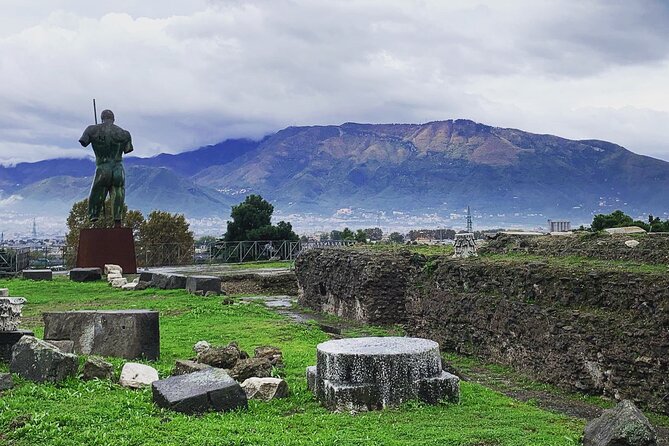
Pompeii is one of those places where time turns into stress fast. You arrive, you find the entrance, you join the line, and suddenly the day is half gone before you’ve even started. This tour’s main payoff is simple: priority service to skip the line, paired with an organized start right near the park entrance area.
At $66.38 per person for about 2 hours 30 minutes, you’re paying for three things at once: your entrance ticket, a local authorized guide, and a structured route so you don’t guess your way through the site. If you’re visiting with limited time (cruise stop, one Pompeii day, or you’re pairing it with Naples plans), this format is usually a smart match.
I also like that the tour is capped at 14 travelers. Smaller groups tend to feel easier to manage inside ruins, where paths get narrow and you don’t want to be stuck behind a big crowd.
You can also read our reviews of more guided tours in Pompeii


Meeting at Via Villa dei Misteri: The Quick Logistics That Prevent Headaches
The meeting point is Via Villa dei Misteri, 3, 80045 Pompei NA, Italy, and the tour ends back at the meeting spot. The starting area is close to the entrance to the ruins, a few meters from station and car parks—so you’re not trekking across town before you begin.
A practical tip: arrive a few minutes early and stay flexible. Pompeii is walk-heavy, and station-to-ruins directions can get confusing even for good maps. Give yourself a buffer so you don’t end up rushing in the first minutes.
This tour runs in English, with mobile tickets, and service animals are allowed. It’s also described as suitable for most travelers, and it’s near public transportation—helpful if you’re not renting a car.
Inside the Archaeological Park: Ash-Preserved Streets and Roman Everyday Life
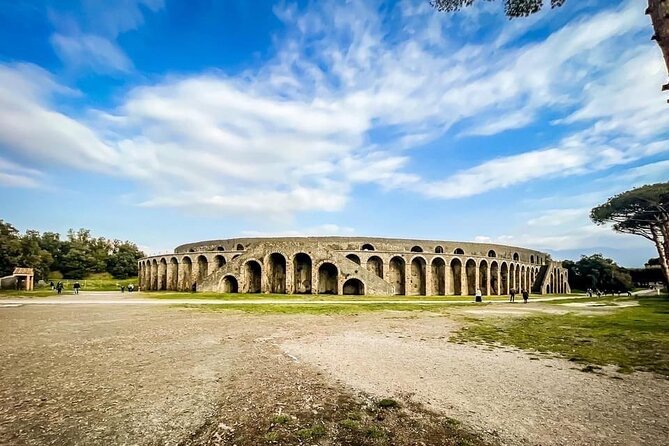
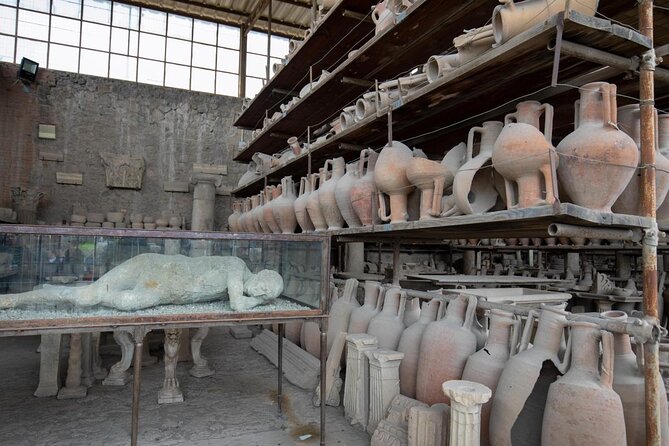
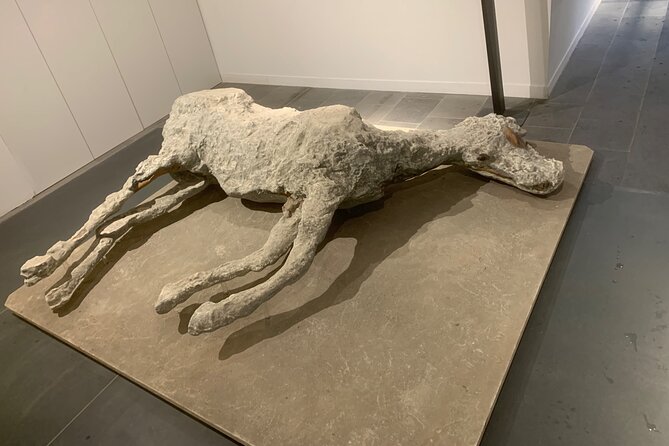
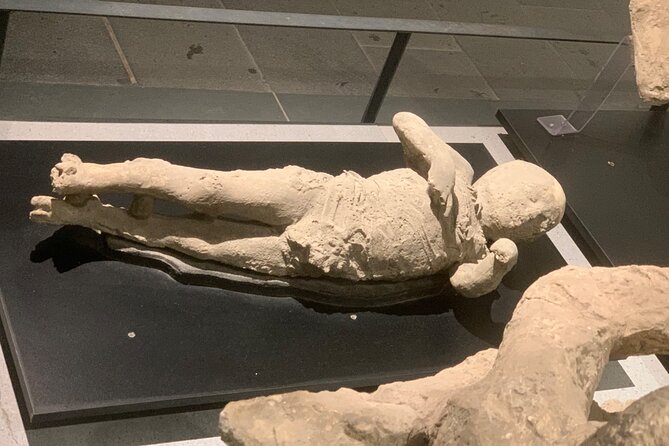
Your first stop is the Archaeological Park of Pompeii, the heart of the whole experience. Pompeii’s fame isn’t just that it was “big” or “ancient.” It’s that volcanic ash preserved the city in a way that lets you read everyday life—work, home layouts, public space—almost like a snapshot from 2,000 years ago.
The tour begins at the appointment point near the entrance and then you walk into the ruins with a guide explaining what you’re seeing. This matters because Pompeii is easy to get lost in. Without context, it can feel like ruins you’re trying to name. With a guide, the same buildings start to make sense: which areas were public, which were private, and what daily routines would have looked like.
You’ll also hear that excavations started in the 18th century, and that after around 250 years, about 75% of the site has been brought to light. That scale is part of the emotional punch. You’re not looking at a “small museum.” You’re looking at a large city that—if time travel was real—still seems like it could be waiting for you.
At the end of the guided portion, you may have time to remain inside the excavations. This is a nice way to switch gears: first you get the guided route for orientation, then you can slow down and look around at your own pace for a bit.
Casa del Menandro: A Rich House, Fresco Stories, and a Hidden Silver Cache
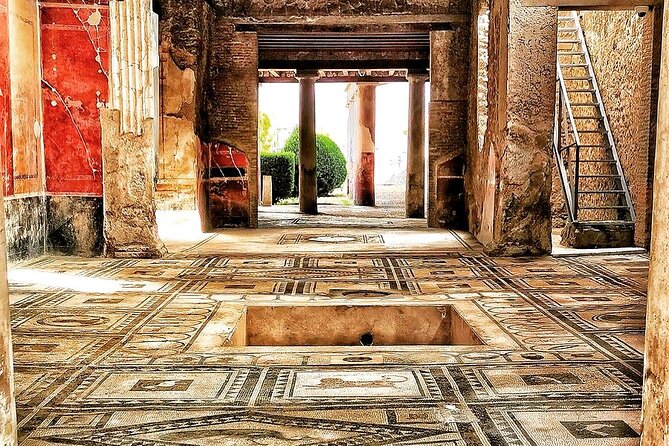
Next you’ll visit Casa del Menandro, a large home linked to a high-ranking family. This is the part of the tour where Pompeii stops being only “ruins” and starts feeling like lived-in space.
What makes this stop special is the mix of art and household practicality:
- The atrium is frescoed with scenes from the Iliad and the Odyssey—myth as status, not just decoration.
- The peristyle is described as a “rhodium” type, with a northern side higher than the rest, showing how even outdoor ritual space had architectural personality.
- The house’s name comes from a portrait of Menander, an Athenian playwright, placed in the porch.
Then there’s the story that adds real drama: beneath the main areas there’s mention of a small thermal district and an underground room—possibly a cellar—where a chest of 118 pieces of silverware was found. That silver was hidden before restoration work began and is now shown at the National Archaeological Museum of Naples. Even if you can’t see every detail, knowing the treasure existed changes how you interpret the home: this wasn’t just wealth on display, it was wealth stored, protected, and used for banquets.
You’ll also encounter details like forms used to pour wine and tableware built for feasts. And on the southern side, there’s a rustic quarter with a reconstruction of a wagon—useful because it reminds you that “rich house” didn’t mean one uniform lifestyle. Pompeii households included practical production and work zones too.
One watch-out: this stop is listed as about 15 minutes, so it’s more of a targeted highlight than a long, slow house museum visit. If you love dwelling on interiors, you may want extra time here after the tour.
The Lupanar Stops: Understanding Roman Sex Work Without Getting Lost

Pompeii’s Lupanar—the brothel—gets a lot of attention, and it can go two ways: either it’s treated like shock content, or it’s explained like architecture and social history. This tour treats it as both.
You’ll see a building with two floors. The lower rooms are arranged along a corridor with built-in beds, and the rooms were closed by a curtain. There’s also a latrine visible under the stairwell area. In other words, you’re not just hearing about prostitution; you’re learning how the building worked day-to-day.
The tour also notes how the women were described as mostly Greek and Oriental slaves, and that services could cost between two and eight asses (and a cup of wine cost one). That kind of detail helps you understand it as part of the city’s economy, not only an isolated scandal.
The walls include small erotic depictions meant to inform customers about what took place. The building takes its name from the Latin term lupa, used to designate a prostitute.
One thing I’d say before you go: this is a Roman history site, and the subject matter is explicit in design and messaging. If you want a “family-friendly only” experience, this route includes it. For most adults, it’s handled as a historical stop—with design details and cultural context.
Also note: you’ll see Lupanar again later (two separate stops, each about 10 minutes). That usually means you’re getting different angles or adjacent areas rather than repeating the same exact room.
You can also read our reviews of more tours and experiences in Pompeii





The Forum of Pompeii: Where Justice, Admin, and Commerce Met
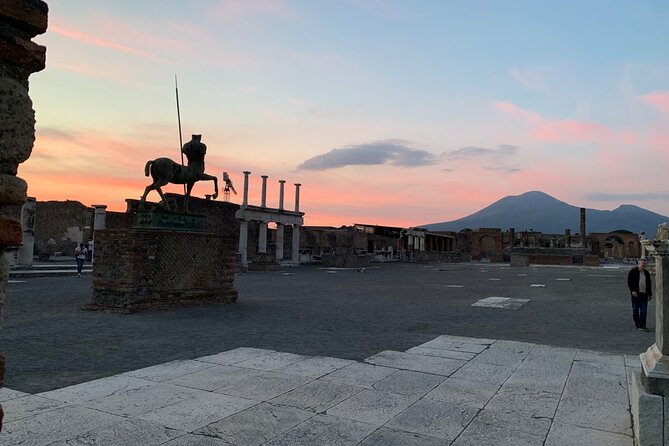
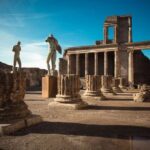
Then you shift from private life to civic life at the Forum of Pompeii, the center of daily activity. This is where you start seeing how the city operated as a system.
You’ll learn that major public buildings for administration, justice, and business management overlook the Forum, and that commercial activity happened around it. The square’s original look is described as a simple open area of rammed earth with a more or less regular shape—then later it was modified and regularized.
The tour points out the Sanctuary of Apollo on one side and shops on the other. Later changes between the 3rd and 2nd century B.C. included arcades and a bottom paved with tuff slabs. In the imperial age, the paving became travertine slabs. Even the details of bronze letters are mentioned through stone features built to hold inscriptions.
This is a high-value stop because it answers a question most people don’t know they have: what did Romans actually do with a “square”? Here, you get the idea that politics, trade, law, and religion weren’t separate worlds. They were mixed into the same public stage.
Expect about 20 minutes here—enough to get the big picture while still leaving time for the more personal spaces that follow.
Terme Stabiane: Roman Bathing, Oldest in the City, Still Easy to Picture
Your final major stop is Stabian Baths (Terme Stabiane), described as the oldest thermal building in Pompeii. It’s also buried by the eruption and later rediscovered during excavations, so it’s part of that same volcanic preservation story.
Bathing in Roman times wasn’t only hygiene. It was social time, conversation space, and a routine that cut across classes. Even with a short visit window, the Terme Stabiane stop gives you a sense of how the city worked beyond homes and public squares.
This is listed at about 10 minutes, so don’t expect a full building walkthrough. Expect the “here’s how it functioned” snapshot. If you like Roman public life—food, politics, crowds—this is a good closing chapter because it shifts from rooms and rituals into communal daily practice.
Pacing Reality Check: What 2 Hours 30 Minutes Lets You Do
The itinerary is packed with highlights: main park time, plus Casa del Menandro, the Lupanar, the Forum, and Terme Stabiane. That’s great if you want a guided spine you can rely on.
But it also explains why some people feel the time limit. Two and a half hours can be just right for orientation and key sights, and too tight if your ideal Pompeii day means lingering over every wall painting, every street corner, and every side passage.
This is where I recommend planning your day with intent:
- If you want the big Pompeii beats with clear stories, this works.
- If you want slow wandering, add separate time before or after the tour to revisit your favorite areas.
One extra note from experience-style feedback: you’ll benefit from any personal tool that helps you hear clearly—headphones or ear-friendly settings. The tour is in English, and ruins make sound tricky.
Who This Tour Fits Best (And Who Might Want More Time)
This tour fits best if you:
- want skip-the-line entry and a guided plan
- like connecting architecture to real daily habits (homes, public law space, baths)
- are visiting on a schedule and don’t want to risk getting lost in Pompeii’s sprawl
- prefer a small group experience (max 14)
You might want a longer or more flexible tour if you:
- enjoy spending extra time inside major homes like Casa del Menandro
- want slower reading of details like frescoes, inscriptions, and room-by-room layouts
- plan to do lots of photos and want time to breathe
Should You Book This Pompeii Skip-the-Line Guided Tour?
If you have limited time and want Pompeii to make sense fast, I’d book it. The priority entry plus a local guide is the core value, and the stop selection covers the spectrum: household life (Casa del Menandro), civic life (Forum), and Roman public realities (Lupanar and baths).
Just be honest with yourself about pacing. This is a high-intensity highlights experience, not a sit-and-stay-for-hours museum day. If that’s your style, this tour delivers.
FAQ
How long is the Pompeii tour?
It’s approximately 2 hours 30 minutes.
Is skip-the-line entry included?
Yes. The tour includes priority service to skip the line for entry.
What’s included in the price?
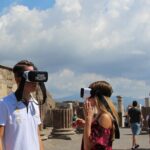
The package includes entrance tickets, an authorized local guide service, and a Time Machine component.
What stops are included during the tour?
You’ll visit the Archaeological Park of Pompeii and then several specific areas, including Casa del Menandro, Lupanar, the Forum of Pompeii, and the Stabian Baths (Terme Stabiane).
Where do we meet and where does the tour end?
You meet at Via Villa dei Misteri, 3, 80045 Pompei NA, Italy, and the tour ends back at the meeting point.
What language is the tour offered in?
The tour is offered in English.
Is there a limit on group size?
Yes. The maximum group size is 14 travelers.
Is a mobile ticket provided?
Yes. The tour uses a mobile ticket.
What happens if the weather is poor?
This experience requires good weather. If it’s canceled due to poor weather, you’ll be offered a different date or a full refund.
Is tipping included?
No. Tip / tip is not included.