REVIEW · POMPEII
Pompeii: Skip-the-Line Entry Ticket with Digital Audio Guide
Book on Viator →Operated by Vox City International Ltd · Bookable on Viator
Pompeii hits hard in the best way. This ticket gets you into the park with a smartphone audio guide that points out 130+ locations across the ruins, so you’re not just wandering stone streets. You’ll hit major highlights like temples dedicated to Venus, Apollo, and Jupiter, plus famous residences such as the House of the Faun.
The main thing to plan for is the tech side. You need your own phone and headphones, and the audio app must be downloaded ahead of time from the QR code. If your setup is shaky, the experience can feel frustrating fast.
In This Review
- Key highlights you’ll feel right away
- Price and what you truly get for $33
- Getting in: where you redeem and how you avoid chaos
- The audio guide: great in theory, manage it like a mission
- The walking plan inside Pompeii: how to actually enjoy 2–4 hours
- Stop 1: Pompeii Archaeological Park and the first shock of scale
- Amphitheatre energy and the street-life vibe
- Temples, mosaics, and big names like the House of the Faun
- The Pompeii Forum: trading hub and political center
- The eruption impact: ash-covered homes and plaster casts
- What’s not included: suburban villas like the Villa dei Misteri
- Who this ticket suits best
- Practical tips so your day feels smooth
- Should you book this Pompeii audio + skip-the-line ticket?
- FAQ
- Do I need headphones for the Pompeii audio guide?
- How many places does the audio guide cover?
- What languages are available for the audio commentary?
- Where do I redeem my voucher to get the entry ticket?
- Is access to the suburban villas included?
- How long should I plan to spend in Pompeii?
Key highlights you’ll feel right away

- Reserved entry plus audio: one price covers admission and a multilingual guide
- 130+ points of interest: you get a lot of structured stops, not random listening
- Big themes, not just big buildings: everyday life, religion, politics, and the eruption aftermath
- Pompeii Forum is the centerpiece: a trading hub and political center in the heart of town
- Suburban villas excluded: Villa dei Misteri and other suburban sites require an added ticket
Price and what you truly get for $33
For $33, you’re paying for two things that matter in Pompeii: entry access and a guided way to make sense of the park. That’s decent value if you want help choosing what to notice and when to move on.
But here’s the reality check. Pompeii is large, and the experience can feel better with guidance than without it. If you already know the main sites and enjoy reading on your own, the audio might feel like extra noise. The best use of this ticket is when you treat the audio as your road map and let it lead you from one highlight to the next.
One more note that can change your plans: this ticket does not include the suburban villas, including the Villa dei Misteri. Those are often the add-ons people remember most. If those are high on your list, budget an extra 8€ for the suburban villas.
You can also read our reviews of more tours and experiences in Pompeii



Getting in: where you redeem and how you avoid chaos
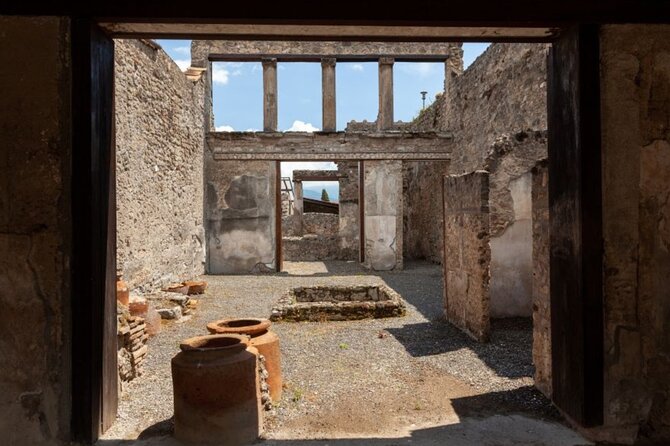
Your voucher turns into an admission ticket at Piazza Esedra, 1, 80045 Pompei NA, in front of Hotel Vittoria. It’s near public transportation and you’re close to the entry area once you’ve exchanged your voucher.
This matters because Pompeii can turn into a timing game. If you arrive and you’re still trying to figure out where your ticket goes, you lose time—time you could spend inside the ruins.
Quick practical move: go early enough that you’re not sprinting from the redemption point to the gate. Even though entry is reserved, you’ll still want a relaxed start so you can download and test your audio before you commit to a walk.
The audio guide: great in theory, manage it like a mission

This is a smartphone audio guide with multilingual narration in English, French, Spanish, German, and Italian. The big advantage is that it’s built around 130+ points of interest, so you can bounce between major landmarks, mosaics, and historic residences without guessing what you’re looking at.
Offline setup is key. You scan the QR code on your voucher to download the audio guide prior to arrival. The info also makes the point that once you’ve downloaded it, you do not need internet on site.
So bring the basics:
- Your own mobile device
- Your own headphones (not included)
One of the most important considerations from real-world usage is that some people report the app didn’t work well with their headphones or behaved badly on site. Also, the GPS map can be hit-or-miss. One person specifically noted Google’s GPS worked when the included GPS mapping didn’t. Translation: don’t rely on fancy maps alone—plan to use a simple Pompeii park map once you’re inside.
The walking plan inside Pompeii: how to actually enjoy 2–4 hours
You’re looking at a huge area—44 square hectares—and the park is open daily. Most people spend about 2–4 hours inside, and the tour duration is roughly 2–3 hours. That range is real. Pompeii isn’t one neat circuit; it’s a set of neighborhoods and landmarks spread out across the city.
Here’s how to make that size feel manageable with your audio:
- Start early and commit to a theme: daily life + religious sites + the Forum + the eruption aftermath.
- Don’t try to cover every building. Pick the big names and let the audio fill in the story beats.
- Use the audio points like “chapters,” not like a requirement to listen to everything.
Also, Pompeii is full of Roman stone paths. Comfortable shoes are more important than you think, because the ground can feel uneven and you’ll be reading details at street level.
Stop 1: Pompeii Archaeological Park and the first shock of scale
Once you’re in the Pompeii Archaeological Park, the ruins do something most museums can’t: they give you the feeling of walking through a real place, not a display. You’ll see dramatic stone streets, building outlines, and the way spaces connect.
This is where the audio guide can earn its keep. Instead of looking at a random doorway and wondering what it was, you can follow the narration across major landmarks and key structures.
The first big benefit of the 130+ points system is momentum. You’re less likely to get lost or bored, because there’s always a next stop with an explanation attached.
You can also read our reviews of more guided tours in Pompeii





Amphitheatre energy and the street-life vibe
Among the early standout structures is the amphitheatre. Even without a lecture, you can sense what it was for: gatherings, public events, and the kind of crowd energy ancient cities needed.
When you use the audio here, it helps you interpret scale. The amphitheatre is also a good “calibration” moment. After you’ve seen it, the rest of the city feels more logical. You start to connect neighborhoods with the kinds of public life they supported.
If you’re a “show me where people stood” kind of person, Pompeii does that well. You get a sense of movement—where you’d have walked, where people would have gathered, and how streets framed daily life.
Temples, mosaics, and big names like the House of the Faun
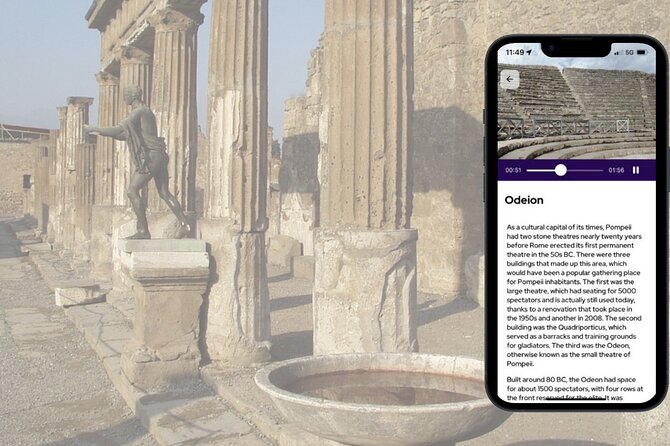
Pompeii’s religious and domestic sides are both on the menu. The audio points you toward temples dedicated to Venus, Apollo, and Jupiter, which is a great set for understanding what people worshipped and how religion fit into everyday routines.
Then come the homes and the decorative details, including intricate mosaics and historic residences like the House of the Faun. That specific name matters because it’s one of those labels you hear again and again when people talk about Pompeii. Seeing it in context inside the park makes it feel less like trivia and more like a real place where someone lived.
A practical tip: don’t rush the mosaic areas. Even if you’ve seen photos before, the scale of some decorative work becomes clearer when you stand close and let the audio explain what you’re looking at.
The Pompeii Forum: trading hub and political center
If you only make room for one “heart of Pompeii” stop, make it the Pompeii Forum. This area served as a trading hub and political center, meaning it wasn’t just ceremonial. It was where decisions got made and commerce moved.
The Forum is also where the ruins feel most like a functioning city. Streets converge. You can imagine the flow of people. You can sense why power and trade would sit close together.
With your audio guide, this part becomes more than a landmark. You get context for what the Forum meant, so you’re not just admiring stone geometry—you’re understanding how the city ran.
The eruption impact: ash-covered homes and plaster casts
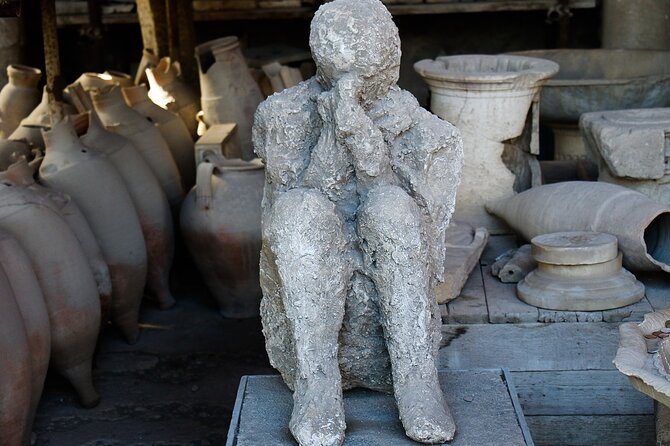
Pompeii’s most haunting sections focus on what the eruption did to the city—ash-covered homes and the famous plaster casts of victims. It’s heavy material, and you’ll feel that weight immediately once you’re close to these areas.
I like that the audio doesn’t keep it abstract. The key is that these details connect tragedy to place. You’re not reading about a disaster in a vacuum; you’re standing in the environment it happened in.
If you’re the sensitive type, pace yourself. Don’t cram this part at the end of your visit when you’re tired. Give yourself time to move through slowly, take a breath, and keep your bearings.
And yes—the backdrop of Vesuvius helps. It turns the story from a text into something visual. Even when you’re not looking straight at the mountain, knowing it’s part of the scene changes how you read the ruins.
What’s not included: suburban villas like the Villa dei Misteri
This ticket explicitly does not include access to the suburban villas, including the Villa dei Misteri. The listed add-on price is 8€.
So ask yourself one question before you book: are those villas a must for you? If yes, this ticket still works, but you’ll want a plan for adding them so you don’t finish your day feeling like you missed the big finale.
If the suburban villas are not a priority, you can still have a full, satisfying Pompeii visit. The core city highlights plus the Forum and eruption aftermath are enough to make the ticket worthwhile.
Who this ticket suits best
This experience is strongest for you if:
- You want help turning a huge park into a set of meaningful stops
- You prefer listening in multiple languages rather than relying on printed guides
- You want to see famous locations like the House of the Faun and the Forum without guessing
It may not be the best match if:
- You dislike audio tours or prefer quiet, solo wandering
- Your phone battery life is usually poor (because you’ll need your device running)
- You want suburban villas without paying extra
Practical tips so your day feels smooth
A few small things can make a big difference at Pompeii:
- Download before you arrive: use the QR code beforehand so you don’t get stuck with an app that’s slow or broken on site.
- Bring wired or reliable headphones: you’ll get the most out of the audio if there are no connection surprises.
- Have a backup for wayfinding: if the GPS map in the guide doesn’t behave, use a park map once you’re inside and lean on general orientation.
- Pace the Forum and eruption areas: these carry the most emotional weight, and they’re also easy places to linger if you want the full effect.
Pompeii rewards the calm visitor. If you treat it like a quick photo stop, the day can feel cold. If you move through it like a story, it sticks.
Should you book this Pompeii audio + skip-the-line ticket?
I’d book it if you want an organized way to experience Pompeii without spending extra time figuring out what matters. The reserved entry and the audio’s 130+ points are useful, especially for first-timers who want structure across big themes like religion, politics, home life, and the eruption aftermath.
I would pause before booking if you already know Pompeii well and you hate smartphone-based guides. Also pause if you’re worried about tech reliability, because this experience depends on your device and headphones, and the audio setup is tied to downloading via QR code before you arrive.
If your goal is a meaningful 2–4 hour visit and you’re willing to prepare your audio ahead of time, this ticket is a solid way to get in and make the ruins readable.
FAQ
Do I need headphones for the Pompeii audio guide?
Yes. Headphones and your mobile device are not included, so bring your own to listen to the audio.
How many places does the audio guide cover?
The audio guide includes 130+ points of interest across the Pompeii ruins.
What languages are available for the audio commentary?
The audio commentary is available in English, French, Spanish, German, and Italian.
Where do I redeem my voucher to get the entry ticket?
You exchange your voucher at Piazza Esedra, 1, 80045 Pompei NA, in front of Hotel Vittoria.
Is access to the suburban villas included?
No. This ticket does not include access to the suburban villas. Access to sites like the Villa dei Misteri requires an additional 8€ ticket.
How long should I plan to spend in Pompeii?
Pompeii is usually a 2 to 4 hour visit for most travelers, and this experience is listed at about 2 to 3 hours.