REVIEW · POMPEI CAMPANIA
From Naples_ Pompeii Tour_Skip the line ticket + audioguide
Book on GetYourGuide →Operated by MOTORENT S.R.L. · Bookable on GetYourGuide
Pompeii is bigger than you think. This Naples to Pompeii day trip keeps things efficient with skip-the-line entry plus a built-in audio guide so you can tour at your pace.
I like the straightforward format: you get roundtrip bus service and everything you need to navigate independently, without waiting for a group guide to catch up. I also like that the visit is built for the big hits—domus, spas, temples, theaters, brothels, the victims casts, and a very well-preserved Roman amphitheater.
The main trade-off: there is no live guide, so if you struggle with using audio plus the map at the same time, you’ll want a simple plan (and maybe headphones) before you arrive.
If you hate long lines and want a clean, practical route through one of the world’s most famous archaeological sites, this is a good fit. Pompeii is UNESCO-listed and covers about 66 hectares, with roughly 3 million visitors each year—so “easy entry” really matters.
In This Review
- Key things that make this tour work
- Pompeii’s scale: why the “easy, fast” promise matters
- Getting to Pompeii from Naples: the practical bus ride
- Timing reality check
- Entering Pompeii with a skip-the-line ticket
- Your audio guide + updated map: the best way to tour independently
- One small trick that improves everything
- What you’ll see in 5 hours: a realistic highlight route
- The frescoed houses (domus): where Pompeii feels personal
- Time tip
- Spas and public baths: the social engine of the city
- What you’ll likely notice
- Temples and the religious streetscape
- Shops and thermopolis: how people ate and bought things
- Quick payoff
- Theaters and brothels: the public and the hidden
- The casts of the victims: where the visit turns heavy
- The Roman amphitheater: one of the best preserved stops
- How much is $77 really buying you?
- The staff and small comforts that can make the day better
- Who this Pompeii tour suits best
- Should you book this skip-the-line Pompeii from Naples?
- FAQ
- What’s the duration of the Pompeii tour?
- Does this include skip-the-line access?
- What’s included with the ticket?
- Is a live guide included?
- What languages are available for the audio guide?
- Where is the meeting point in Naples?
- What’s the bus logo?
- What should I bring?
- Are there restrictions on luggage?
- Is the tour suitable for mobility impairments?
Key things that make this tour work
- Skip-the-line ticket for faster entry once you reach Pompeii
- Audio guide in many languages so you’re not stuck with one option
- Roundtrip bus from Naples by the Around Vesuvio shuttle logo
- Self-guided layout with an updated map to help you not wander in circles
- A focused, doable 5-hour window for the highlights without turning it into a full day
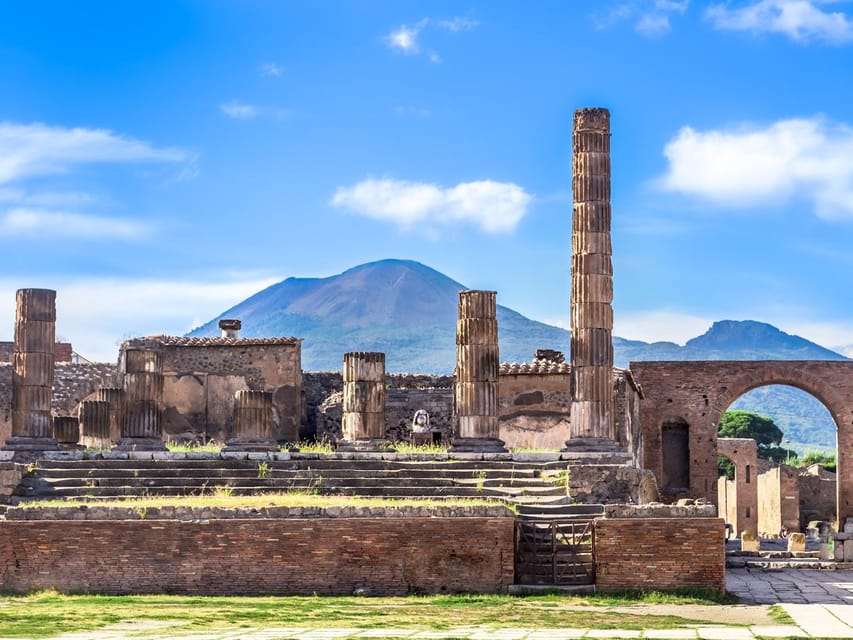
- Pompeii’s major categories in one walk (houses, baths, temples, theaters, shops)
Pompeii’s scale: why the “easy, fast” promise matters

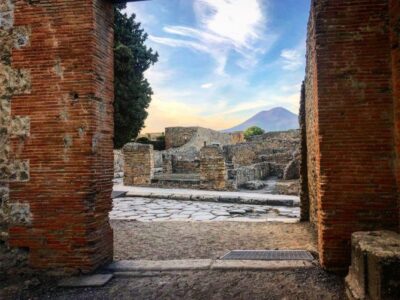
Pompeii feels compact on postcards. On the ground, it’s a whole city—around 66 hectares of streets, buildings, and public spaces covered by volcanic ash. With about 3 million visitors a year, it’s also a place where time can disappear fast if entry is slow.
That’s why skip-the-line is more than a convenience slogan. It’s the difference between spending your morning looking at a queue and spending it looking at frescoes, mosaics, and the ruins’ everyday details. With this package, you’re set up to start the visit smoothly and then move on your own schedule.
You can also read our reviews of more tours and experiences in Pompei Campania



Getting to Pompeii from Naples: the practical bus ride

This is a roundtrip experience from Naples by bus, with the meeting point near Via Galileo Ferraris n. 40 (use coordinates 40.8505189N, 14.2747942E). Your shuttle has the logo Around Vesuvio, and the driver is listed as speaking English and Italian.
For many people, this is the real value: you’re buying the least-stress option for transportation. Instead of juggling trains, transfers, and local schedules, you show up, board, and focus on the main event—Pompeii itself.
Timing reality check
The day trip is listed at 5 hours total, and you’ll want to treat that as “Pompeii time plus travel time.” One practical consideration from the experience setup: return pickup timing can mean waiting at the end, so bring patience (and water if allowed where you are).
Entering Pompeii with a skip-the-line ticket

Once you arrive, the biggest win is that your ticket is meant to get you through faster than standard entry lines. That matters at Pompeii because entrances can bottleneck—especially during peak hours.
Because this package is self-guided, skipping the line gives you the chance to start your route while your energy is highest. In Pompeii, that’s when you’re most likely to remember what you saw and connect the buildings to the story you’re hearing through the audio.
Your audio guide + updated map: the best way to tour independently
This is not a guided lecture with a human escort. Instead, you’ll use an audio guide system and an updated map to navigate the ruins on your own.
The audio guide is offered in multiple languages, including English, French, German, Italian, Portuguese, Russian, and Spanish. The flexibility here is helpful—if you’re traveling with someone, you can often choose the language that actually works for you, not the one the operator assumes.



One small trick that improves everything
The format sounds simple: press play, follow the map, stop when the music changes. But in practice, you’ll move your attention between three things—walking, reading the map, and listening.
If you prefer audio without interruption, consider bringing headphones (or at least plan how you’ll hear clearly). If you can, set yourself up so you’re not forced to hold the map up with one hand and fumble with audio with the other.
What you’ll see in 5 hours: a realistic highlight route
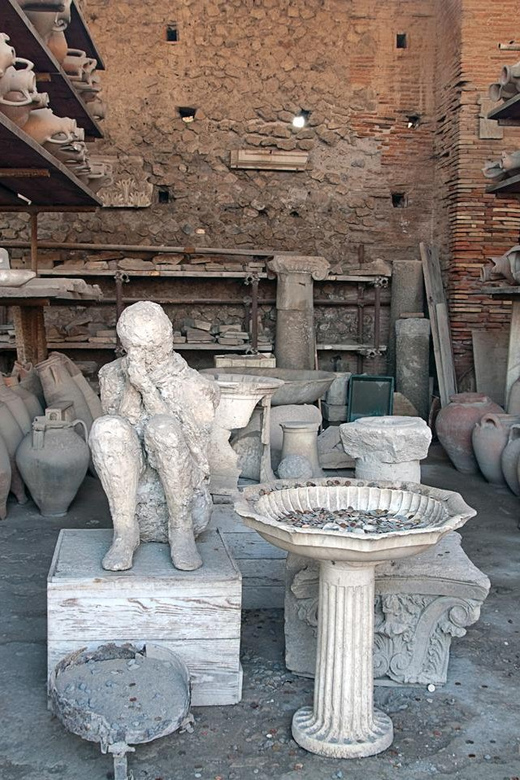
Pompeii is enormous. The good news is the ticket package is designed to help you hit the most memorable areas without getting lost. The key categories you can expect to include are:
- frescoed domus (private houses)
- spas (bath complexes)
- temples (religious spaces)
- shops and thermopolis (fast-food style counters of the time)
- theaters
- brothels
- the casts of victims from the eruption
- one of the best preserved Roman amphitheaters
Because your visit is self-paced, you can choose how hard you go on details versus how much you just soak up the atmosphere. Here’s what those highlights mean on the ground.
The frescoed houses (domus): where Pompeii feels personal
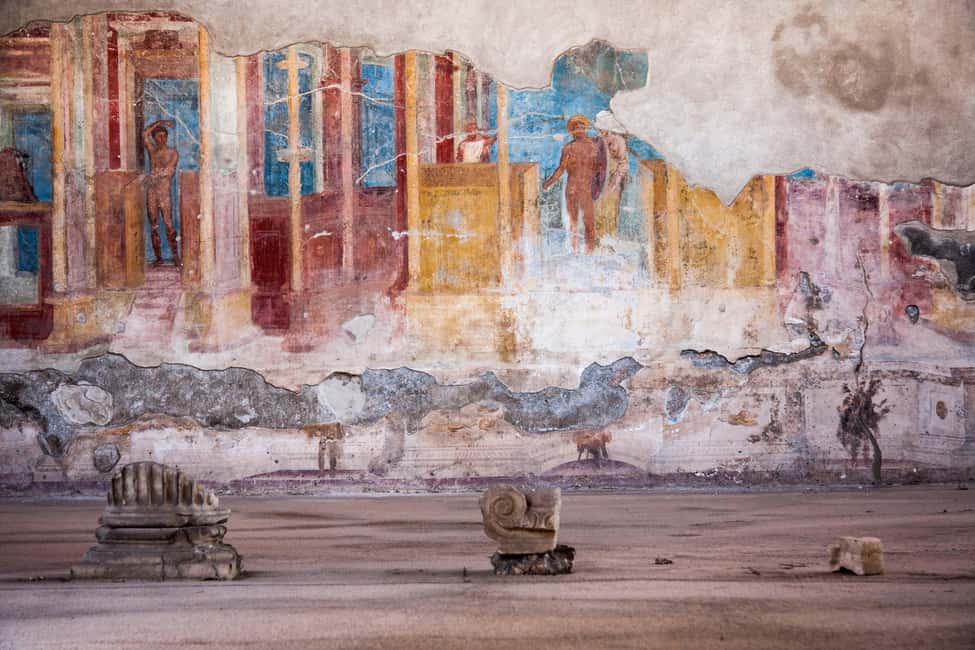
The most striking parts of Pompeii are often not the big public buildings. They’re the domus—frescoed houses where you can feel daily life rather than just history-as-text.
When you walk through these homes, look for the contrast between preserved surfaces and broken spaces. The ruins don’t just show architecture; they show where people placed color, where rooms opened to light, and how decoration communicated status.
Time tip
In 5 hours, you’ll get more out of two or three domus spaces you actively study than trying to race through all of them. Use the audio to tell you what you’re looking at, then pause for a minute to visually confirm it.
Spas and public baths: the social engine of the city

Pompeian spas aren’t just for cleaning. They’re social spaces—places where people met, talked, and circulated around different temperatures and rooms.
In your self-guided route, pay attention to how the bath spaces are arranged. Even without a guide explaining every detail, the layout often makes the experience intuitive: where you enter, where you move through stages, and how circulation works.
What you’ll likely notice
You’ll probably find that the bath areas help you understand Pompeii as a working city, not a museum. The ruins show systems and routines—people would have repeated these spaces day after day.
Temples and the religious streetscape
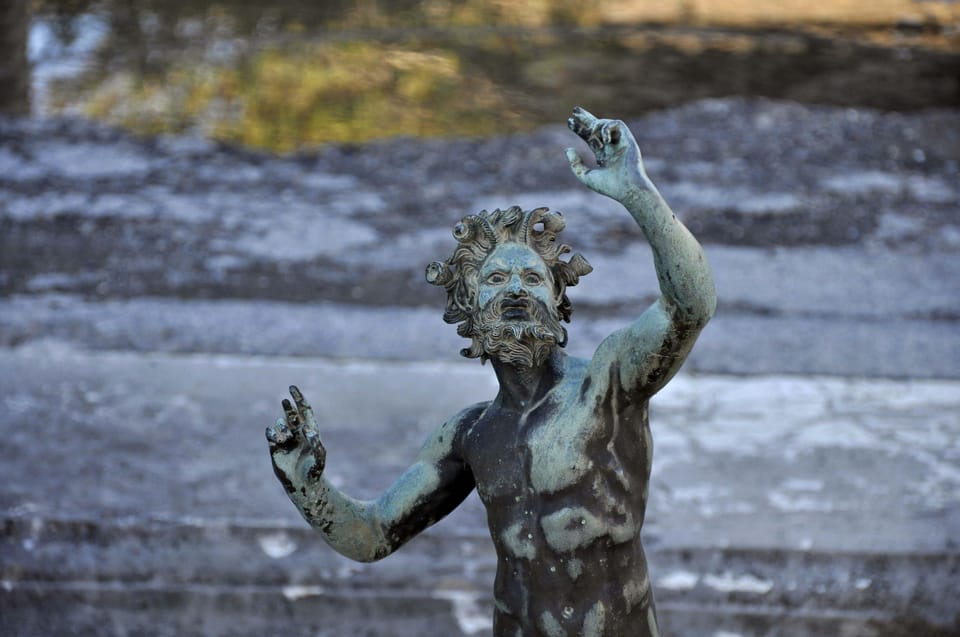
Temples in Pompeii give you a sense of what residents believed and how public life expressed that belief. As you pass through areas associated with temples, listen to the audio segments that connect buildings to purpose.
If you’re the type who gets bored by “religious architecture,” don’t skip these parts. Pompeii’s religious spaces help you see how everyday streets supported ceremonies and civic identity.
Shops and thermopolis: how people ate and bought things
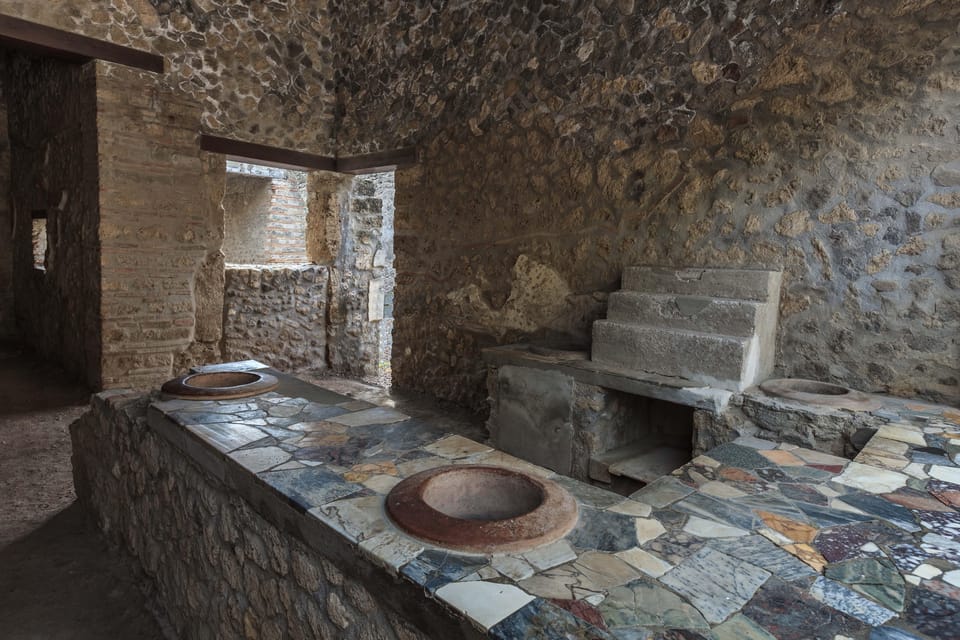
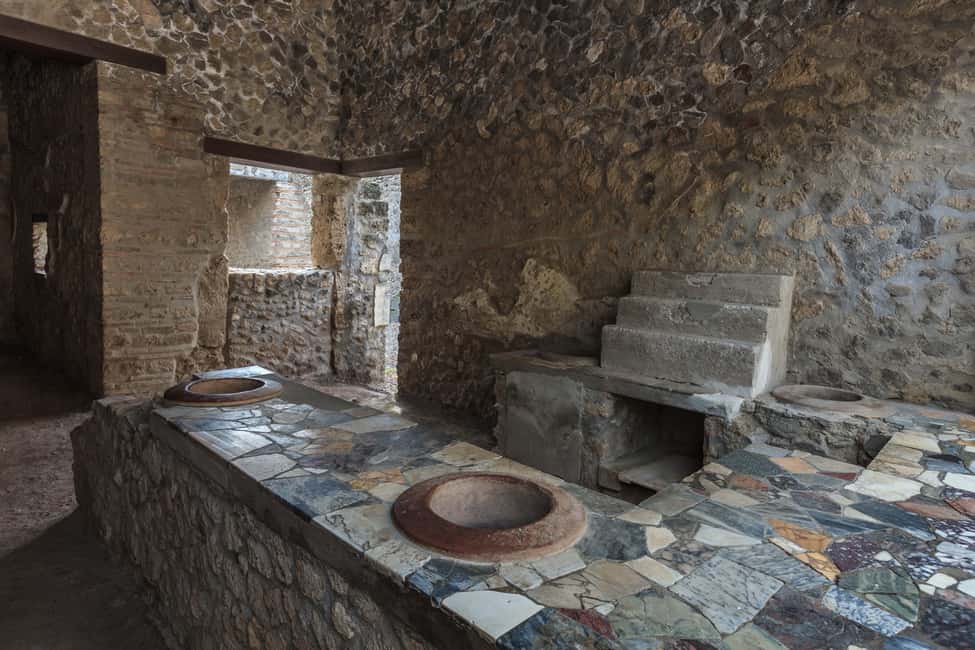
This is where the city gets wonderfully practical. Pompeii included shops and thermopolis—think counter-style quick food and drink—so you’re not only walking through residences and grand buildings.
When you reach these areas, look for the small-scale design. The idea is to imagine a line of customers, the rhythm of commerce, and the fact that people were living in these exact spots right up to the eruption.
Quick payoff
Even if you only spend a few minutes here, it can reframe your whole walk: Pompeii becomes less like “ruins” and more like a place with habits and routines.
Theaters and brothels: the public and the hidden
Pompeii included entertainment and also adult spaces, including theaters and brothels. Seeing them in the same ruins city helps you understand the range of Roman life—public spectacles on one side, private commerce and behavior on another.
With an audio guide, you can avoid the common problem of standing in front of a building and thinking, I know what it is, but not why it mattered. Use the narration to connect the setting to daily function.
The casts of the victims: where the visit turns heavy
The casts of victims are often the emotional center of a Pompeii visit. The experience can be intense because it turns a disaster into specific people and specific moments.
Plan this into your route early enough that you can give it attention. Don’t treat it like a quick photo stop. If you’re traveling with kids, this is where you’ll need to decide what level of detail works for your group.
The Roman amphitheater: one of the best preserved stops
This package includes a visit to one of the best preserved Roman amphitheaters. Amphitheaters are great because they translate architecture into experience: you can picture the crowd, the sight lines, and the rhythm of events.
Even if you’re not a theater buff, the amphitheater tends to land well because it’s visually clear. You’re looking at structure designed for viewing and sound, and Pompeii lets you see it in a way that feels remarkably intact.
How much is $77 really buying you?
At $77 per person for about 5 hours, you’re paying for three main things:
- Skip-the-line entry, which saves time at a site known for queues
- Roundtrip transport from Naples, which is hard to match without coordination
- An audio guide in multiple languages, so you can understand what you’re seeing without hiring a human guide
What you’re not paying for is a live guide. That can lower the cost and increase independence, but it also means you rely on audio and the map to connect the dots. If you love walking, this can feel like freedom. If you prefer Q&A and a human pace, you may feel under-supported.
The staff and small comforts that can make the day better
The organization quality stands out in feedback, including a friendly driver and extra gestures like coffee. Those details aren’t part of the “headline” itinerary, but they matter when you’re doing a day trip where timing and energy matter.
The driver’s music selection also adds personality to the ride. That kind of atmosphere doesn’t change Pompeii—but it can change how relaxed you feel before you step into the ruins.
Who this Pompeii tour suits best
This is a strong match if you:
- want fast entry and don’t want to spend your day stuck in lines
- like exploring at your own pace with audio guidance
- prefer a structured “highlights” format instead of an all-day marathon
- are comfortable with basic navigation using a map while walking
It may feel less ideal if you:
- want a live guide to answer questions or tailor the visit
- struggle with multi-tasking between audio and reading a map
- need step-free access (mobility impairments are noted as a mismatch)
Should you book this skip-the-line Pompeii from Naples?
I’d book it if your top goal is a smooth, efficient Pompeii day with skip-the-line access and built-in audio that keeps you moving. With Pompeii’s sheer size and the heavy annual visitor volume, saving time at entry is real value.
Hold off or consider an alternative if you’re the type who gets frustrated by self-guided navigation. Pompeii rewards curiosity, but it also demands your attention. If you can manage audio well—ideally with clear listening—and you’re okay with walking a lot, this is a practical way to see the city’s most important features in one trip.
FAQ
What’s the duration of the Pompeii tour?
The total duration is listed as 5 hours.
Does this include skip-the-line access?
Yes. The ticket package includes skip the ticket line for Pompeii Ruins.
What’s included with the ticket?
You get an entrance ticket for Pompeii Ruins, an audio guide, and roundtrip transfer from Naples by bus.
Is a live guide included?
No. A guide is not included.
What languages are available for the audio guide?
The audio guide is listed in English, French, German, Italian, Portuguese, Russian, and Spanish.
Where is the meeting point in Naples?
The meeting point is near Via Galileo Ferraris n. 40, Naples, with provided coordinates 40.8505189N, 14.2747942E.
What’s the bus logo?
The bus is listed with the logo Around Vesuvio.
What should I bring?
Wear comfortable shoes and comfortable clothes. Bring a passport or ID card (a copy is accepted).
Are there restrictions on luggage?
Yes. Oversize luggage and large bags are not allowed.
Is the tour suitable for mobility impairments?
No. It is not suitable for people with mobility impairments.