REVIEW · POMPEII
Pompeii 2h Small-Group Tour with Expert Archaeologist
Book on Viator →Operated by Mondo Guide Srl · Bookable on Viator
Pompeii in just two hours. This small-group route gives you a guided hit of the city’s top sights, so you can see more than you’d pick on your own when time is tight. Two things I really liked: you get admission tickets included along the way, and the pacing is built for a real visit, not a sprint.
You also get a tour that works for real mixed groups, including families. Guides are often praised for engaging storytelling and keeping people moving at a manageable pace, even when the heat hits. That matters a lot in Pompeii, where walking between points can feel endless without someone steering you through it.
One possible drawback to weigh: because it’s a guided group experience with a set route, you may not get the deeper, archaeology-first explanations you’d want. I’d also keep an eye on how the guide handles kids and headsets, since there are occasional reports about the tone of the tour or audio being harder to hear.
In This Review
- Key points worth knowing before you go
- A 2-Hour Pompeii Walk That Helps You Beat the Time Crunch
- Price and Value: What $32.67 Really Buys You
- Where to Meet (and How to Arrive Without Stress)
- Stop 1: Pompeii Archaeological Park and Frescoes in the Right Order
- Stop 2: Odeon and Teatro Piccolo for a Quick Look at Ancient Performance
- Stop 3: Teatro Grande, Pompeii’s Major Theater
- Stop 4: House of Menander for Architecture and Decoration at Human Scale
- Stop 5: Stabian Baths (Terme Stabiane), the City’s Old Thermal Complex
- Stop 6: Lupanar, Pompeii’s Famous Brothel (Know What You’re Signing Up For)
- Stop 7: Via dell’Abbondanza for the Main Through-Route Feel
- Stop 8: House of the Faun, Pompeii’s Big Private Residence
- Stop 9: Forum de Pompeya and the Basilica for Civic Life
- The Real Secret Sauce: Guide Styles and How They Affect Your Tour
- Pompeii Comfort Tips for Heat and Weather That Won’t Wait
- Who Should Book This 2-Hour Small-Group Tour?
- Should You Book It? My Honest Take
- FAQ
- How long is the Pompeii tour?
- Is the tour in English?
- Are Pompeii admission tickets included?
- What group size should I expect?
- Is there a fitness requirement?
- Where does the tour start and end?
Key points worth knowing before you go
- Two hours with timed stops keeps Pompeii from taking over your whole day
- Entrance tickets are included for the park and key stops on the route
- Family-friendly approach is built into the pacing and group flow
- Popular theaters, baths, and villas mean you’ll see variety, not just one theme
- Guide quality really matters, and you can often feel the difference immediately
- Heat and crowds are real, so shaded pauses and crowd-smart routing are a big plus
A 2-Hour Pompeii Walk That Helps You Beat the Time Crunch
Pompeii is huge. This tour tackles that problem by focusing on major clusters of sights so you can build a mental map fast, then roam more easily afterward. The tour runs about 2 hours, and it’s designed for moderate physical fitness, so you should expect walking on uneven ancient surfaces.
Group size is capped at 30, which helps keep things from feeling chaotic. There’s also a minimum of 6 people, so if the group doesn’t meet that threshold you may be offered a different date or a full refund. I like that safety net when you’re planning a tight itinerary.
You can also read our reviews of more tours and experiences in Pompeii
Price and Value: What $32.67 Really Buys You
The price is $32.67 per person, and Pompeii entry is included on the route. That is a big part of the value here, because tickets and timed access can add up when you’re also trying to organize everything yourself. You’ll also use a mobile ticket, which usually makes arrival simpler.
There’s one extra twist that can make this tour especially good value: Pompeii’s entrance ticket is free on the first Sunday of each month, and admission is always free for visitors under 18 (with valid ID or passport). If you fall into either group, you might decide to do the guided tour mainly for the interpretation and crowd management, not the ticket cost.
One more cost-related note: some tours feel like you’re paying for someone to point and move. This one is sold as a guide-led experience with an archaeologist, and the best versions of it are about understanding what you’re seeing—not just where it is. That’s why guide choice and tour style matter.
Where to Meet (and How to Arrive Without Stress)
The meeting point is Ristorante Suisse, Piazza Esedra 10/13, 80045 Pompei NA, Italy. The tour ends back at the meeting location, which is convenient when you’re trying to line up the rest of your day.
It’s also described as being near public transportation, and one practical detail stands out from past experiences: the train station is within about a five-minute walk. That’s useful if you’re coming from Naples and want a calm buffer before the tour starts.
My advice: arrive early enough to handle sun, bathroom breaks, and the simple act of finding your group. Pompeii can heat up fast, and when you start already rushed, the whole experience feels harder.
Stop 1: Pompeii Archaeological Park and Frescoes in the Right Order
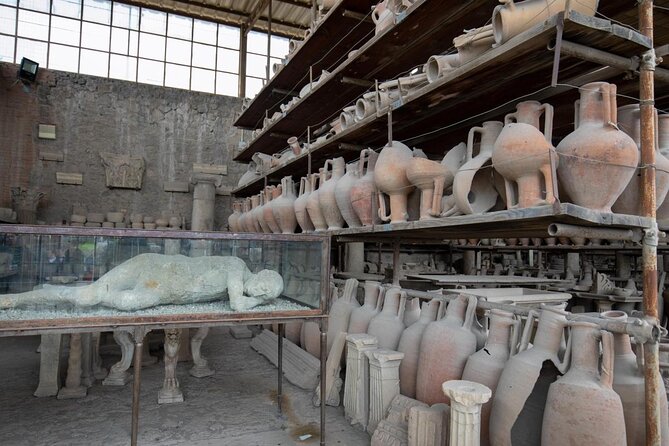
You start in the Archaeological Park of Pompeii, the core of the whole experience. The city was preserved after the eruption of Mount Vesuvius in 79 AD, and seeing it with a guide helps you read the ruins like a place rather than a pile of stones.
A key part of the stop is getting to the frescoes (and understanding what you’re looking at). Fresco walls can feel random if you don’t know the context, but with guidance you start noticing how art, daily life, and status show up in everyday spaces.
The time here is listed at about 10 minutes. That’s not long enough to make you an expert, but it is enough time to orient you and stop you from wandering to the wrong places first.
Stop 2: Odeon and Teatro Piccolo for a Quick Look at Ancient Performance
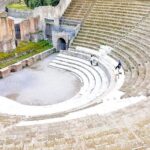
Next up is Odeon – Teatro Piccolo. Even in a short stop, this is a useful way to understand that Pompeii wasn’t only homes and shops—it also had social entertainment built into the city’s rhythm.
This stop is also around 10 minutes. You’re not trying to memorize the architecture; you’re getting the big-picture takeaway that entertainment and civic life were intertwined.
The advantage of hitting this early in the route is that it helps you connect later sights. Once you’ve seen the theaters, you understand the city layout a bit better when you move toward the more civic areas.


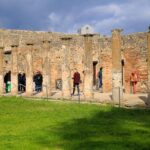
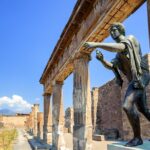

Stop 3: Teatro Grande, Pompeii’s Major Theater
The route then reaches Teatro Grande, described as the most important theater in Pompeii. This is where you start seeing how large-scale public space worked in a Roman city—how people gathered, how performances shaped social life, and how power showed up in architecture.
Time at this stop is listed at about 15 minutes. In a two-hour format, that’s a fair chunk for a big sight, and it gives you a chance to ask questions without your guide feeling rushed.
One practical reason a guided stop like this helps: theaters can be visually impressive, but they’re easy to misread. A good guide will help you interpret what the space was for and how it fit into everyday Pompeii.
Stop 4: House of Menander for Architecture and Decoration at Human Scale
At House of Menander, you’re in a wealthy private home known for architecture, decoration, and contents. This is one of the stops that brings the past down from “history class” to everyday details.
You get roughly 15 minutes here, which is a solid amount in a timed tour. The house format is also a great way to explain Roman life: spaces for receiving guests, showing status, and displaying taste.
The drawback, if you’re expecting a slow museum-style walkthrough, is that a two-hour tour can only scratch the surface. But it’s still a smart stop because it teaches you how to look—so even after the tour ends, you can interpret what you see.
Stop 5: Stabian Baths (Terme Stabiane), the City’s Old Thermal Complex
Next is the Stabian Baths (Terme Stabiane), noted as the oldest thermal complex in the city. Baths in Pompeii weren’t just about bathing; they were social, practical, and often part of a daily routine.
This stop takes about 15 minutes, and the bath complex is vast, so the guide’s job is to help you connect the layout instead of letting you get lost in it. If you’ve ever toured a large site and felt your brain bounce off the details, this is where a guide really helps.
Also, baths make a smart break in the route. They often give you a different type of space to look at, which helps keep attention from dropping mid-tour.
Stop 6: Lupanar, Pompeii’s Famous Brothel (Know What You’re Signing Up For)
The route includes the Lupanar, described as the most famous brothel in Pompeii. This is a sensitive topic, and it’s one you might want to think about based on your group.
Time here is around 10 minutes. In a short stop, the guide can give context without turning it into something sensational. Still, if you’re traveling with children, you’ll want to judge whether the tone and approach feel right for your family.
For adults, the value is that it shows Pompeii wasn’t filtered or sanitized for visitors. It was a real city with real trades and real systems.
Stop 7: Via dell’Abbondanza for the Main Through-Route Feel
Then you pass along Via dell’Abbondanza, the main street feeling of Pompeii’s grid. This is one of those “connective tissue” stops that makes the whole experience click, because the route between major sights matters.
Even without extra time details beyond the route mention, this kind of street segment helps you understand how people actually moved through the city. It also makes the forum and civic spaces later on feel more logical.
If you like to leave tours with a better sense of orientation, this is a helpful part of the plan.
Stop 8: House of the Faun, Pompeii’s Big Private Residence
The House of the Faun is highlighted as one of the largest and most impressive private residences in Pompeii. This stop is where you can see how much space status could require, and how big households were in a city that also had public spaces like theaters and bath complexes.
This is about 10 minutes. Again, it’s not enough to become a “house connoisseur,” but it is a good way to understand scale. A guide can point out what makes it stand out and how it differed from smaller homes you might notice later.
If you’re the type who likes to compare architecture and layout across sites, this is a good swing in the route.
Stop 9: Forum de Pompeya and the Basilica for Civic Life
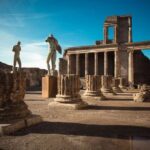
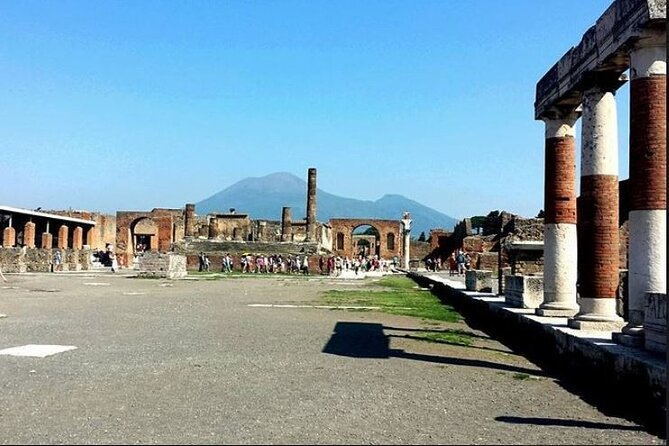
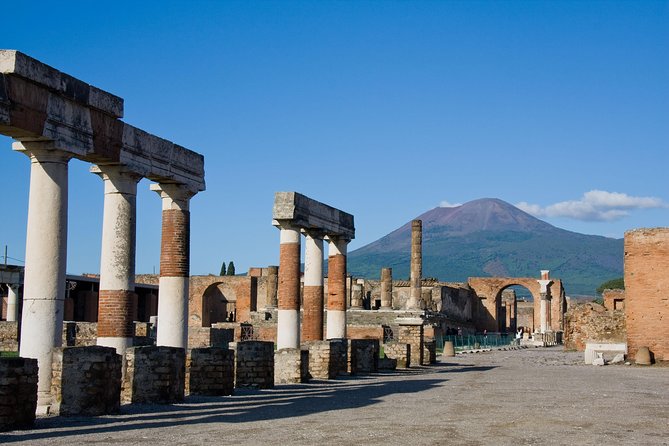
You end this highlight route at Foro de Pompeya (the ancient main square) and the Basilica, described as an open portico that sheltered merchants and other activities. These are the places where the city’s everyday business happened.
Time here is listed at about 15 minutes for each area in the itinerary structure, which is enough to get the point. The forum helps you understand Pompeii as a living city, not just a collection of rooms and ruins. The basilica adds the “how commerce worked” element.
This is also where your mental map gets clearer. After theaters, baths, and villas, the forum and basilica put it all back into the civic picture.
The Real Secret Sauce: Guide Styles and How They Affect Your Tour
The biggest difference between a good Pompeii experience and a frustrating one is the guide. When the tour hits well, it feels like someone is giving you a guided lens, not just facts.
In past experiences, guides like Luca, Gianluca, Manuela, Roberta, Roberta’s group leadership, Patrizia, Mafilda, Clare, and Enzo have been singled out for different strengths—storytelling, humor, pacing, and answering questions. Many guides are also praised for finding ways to keep you comfortable, like stopping in shade when the heat is intense.
You’ll also want to pay attention to pace. One guide is credited with a moderate walking pace that suited an older parent, and another handled two-hour timing well so families with kids stayed engaged. That’s not small stuff; Pompeii punishes slow thinking. If you keep stopping for the wrong spots, your time disappears fast.
Two caution flags from the feedback you should take seriously:
- If you’re bringing kids, confirm you’re choosing a tour approach that actively works for them. Some feedback includes a case where children were mocked on tour, which is not what you want in a family setting.
- If you’re relying on audio headsets, make sure you’ll be able to hear comfortably. There’s at least one report of headset hearing issues that affected the experience.
If you can, choose the guide you’re most comfortable with, and don’t be shy about asking how they handle families or questions.
Pompeii Comfort Tips for Heat and Weather That Won’t Wait
Pompeii can be brutally hot, and some tours have been described as adapting on the fly by speaking in shaded areas. That’s a good sign that your guide understands reality, not just a script.
Bring basic comfort items: water, sunscreen, and comfortable walking shoes. The stones are ancient and uneven, and even short stops add up quickly.
Weather can also turn fast. One experience described hail and sideways rain, and the guide still managed the tour by finding covered or sheltered spots for explanations. If your visit is during unstable weather, that flexibility is a big deal.
Who Should Book This 2-Hour Small-Group Tour?
Book this if you want a guided highlight route and you’re working with limited time. It’s a strong fit for families with kids around school age, because the structure and pacing are built to keep people interested for about two hours. It’s also a good option if you’re visiting with older relatives who need a moderate walking rhythm.
It’s less ideal if you’re the type who wants a slow, deep archaeological lecture. Even with a great guide, two hours will only cover the most famous stops, not the full complexity of the city.
There’s also an upgrade option for a private tour, which can help if you want more tailored explanations or better control of pace and questions.
Should You Book It? My Honest Take
I’d book this tour if your goal is to get your bearings fast and cover the major Pompeii landmarks without spending your day stuck deciding where to go. The mix of theaters, baths, wealthy homes, the forum, and basilica gives you a balanced picture of the city’s public and private life.
I would skip or at least reconsider if you’re expecting long-form archaeology training, or if you’re traveling with very young kids and want guaranteed kid-first engagement throughout. In those cases, a private option or a tour style that’s explicitly built for children can be a safer bet.
FAQ
How long is the Pompeii tour?
It runs for about 2 hours.
Is the tour in English?
Yes, the tour is offered in English.
Are Pompeii admission tickets included?
Yes. Admission tickets are included for the stops listed on the route.
What group size should I expect?
It’s a small-group tour with a minimum of 6 people and a maximum of 30 travelers.
Is there a fitness requirement?
The tour notes a moderate physical fitness level.
Where does the tour start and end?
It starts at Ristorante Suisse, Piazza Esedra 10/13, 80045 Pompei NA, Italy, and ends back at the meeting point.