REVIEW · POMPEII
Pompeii Skip-the-Line Entry Small Group Guided Tour
Book on Viator →Operated by Enjoy Pompeii · Bookable on Viator
Pompeii feels personal with a small group guide. You walk into a UNESCO World Heritage Site with skip-the-line entry and a plan that focuses on what Romans did every day, right up to the Vesuvius eruption in 79 AD. I love how the guides like Frankie and Sasa don’t just point at ruins; they tell stories that help you picture real routines. I also love the small group size, which means your questions actually get answered, not waved away. The main drawback is practical: Pompeii’s walking can be tricky and crowd noise can make parts of the narration hard to catch.
Logistics are straightforward. You meet at Ristorante Bar Sgambati on Via Villa dei Misteri 1 and you finish near the Forum on Via Villa dei Misteri 2, with about 2 hours and 15 minutes on-site. You get a mobile ticket, and the tour caps at a maximum of 20 people, which helps keep things moving at a human pace.
In This Review
- Key Highlights at a Glance
- Skip-the-Line Pompeii: What You Gain in 2 Hours
- Meeting at Ristorante Bar Sgambati and Ending at the Forum
- Western Pompeii Highlights: Forum, Basilica, and the Big Picture
- What to look for while you’re walking
- Thermal Baths, Bakery, and Homes: Daily Roman Life Comes Through
- A reality check: the ground can be rough
- Why the Guide Matters: Frankie, Sasa, Angelo, and More
- Comfort and Practical Tips for Uneven Stones and Crowd Noise
- A simple packing checklist
- Price and Value at $59.28: When It Feels Worth It
- Who This Pompeii Tour Fits Best (and Who Might Want to Skip)
- Should You Book This Pompeii Skip-the-Line Tour?
- FAQ
- How long is the Pompeii skip-the-line small group tour?
- What language is the tour offered in?
- How many people are in the group?
- Where do I meet the guide?
- Where does the tour end?
- Is a mobile ticket provided?
- Is skip-the-line entry included?
- Is Pompeii admission included in the price?
- What is the cancellation policy?
- What happens if weather is poor?
Key Highlights at a Glance
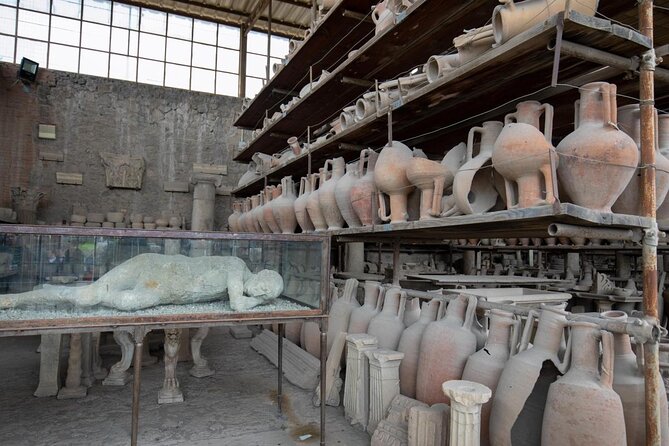
- Quick entry that beats long lines so you spend more time inside the site
- A focused western-side route that hits the Forum, Basilica, baths, bakery, and homes
- Story-first guiding with strong personalities like Frankie, Sasa, Angelo, and others
- Small group access to questions so you can get clarity on what you’re seeing
- A time-boxed tour that’s efficient, but you’ll still do real walking
Skip-the-Line Pompeii: What You Gain in 2 Hours
Pompeii is enormous. Even if you have a map and good shoes, you’ll still wander, double back, and miss the “why” behind the sights. This tour’s value is that you go in with a plan and a guide who knows how to connect buildings to daily life, not just name them.
The best part of skip-the-line is psychological. Long queues can drain your energy before you even start exploring. With this setup, you’re more likely to arrive with your attention intact and your expectations set: you’re here for context, not a stamp-collecting route.
The tour runs about 2 hours and 15 minutes, which is a sweet spot for first-timers. You get enough time to cover several major areas without feeling like you’re trapped on a marathon walk.
You can also read our reviews of more guided tours in Pompeii

Meeting at Ristorante Bar Sgambati and Ending at the Forum
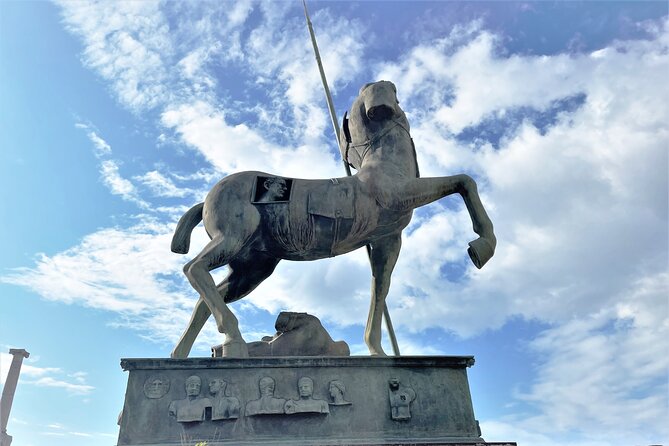
Finding the group is usually easier than it sounds, because the start point is a specific restaurant address: Ristorante Bar Sgambati, Via Villa dei Misteri, 1, 80045 Pompei NA. You also end right near the Forum of Pompeii at Via Villa dei Misteri, 2. That matters because Pompeii is easiest to enjoy when you’re not zig-zagging through the site to reach the next “must-see.”
This is also a good kind of ending if you want to keep exploring after the guided portion. The Forum area is naturally central, so you’ll likely be closer to other parts of the park than if your tour ended far away.
You’ll use a mobile ticket, and the timing is tight. The site is busy, and the tour is designed to move as a group, so being prompt at the meeting point will keep your experience smooth.
Western Pompeii Highlights: Forum, Basilica, and the Big Picture
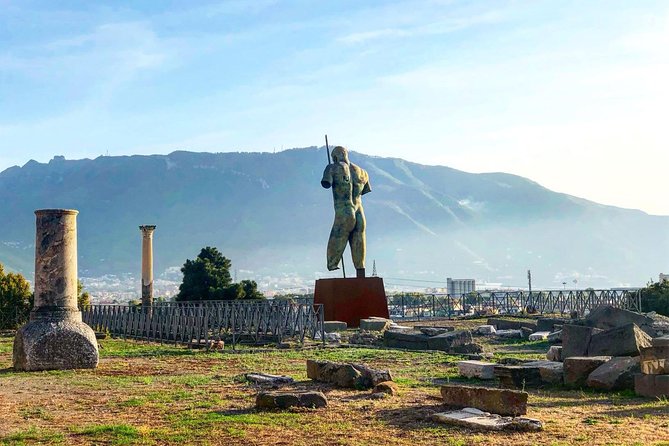
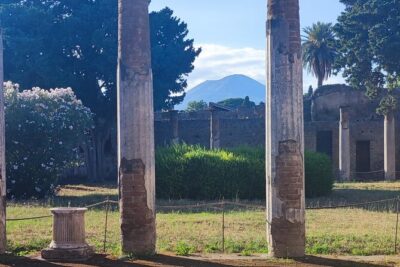
Your main walk focuses on the western part of Pompeii. That’s smart for most people. It’s where you can quickly build the “shape” of the city: public life first, then daily life around it.
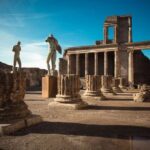
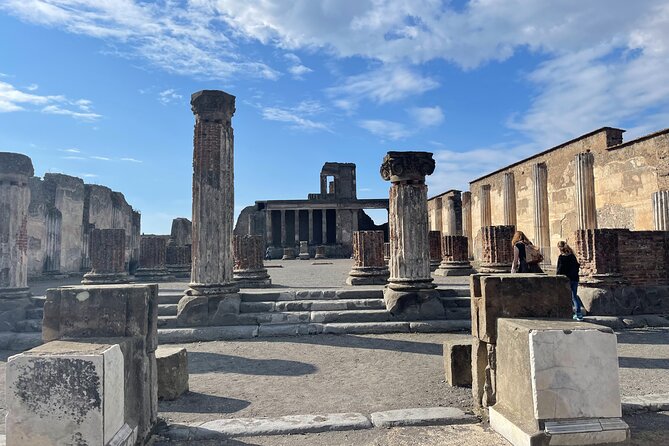
The Forum is usually the anchor. It’s the civic and commercial center, so when your guide explains what happened there, the ruins stop looking like random stones. You start to understand how Romans gathered, traded, and argued, and why this area mattered before everything froze in time.
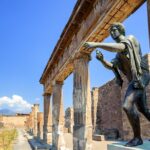
From there, you’ll see the Basilica, a large public building that helped organize public life. Even if the structure is partially standing only in fragments, the guide’s narration helps you visualize how it functioned. This is one of those places where a human storyteller beats a self-guided reading session every time.
A good Pompeii guide also frames the eruption in plain terms—what changed, why it was catastrophic, and how that sudden event preserved a snapshot of daily life. You may hear details that remind you Pompeii isn’t only “ancient drama,” but also a place with routines, work, meals, and household solutions.
What to look for while you’re walking
Try to keep an eye out for patterns your guide points out: where people would gather, where business happened, and how buildings relate to each other. When your brain gets those connections, Pompeii becomes easier to navigate even after the tour ends.
Thermal Baths, Bakery, and Homes: Daily Roman Life Comes Through
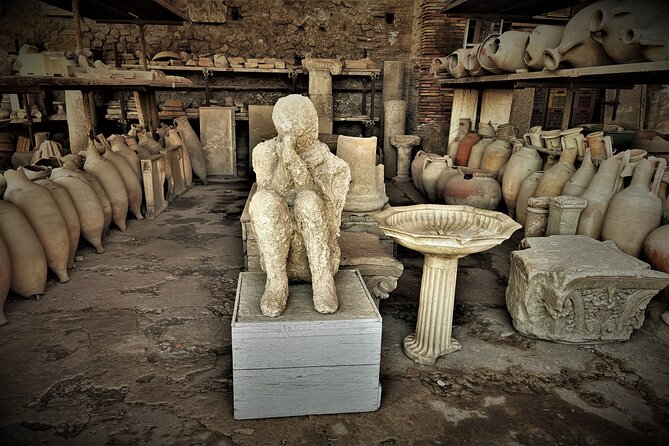
Pompeii stands out because it shows ordinary life so clearly. The walking route includes stops that point you to that idea: thermal baths, a bakery, and residential houses.
The thermal baths are a big one for understanding Roman comfort. Even ruins can show how people organized space for washing, socializing, and relaxing. When your guide connects the baths to culture—who went, how the spaces worked—you’ll start seeing the city as a functioning home, not a museum warehouse.
The bakery stop tends to land well because food is personal. When you hear how bread and grain processing worked, the city feels practical and real. It’s also a nice break from just looking at monumental stonework. It answers the question, What did people do here before the disaster?
Residential houses add another layer. Seeing housing ruins is powerful because it forces you to think beyond public buildings. Your guide can help you connect what you see to Roman conveniences, including things like household heating systems and water management. Reviews highlight that this kind of detail helps you imagine daily routines—where water came from, how rooms might have been used, and how people coped with the realities of living in a city.
You can also read our reviews of more tours and experiences in Pompeii



A reality check: the ground can be rough
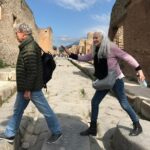
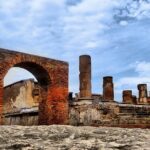
You’ll be on uneven stone and uneven steps. That’s not a scare tactic; it’s just the way Pompeii is. Wear shoes with grip and keep your eyes slightly down when you’re moving between stops. If you don’t, you’ll spend more time balancing than absorbing the story.
Why the Guide Matters: Frankie, Sasa, Angelo, and More
This tour lives or dies by the guide. The strongest praise in the feedback is consistent: guides like Frankie, Sasa, Angelo, Salvatore, Francesca, and Antonio are praised for making Pompeii readable and fun without turning it into comedy night.
Here’s what you should expect when a guide is truly good:
- They explain what you’re seeing in a way that sticks after you leave.
- They keep a steady tempo so you don’t feel dragged or stuck.
- They add details that make modern life feel connected to ancient life.
Frankie, in particular, comes up repeatedly for being entertaining and fast-moving without seeming rushed. Sasa is also praised for passion and clarity. Angelo is praised for engagement, including with younger visitors, and for being personable while still delivering strong information.
Some tours can feel like a lecturer facing a crowd. This one works better when the guide stays oriented to the group and keeps the narration flowing. Still, audio can be a factor in crowded ruins—one set of feedback noted it was hard to hear because of noise and the way the guide was positioned. If clear audio is a deal-breaker for you, I’d plan to ask questions early and keep a close eye on the guide’s body language.
Comfort and Practical Tips for Uneven Stones and Crowd Noise
Two things can shape your experience more than you’d expect: weather and pacing.
Pompeii is outside, and the experience requires good weather. If weather turns, the tour may be canceled and you’ll be offered another date or a full refund. That’s a useful policy because walking in rain can make the ground slick and reduce visibility.
Rain can also change the mood in a way that feels almost cinematic. One traveler described seeing Pompeii in pouring rain and still feeling like it added to the experience. Just know that rain makes everything harder: footsteps, photos, and hearing.
Heat is the other factor. A few reviews mention shade when possible and appreciate that guides looked out for comfort in hot weather. That’s not just nice; it can keep your energy up so you can actually listen instead of focusing on sweat and thirst.
A simple packing checklist
Bring water, wear grippy shoes, and plan for sun if you’re going in summer. If you’re the kind of person who likes photos, remember this is a timed tour, so you’ll likely move on to the next stop before you’ve finished your camera burst.
Price and Value at $59.28: When It Feels Worth It
At $59.28 per person, this tour isn’t about buying “the privilege of walking.” It’s about buying time, structure, and interpretation. Pompeii is the kind of place where a guide can save you from spending half your day figuring out where to go and what you’re actually looking at.
You’re getting:
- A guided walk for about 2 hours (with the overall tour time around 2 hours and 15 minutes)
- A small group setting (maximum 20)
- Skip-the-line ticket support
- An expert guide
- English language
One caution on value: the details provided note that the admission ticket may not be included, even though a skip-the-line ticket is part of the offering. Before you go, double-check exactly what you’re paying for so you don’t get surprised at the park entrance.
When it’s most worth it is when you care about context. If you’re okay with a quick look and you don’t mind reading basic signs, self-exploring can work. But if you want Pompeii to feel like real life—public spaces, meals, baths, homes—this guided format is usually the better deal.
Who This Pompeii Tour Fits Best (and Who Might Want to Skip)
This tour is ideal if:
- You’re visiting Pompeii for the first time and want the highlights without getting lost.
- You like storytelling that connects ruins to everyday behavior.
- You value small group dynamics and the ability to ask questions.
- You want a structured walk that lasts a couple of hours instead of an all-day plan.
It may be less ideal if:
- You’re very sensitive to noise and struggle to hear in crowded outdoor spaces.
- You prefer slow wandering and long photo pauses between stops.
- You want a tour that moves at a pace tailored to individual interests rather than a set route.
Also, think about your comfort with uneven walking. Even strong walkers will feel it here, and this route includes steps and tricky stone surfaces.
Should You Book This Pompeii Skip-the-Line Tour?
If you want Pompeii to make sense fast, I’d book it. The combination of skip-the-line entry, a small group cap, and a guide who can explain day-to-day Roman life is exactly how you get the most from limited time. Guides like Frankie and Sasa are frequently praised for being engaging and energetic, and that matters in a place this big.
I’d make your decision with one check in mind: confirm what’s included for entry/admission so you know your true total cost. If you’re good with a timed, guided walk that still includes real walking on uneven ground, this is a strong choice.
FAQ
How long is the Pompeii skip-the-line small group tour?
It runs about 2 hours 15 minutes (approximately).
What language is the tour offered in?
The tour is offered in English.
How many people are in the group?
The maximum group size is 20 travelers.
Where do I meet the guide?
You meet at Ristorante Bar Sgambati, Via Villa dei Misteri, 1, 80045 Pompei NA, Italy.
Where does the tour end?
The tour ends at the Forum of Pompeii, Via Villa dei Misteri, 2, 80045 Pompei NA, Italy.
Is a mobile ticket provided?
Yes, you’ll have a mobile ticket.
Is skip-the-line entry included?
The tour includes a skip-the-line ticket.
Is Pompeii admission included in the price?
Admission is listed as not included, so you should check whether official park entry is bundled or requires an additional payment.
What is the cancellation policy?
You can cancel for free up to 24 hours in advance for a full refund.
What happens if weather is poor?
If the experience is canceled due to poor weather, you’ll be offered a different date or a full refund.